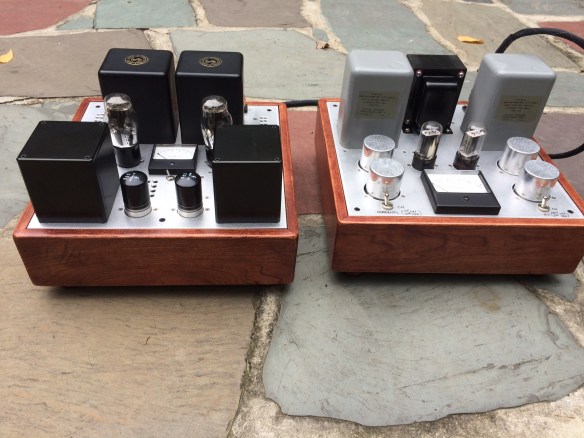
Shiny Eyes Mini SE 4P1L amplifier

miniSE4p1l closeup

A while ago I bought a pair of new Tango M705 and wanted to find a good use for it. I also had a small wood case made of oak and accent stained with chestnut. This was the beginning…

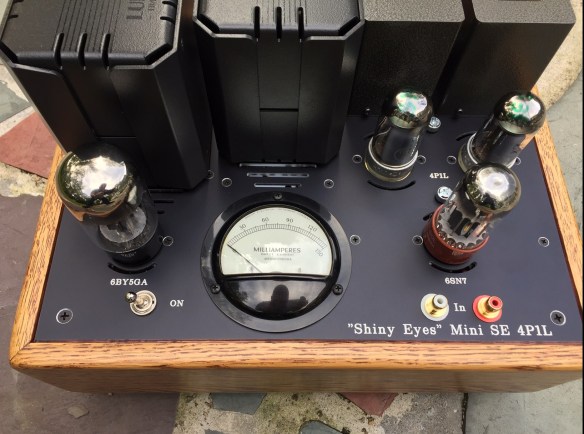
I always wanted to build a compact 4P1L amp and here it is my new “Shiny Eyes” Mini SE 4P1L amplifier.

This is a very nice sounding  1.7W amplifier that sounds way bigger that one might think. The secret is to match it with high sensitivity and easy to drive full range drivers., use it in small rooms or be fine with lower sound levels. It can also be used in multi system speakers when driving upper mids or highs when the level of power is sufficient when using high sensitivity drivers.

The amp is using top components and iron. The output transformers  are Tango M705 and the power transformer and choke are Lundahl. The amplifier has only two stages which is my most preferred setup.

The power tube is the 4P1L in triode mode and the driver/gain stage is the 6SN7 loaded on a mosfet CCS ( cascode DN2540). Both stages are worry free, self biased. The overall gain allowed a very small GNFB of -3dB that improved the THD and the bass frequency response. The 4P1L filaments are powered by voltage regulators, a solution required by the compact size.

The B+ power supply is full wave tube rectified and using a 6BY5GA rectifier and a CLC filter: 50uF PP, LL1673/20H common mode and 220uF Mlytic Mundorf. A really nice 150mA sealed Marion meter is showing the total current. This meter will show about 85mA. The frequency response is 30-40kHz at -0.5dB and THD of 0.7% at 1W with 2nd harmonic dominant.

The amp sounding very detailed, transparent and quite dynamic for its small size. I am very pleased with the sound of a small power compact amp. The amp weights 22 lbs and the size is  13x11x10″.


A Valve Phono-stage Cube


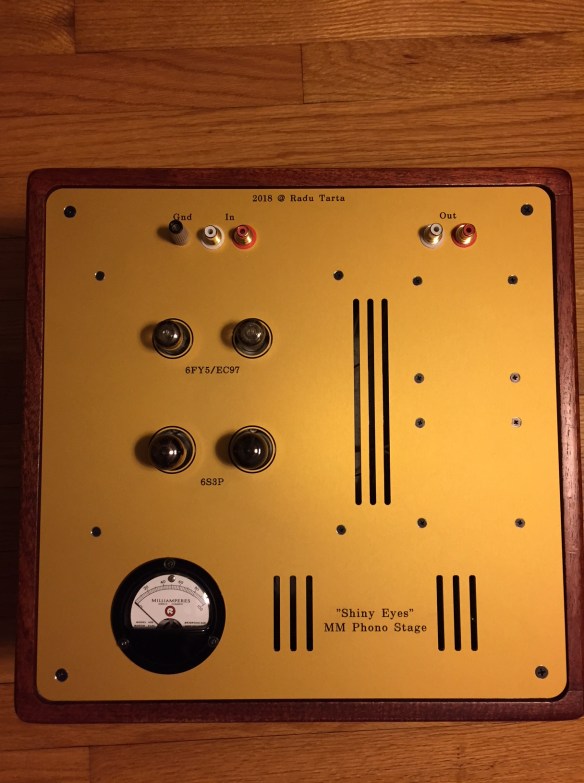
Radu RIAA top

How I’ve got to build this phono stage? My first phono stage build was Kevin’s “The Muscovite” using a nice sounding HF triode 6S3P. I was delighted with the sound of it, but never got beyond breadboard stage. The second build was Salas’s “Valve Itch” phono stage. I had a pleasant sound and dead quiet.

Few years later, I pushed myself to build a good phono stage for my Dual turntable and few records that I own. I had few items that determined the final shape of the preamp: many 6S3Ps bought when trying the Muscovite, a complete RIAA filter components, a readymade cherry box from a different project, and not only. I almost could say that I used most of the components from other projects leftovers.

The design is mostly influenced by Merlin Blencowe. I used the 6FY5/EC97 for the first stage and 6S3P for the second stage. The output is low impedance due to a Mosfet source follower DC coupled to the second stage.

Having a single tall box, imposed to a toroidal mains transformer and SiC rectifiers followed by a CLC filter. To ensure a very low ripple and low output impedance of the power supply, I’ve used an shunt regulator SSHV1.  As a must, I’ve used a regulated supply for the 6.3V filaments.

I’ve also built a Lipshitz-Jung precision Inverse RIAA to test the phono stage. It showed a perfect flat frequency response and a 41-42dB total gain. The THD measured 0.04% at 1Vrms output.

Despite the simplicity of the circuit I’m very pleased with the sound result.


Shiny Eyes EML300B – C3g single ended amplifier

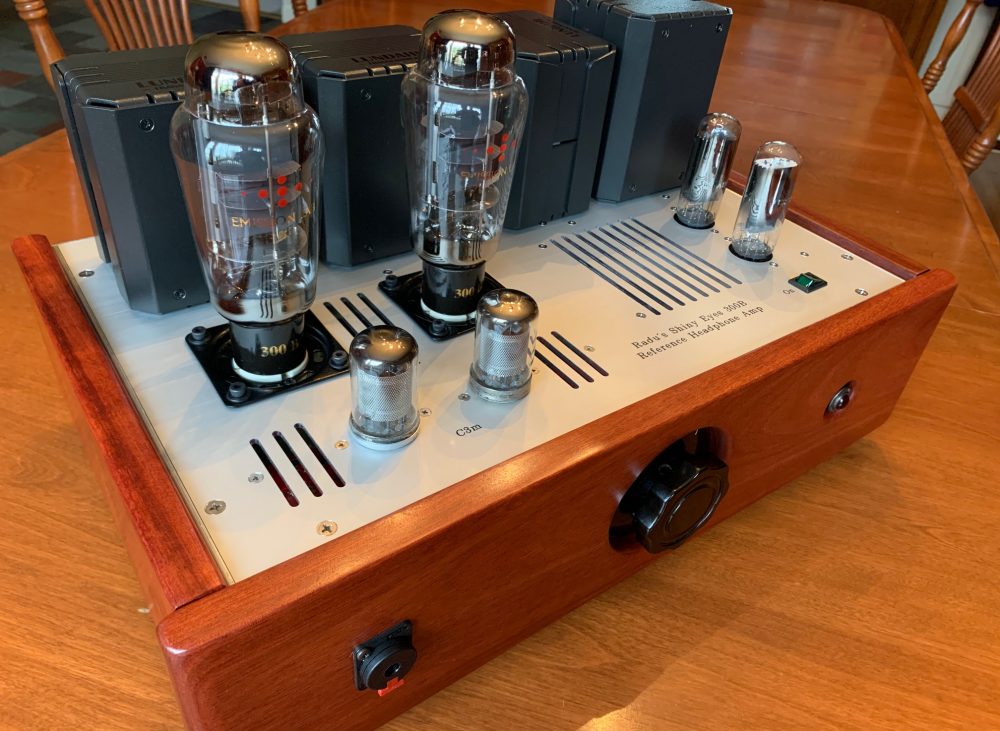
Here is my latest creation inspired by the beauty of a pair of EML300B that was lying unused.

front L

As always, I try to create 2 stage SE amps for many reasons. Hard to do 2 stages with low gain power DHTs. One of the few tubes that have the advantage of high gain, great linearity and still a bit of headroom to be able to let the 300B signature be predominant. The 300B starts clipping at 8W or so and that corresponds to a 1.65Vrms input. The C3g starts clipping at 2.3Vrms input. This allows a headroom of 2.9dB which is not a lot, but still way better than no headroom and better than many designs out-there with drivers that will go into clipping before the 300B.

Anyway, the 300B will distort above 2% at 4.5W and in my opinion the listening levels for a 300B amp should be at 2-3W and that allows a 6-4.2 dB power headroom and therefore creates a more realistic 7.4 dB signal headroom for the C3g.

I was a bit reluctant to built it in one case, but many audiophile are looking for single enclosure amps as more convenient use of space. It ended up weighting more than 50lbs.

The big challenge, when building a tube rectified DHT amp in one enclosure, is to keep it quiet. This amp is dead quiet on my 96dB speakers and my 100dB headphones.

The power supply uses the LL1651 and two LL1673 10H chokes in common mode. The B+ is around 475V. This time I didn’t use the famous Coleman regulators because of lack of space. The 300B filaments and the C3g filaments are powered using LD1085V regulators.

The amplifier is transformer coupled using the LL2753 and the output transformers are Jack Elliano’s Electra-Print 3.5K to 8Ohms low IMD. The tubes are self-biased and decoupled with Elna Cerafine. All the resistors for biasing the 300B are Mills MRA-12. The 300B is biased at 380V/-80V/75mA and the C3g at 225V/-3.5V/17mA.

The amp has an input sensitivity of 1Vrms for 3W output. The frequency response is 20Hz to 25kHz at -0.8 dB and the damping factor of 2.3 which calls for easy to drive, full range drivers.

This amp sounds great on my TangBand and Mark Audio speakers. The bass is well defined and under control, the mids are superb and the high are clean and crisp.


Shiny Eyes SE UL EL34-6SL7 tube amplifier

Shiny Eyes SE UL EL34-6SL7 tube amplifier

front L

Despite the fact that my love stays with DHTs, I’ve designed and built this amp to fill a gap that I thought it was worth the effort: making an amp in one enclosure, small enough but able to put out more power than a 45 or a 4P1L could do. I’ve also wanted to compare the sound with the 300B amp  I was building at the same time.

It all started while I was trying to figure out what amp to build with my last pair of James6123HS. I breadboard the EL34 and tried many drivers and configurations. I’ve ended up liking  the 6SL7 paralleled and using a small amount of global NFB, just enough to bring the distortions down, while widening the frequency response and increasing the damping factor.

This amp measure good as well as sounds very nice. It gives a max 8W at 1.7% ( 0.58% at 1W, 1% at 3W and 1.25% at 5W). The input sensitivity is 1Vrms for 5W output. The frequency response is 10Hz-40kHz @ +0.25dB for 3W output. The damping factor is about 7.

As expected this amp has a predominant 2nd harmonic and the sound is very pleasant. Dear reader, please remember this is still a low power, single ended amp and  will do the right thing if it is used with the right type of speaker ( easy to drive, preferably full range) and music.

I am very pleased with the sound of this amp and considering the cost of tube replacement, I am kindly recommend it for ever is looking for a decent cost SE tube amp that will sound as close to a DHT as possible.

I’ve used all good quality, audio grade components: James 6123HS output transformers, TungSol tubes, Heyboer custom order main transformer and choke, quality Made in Japan sockets, Cardas binding posts, Kimber RCAs, Obbligato Premium Gold coupling caps, Vishay and Takman resistors, Elna Cerafine decoupling caps. The power supply is using CREE Schottky diodes, CDE lytics  and DC regulated filament supply for the 6SL7.

This is a well build amp that will last for a long time and give a rewarding sound. It is self-biased so there is no need for any adjustments throughout the life time of the tubes.

All the equipment is attached to the 1/8″ top aluminum plate that sits on a hardwood wooden case made with the outstanding Brazilian cherry, light oil and urethane coated ( 4 coats).

The amp weights 37 lbs and measures 13x13x9″.

Another 45 amp with C3g driver

Here is another 45 amp. It seems like I like the sound of the 45 very much indeed.

This is the “Shiny Eyes” 45-C3g DHT amplifier, built with care and to provide a rewarding sound. This is an audiophile amplifier and it is not for everyone. It delivers up to 2W output. These 2W sound bigger than it shows. It is indeed a 2,000,000 microWatts. It is meant to be used with high sensitivity speakers. I listened to its sound using recently built TangBand 1772-W8 full range driver speakers. These are 96 dB sensitivity and fills the 300sqft room. For concert levels,a 100dB+ speakers are required.

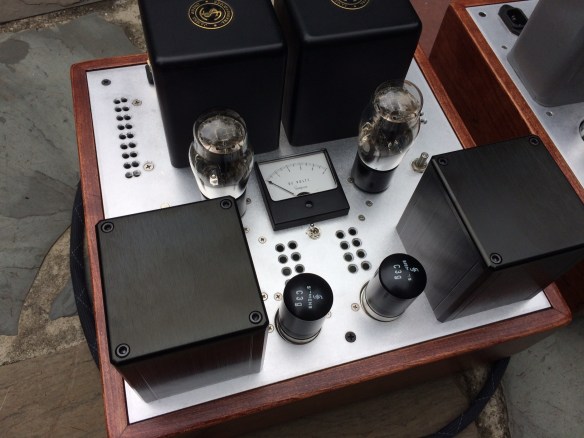
The amplifier has 4 and 8 ohms outputs  through a switch and Cardas binding posts.  The output transformer are James 6123HS and the interstage transformers  are  Lundahl LL2762. The 45 tubes filaments power is supplied through a Coleman regulator. Therefore, it is a need to adjust the filaments every time the tubes are  replaced. A 5V high quality Simpson meter is used for this purpose.

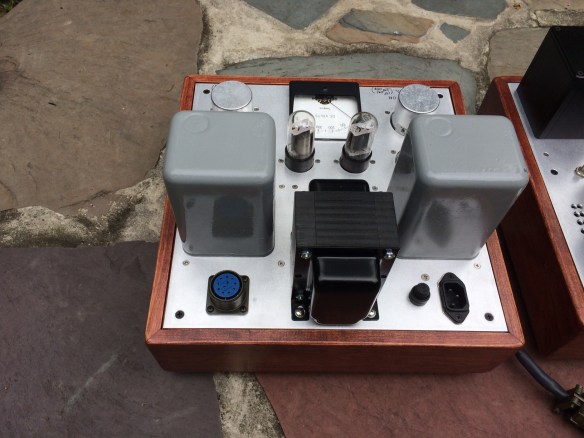
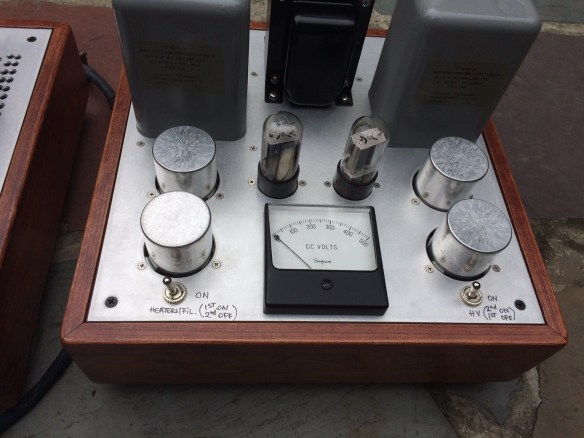
The power supply has a separate enclosure. The high voltage uses a Hammond 278X, high quality Chicago Standard Chokes 10H/180mA chokes and 6AX4 tube rectifiers. The setup is choke input for a better sounding amp. The high voltage delivered to the amp is measured and shown on a nice Simpson 500VDC panel meter. There are 3 raw, well filtered and regulated DC supplies : two for the 45 filaments and the third for the C3g filaments. The power is supplied to the main amp through an umbilical cord that carries only DC. The connector is Amphenol military grade. This way the AC is kept away from the main amp and the amplifier is dead quiet on my 96dB speakers.

All the components are high quality and audio grade where needed, such as Nichicon KG, Takman, Mills, Elna Cerafine, Clarity caps, ASC Oil caps, Mundorf Mlytics.

The amplifier shows a dominant 2nd Harmonic that confers the absolute astonishing sound of a well praised DHT. One of the picture shows the harmonics and THD and one can observe that the THD superimposes almost perfectly on the 2nd harmonic. The maximum THD is 3.8% at 2W ( naturally second harmonic), the frequency response is better than 20-20KHz +/-1dB, the input sensitivity is 0.8Vrms for 2W output, the input impedance is 51Kohms and the damping factor is 4 on 8 ohms.

The enclosures are hand made using American cheery nicely finish with 4 coats of Oil and Urethane, and sanded aluminum 1/8″ top plates.

This is a well built amp to last for a long time.( more of my work can be seen on simplepleasuretubeamps). I am very fond of the sound of the 45 tube and therefore I’ve built a few 45 amps and always pleased with the results.

main sidemain backpsu backpsufrontoverall-live


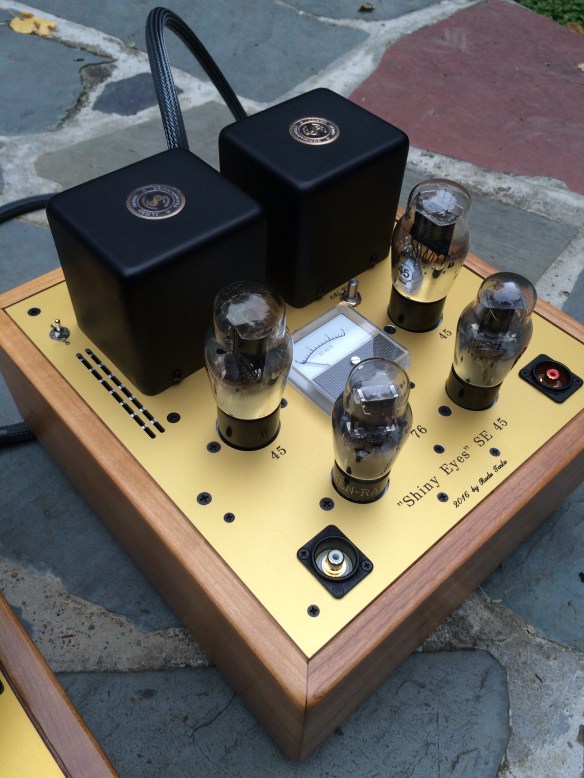
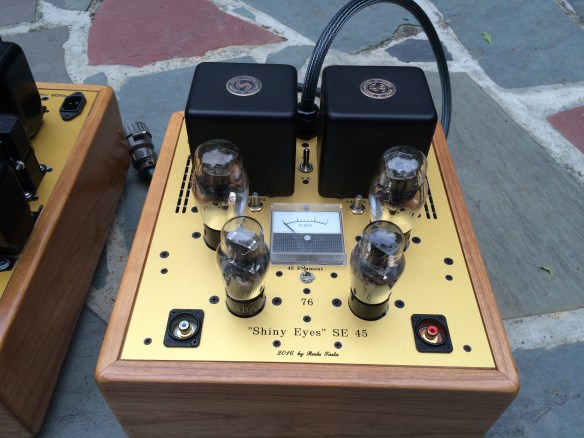
“Shiny Eyes” SE 45

This is a gem and I could confidently say: a reference amplifier. I’ve built it to compare with my PSE 4P1L and the results are amazing. If one has the appropriate speakers for SE tube amps and low power ( the 1st watt is all that matters), than this amp is a must to experience. I’ve spent many hours to experiment with different driver tubes. My goal was to make a 2 stage amplifier where the driver has minimum distortions with a dominant 2nd harmonic. This way the amplifier as a whole will get a predominant 2nd harmonic and will reveal the gorgeous sound of the 45. I also desired to make it less complex in comparison with my PSE 4P1L.

main-side-front

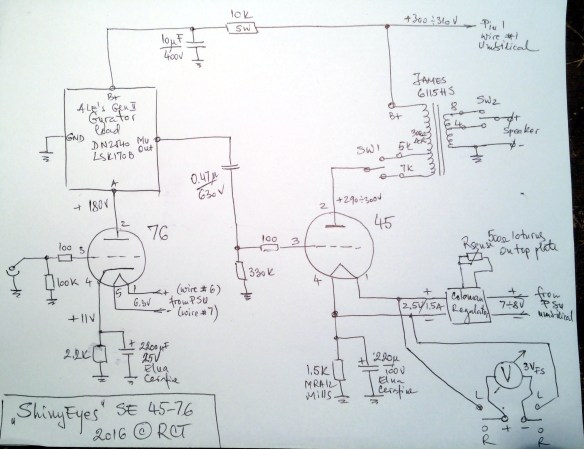
The result of this brainstorming was an amp with lower input sensitivity. I used type 76 triode to drive the 45. The 45 has a Miller capacitance of about 40 pF ( including some stray) and it is easy to drive in class A by using a low  current driver such as the 76 at 5 mA, without introducing slewing distortions.

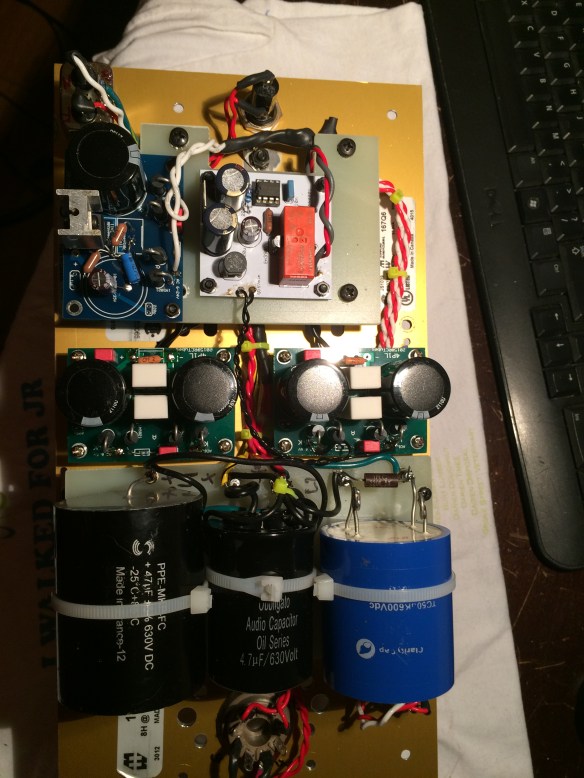
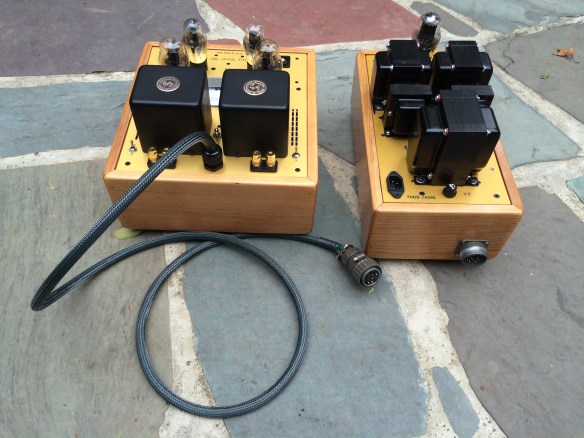
The power supply was built in a separate enclosure for a hum free DHT amp. It uses all Hammond transformers and chokes. Hammond 272Hx is used to provide the high voltage using a 5V4G rectifier and a CLCLC filter with 4.7uF-8H-47uF-8H(Hammond 193D)-47uf. The last capacitor is Clarity TC600, 4 pin Kelvin terminations for decoupling high frequency power supply noise from the signal path. A gorgeous Simpson 600V panel meter is showing the high voltage. The same transformer is used to provide 6.3DC to the 76 filaments, using a DC power supply based on LT1085 regulator. There are 2 Hammond  167Q6 used to provide raw DC supply to the Coleman filament regulators for the 45s. The high voltage comes delayed 25-30 seconds to allow the 45 filament to reach a quasi-steady state and extend their life. The delay timer is based on the 555 IC. The power supply has a 12 pin connector where the umbilical cord is plugged in. The umbilical cord is permanently attached to the main amp case and carries only DC. Here are some pictures of the power supply:

psu-inside


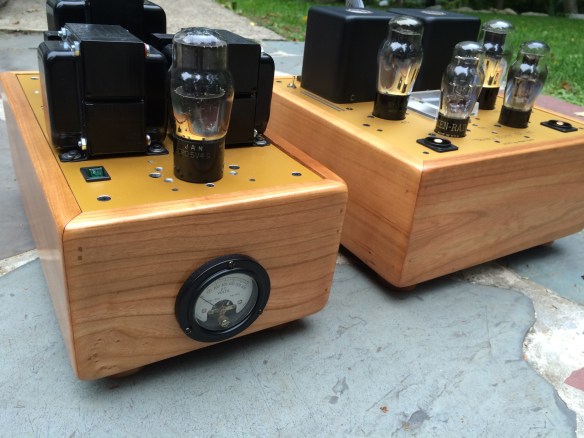
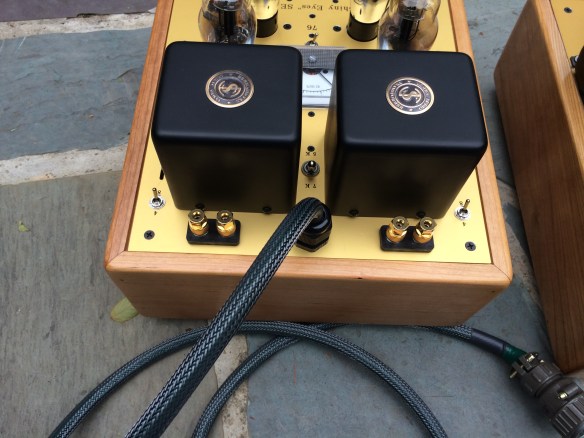
The main amplifier case is built out of American cherry solid hardwood stained with light oil urethane, 4 coats. The top plate is gold anodized aluminum made by Front Panel Express. The main amplifier is provided with Neutrik RCAs and Cardas binding posts. A nice Shurite 3V panel meter can be switched to measure each of the 45 filament and allow precise adjustment to 2.5V. There are separate 10 turns 2W pots top panel accessible for this adjustment. The output transformers are James 6115HS. I’ve provided a switch to choose between 5K and 7K load. On the 7K load the sound is more pleasant as the distortions are reduced. Here is the schematics and some pictures:

schematics-45-76-js6115hs

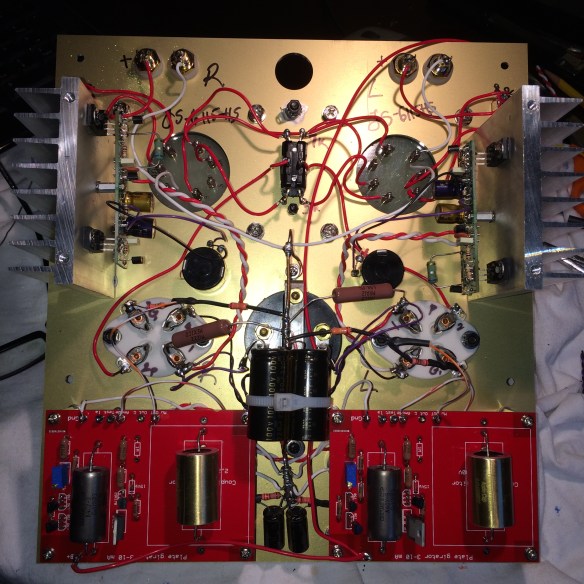
topmain-frontside-bothmain-backback-1fpe-topmain-inside


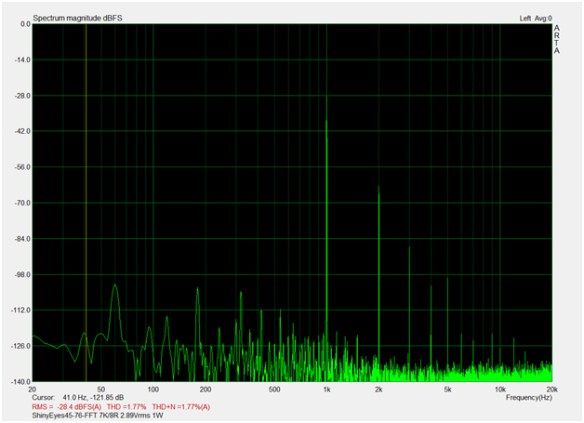
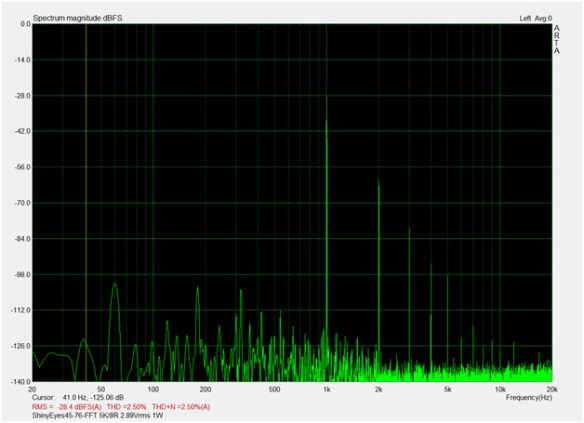
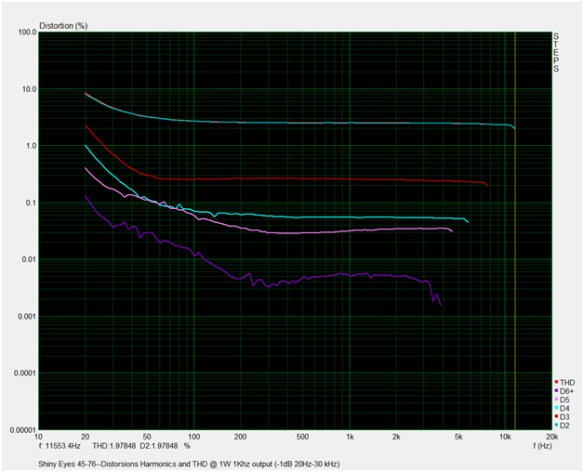
I’ve always measured my amps and in majority of cases the measurements tell the truth about the sound of the device. In this case, as you can see from the distribution of the harmonics, there is a 2nd harmonic dominant SE amp that sound better than it measures. ( as always with early DHTs ).

Input sensitivity:

1 Vrms for 0.25W output, 2.2 Vrms for 1W output,  3 Vrms for 1.75W output max

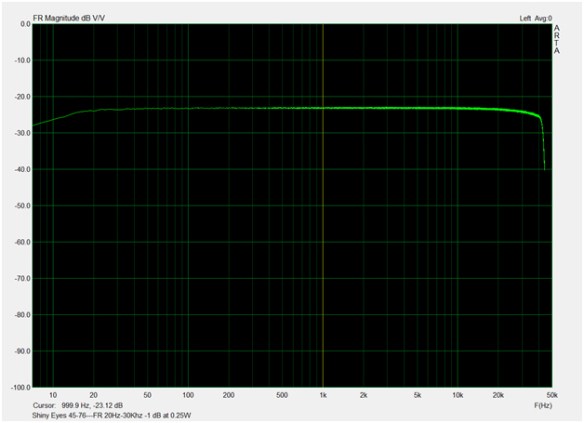
Frequency response: 20Hz-30kHz @ -1dB

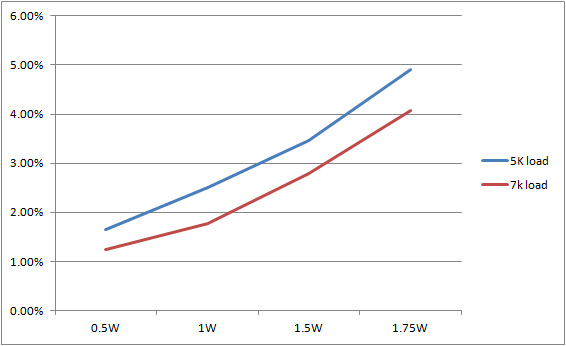
THD  5K load : 1.66% @ 0.5W, 2.5% @ 1W, 3.47% @ 1.5W and 4.9% @ 1.75W

THD  7K load: 1.24% @ 0.5W, 1.77% @ 1W, 2.8% @ 1.5W and 4.08% @ 1.75W

thd-5-and-7k-load-45-amp

fft-1w-7kfft-1w-5kthd-and-harmonics-45-ampfr-at-0-25w

I’ve needed a bit of gain to drive this amp to max power. I found that my 18dB 01A preamp is a great fit. I’ve also tried 26 pre and 10Y pre and they all sound excellent combined with this SE 45.

“Shiny Eyes” 01A DHT line stage

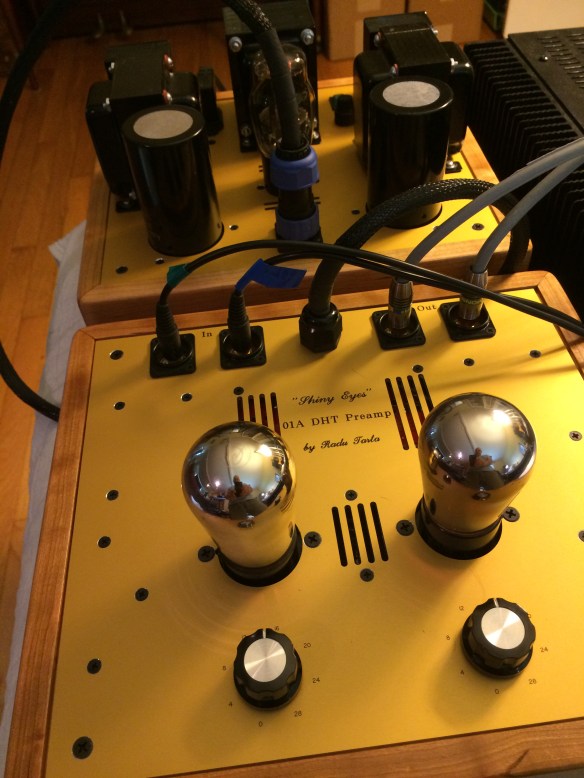
Here is another built of my favorite 01A DHT,  Thoriated Tungsten filament.

IMG_4365

It uses the Lundahl LL2745 in a 5.6:1 step down configuration. A separate enclosure power supply is providing low ripple high and low voltage. A 7 wire umbilical cord brings the power to the main preamp chassis. This preamp is solid state assisted on both high voltage and low voltage side. The 01A is filament biased using Coleman regulators.

There is no capacitor in the signal path besides the power supply ones. There are minimal parts in the signal path carefully chosen for reliability and sound quality.

01A is a superb sounding tube and can often improve the listening experience when combined with solid state amplifiers, digital recordings. There are still plenty of 01As available outthere. Just be patient to find the less microphonic ones. As usual, I dealt with reducing the effect of microphony by starving filaments and suspending the sockets on neoprene mounting dampers.


Another DHT switchable preamp

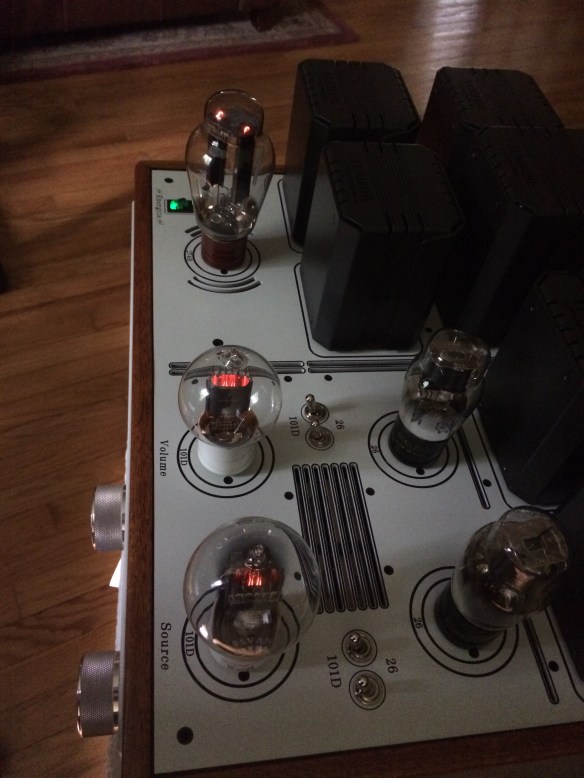
Built for my audiophile pal Paul, this is a one enclosure preamp  using 101D or 26 vacuum tubes.

IMG_4225

This is an all DHT( direct heated tubes) preamplifier/ line stage.  It has one stage and is built within the same enclosure. This a very good option for anyone who want to try and compare the sound of the 101D  DHT triode and the 26 DHT triode.

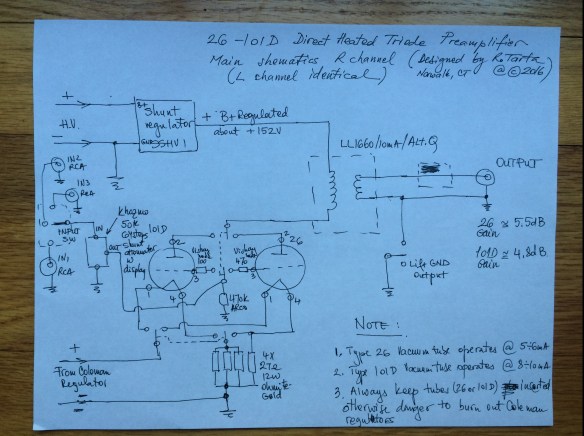
The power supply uses Lundahl LL1683 for main HV in a choke input 0.47uF(Obbligato gold film)-10H Lundahl LL1638-68uF(Obbligato Film-Oil)- 10H Lundahl LL1638-68uF(Obbligato Film-Oil). The rectifier used is the 274B and can be replaced by any rectifier in the 5U4G family. HV is supplied with a low ripple which is perfectly adequate considering that the shunt regulator SSHV1 will add at least 80dB PSSR bringing the ripple at extremely low levels ( I could not measure it with my equipment).  The raw power supply for the filament biases are using Hammond 167 series transformers at 12.6Vac, followed by a rectifier bridge with 1N5822 and 10mF-2×0.33ohms-10mF-0.1uF-220pF. The two raw filament supplies are delivering up to 1 Amp to the Coleman regulator.  The Coleman regulator is adjusted at 1A which is perfect for the 101D tube and slightly starved for the 26.


The preamplifier  uses either the 101D or the 26 tube in a filament bias configuration. In order to switch between 101D and 26 tubes, there are 2 sets of DTDP high quality Carling switches. The anode load of the DHTs is Lundahl  LL1660/10mA connected step down Alt. Q 4.5:1 ratio. This allows to deliver a 20 times lower output impedance compared to the plate resistance of the DHT . The input of the preamplifier is DC connected, therefore care must be taken when connect to other audio equipment to make sure that there is no DC to feed this preamplifier. The preamp is provided with a stereo remote volume control by Khozmo in 64 steps, shunt stepped attenuator having only two resistors in the signal path at a time. All components and wires are high end audio such as Vishay nude, silver gold wire, NEOTECH – Solid Core Copper, *PTFE Jacket
(99.9999% UP-OCC Mono-Crystal design).

Specifications

The following measurements are only to give you a sense  of the approximate performance. I used a computer software and interface and this comes with some artifacts and noise that are not present when the amp is connected in a audio path. One, if owns high quality audio analyzer, can take more precise measurements

  • Frequency response: better than 30Hz-30kHz @ -1dB
  • Distortions better than 0.2% at 3Vrms output, for most tubes if carefully selected for low distorsion
  • Gain using the 26: about 5.5dB
  • Gain using the 101D: about 4.8dB
  • Input impedance: 50 kohms, unbalanced
  • Output impedance under 400 ohms for the 26 and under 300 ohms for the 101D

More pictures: Top plate from Front Panel Express with a very nice powder coated finish…

26-101d-main-schematics.jpg26-101D_PSU schematics

Switchable 01A-26 DHT preamplifier

night viewThis is an all DHT( direct heated tubes) preamplifier/ line stage.  It has one stage and is built within the same enclosure. This a very good option for anyone who want to try and compare the sound of the early 01A  triode and the 26 triode.

The power supply uses Hammond 269AX for main HV in a quasi choke input 0.47uF(film)-30H(40mA)-47uF(Obbligato Film-Oil)-500ohms-47uF(Obbligato Film-Oil). The rectifier used is the 6BY5GA. HV is supplied with a low ripple which is perfectly adequate considering that the shunt regulator SSHV1 will add at least 80dB PSSR bringing the ripple at extremely low levels ( I could not measure it with my equipment).  The raw power supply for the filament biases are using the Hammond167L12 transformers, 1N5822 and 10mF-2×0.33ohms-10mF-0.1uF-220pF. The two raw filament supplies are delivering up to 1 Amp to the Coleman regulator.  The sense resistor of the Coleman regulator is switched between 1 ohms and 3.9ohms, to supply either 0.91A to the 26 filaments or 0.233A to the 01As.

The preamplifier  uses either 01A or 26 tube. In order to switch between 01A and 26 tubes, there are 2 sets of DTDP high quality mini Carling switches. One of the switches is used to switch between the Rsense of the Coleman regulators, and the second switch is switching the bias resistors placed between one of the filament pins and signal ground ( a permanently connected 30 ohms Mills MRA12 is used to bias the 01A and when switching to the 26 tube there are 2 more 30 ohms Mills MRA12 added in parallel to the 30 ohms( equivalent bias resistor for the 26 will consequently be 10 ohms)), and the anode voltage adjustments of 120V for the 01A and of 155V for the 26.

The anode load of the DHTs is a Mosfet-Jfet inductance simulator which has the advantage to lower the distortion to minimum and higher the amplification to maximum. The input of the preamplifier is DC connected, therefore care must be taken when connect to other audio equipment to make sure that there is no DC to feed this preamplifier. The output is capacitor coupled, using a quality capacitor: the Mundorf  Supreme.

The preamp is provided with volume control using Alps RK27 potentiometers, one per channel. The advantage of using separate volume control per channel is to be able to balance the sound. Tubes can’t be perfectly paired and they also drift differently in time.


Specifications

The following measurements are only to give you a sense  of the approximate performance. I used a computer software and interface and this comes with some artifacts and noise that are not present when the amp is connected in a audio path. One, if owns high quality audio analyzer, can take more precise measurements

  • Frequency response: better than 10Hz-30kHz @ -1dB
  • Distortions better than 0.1% at 8Vrms output ( as low as 0.02% depending on the specific vacuum tube)
  • Gain : about 19dB(x8)
  • Input impedance: 82 kohms, unbalanced
  • Output impedance under 300 ohms for the 26 and under 500 ohms for the 01A

“Shiny Eyes” Parallel Push-Pull EL34B

“Shiny Eyes” Parallel Push-Pull EL34B is my first medium power push-pull monoblock . It was sponsored by my audiophile friend Rocky.

First, I want to thank  Kevin Carter from K&K Audio for his technical support and his awesome sounding push-pull driver, an all balanced driver using the Russian pentode 6J49P in triode mode and very good Lundahl transformers.

It uses six EL34B per channel delivering a maximum of 50Wrms into 4 or 8 ohms. The output audio transformer is a 120W Hammond 1650TA. The driver stage is full balanced push-pull input stage kit from K&K Audio using all Lundahl transformers LL1544A for input and LL1692A for output. Driver tubes are 6J49P carefully selected by Kevin Carter.

The power supply consists of a 375VA potted Plitron toroidal transfomer with secondaries at 340V/0.8A and 6.3V/ 12.8A. HT is SiC diodes rectifed and CLCLC filtered, using Hammond 159V chokes and MKP 50uF 900V capacitors. The driver has its own shunt regulator. The high voltage is delivered with a 30 seconds time delay based on IC555.

The enclosure that holds together the mono-blocks was delivered by Modushop in Italy, model Pesante 5U 400.   On the back panel one can observe the IEC main power jack and the fuse holder on the left, the RCA input jack in the center, and on the right the Cardas speaker binding posts and two switches, one for 4 and 8 ohms and one for speaker on/mute. On the front panel there are two meters: the center one is a VU meter, and the right side mA meter shows the total anode current of the six EL34Bs. This mA meter should show not more than 420mA ( typically between 350 and 400mA). On the right of the front panel one can notice the main power switch and light indicator.

The case of the mono-block amplifier is running hot in few spots that are close to the group of the six EL34Bs power vacuum tubes. It is not recommended to touch the top of the case above the power tubes where the temperature can reach values that are not safe for touching. For this reason this amp should not be left unsupervised. Each monoblock weights about 60-70 lbs .

This a medium power amplifier ( 2x50W max), providing a transparent, detailed, good dynamics sound. The EL34Bs are running self-biased, class A triode mode.

Here are some measurements:

Input Voltage (Vrms) Output Voltage (Vrms) on 8.3 ohms Power (W) THD (%)
0.5 6.23 4.67 0.3
0.73 8.8 9.3 0.53
1 12.5 18.8 0.95
1.45 18 39 1.87
1.55 19.2 44 1.76
1.66 20.5 50 2.29

Specifications

  • FR : 20Hz-22kHz =/- 1dB
  • Input sensitivity for 50W output: 1.66 Vrms
  • THD at 1kHz, 40W on 8Ohms output is better than : 2%

Max power: 50W

Mains Voltage: 120V at 60Hz

The schematics ( exception the driver):


More pictures: