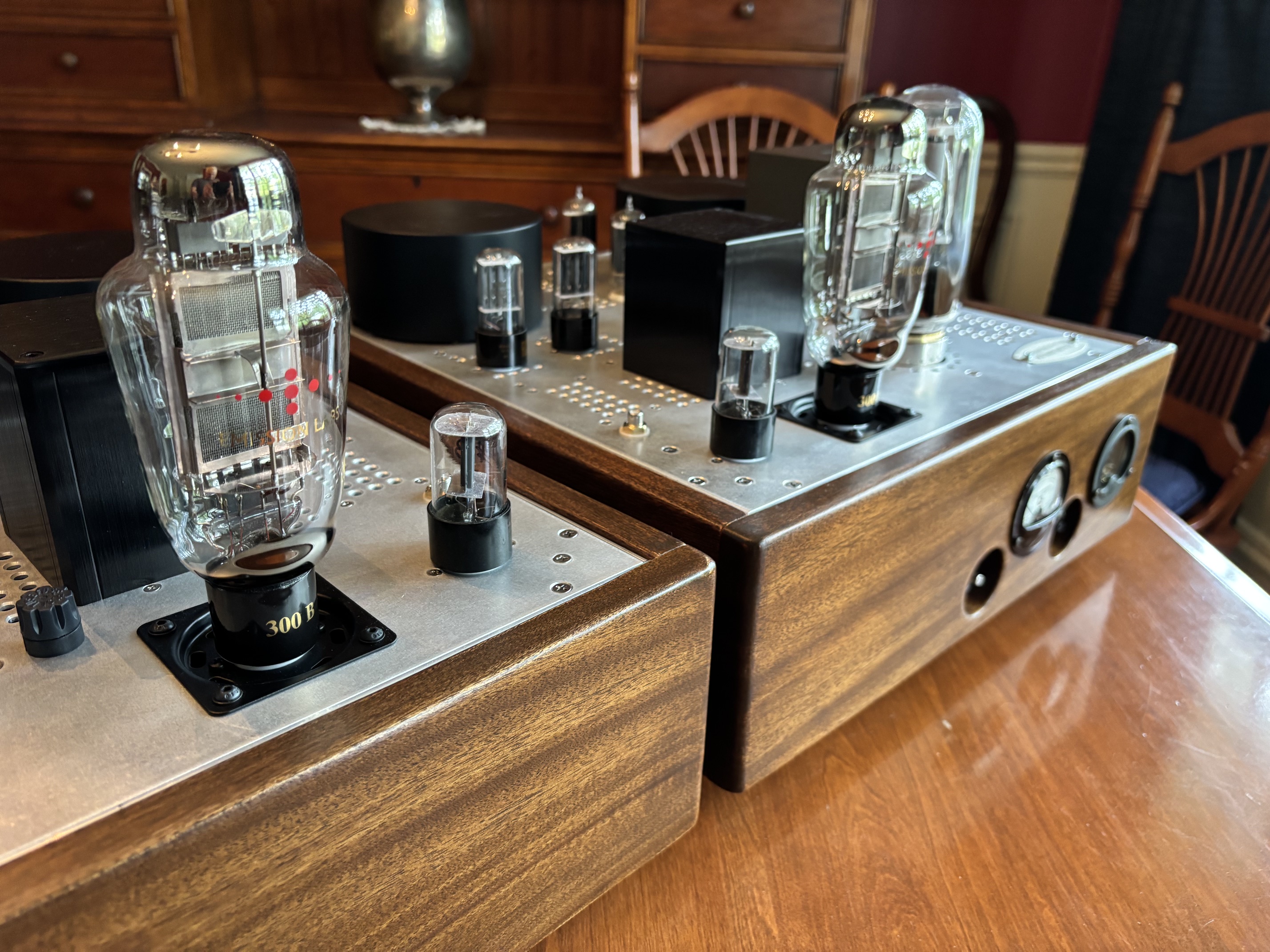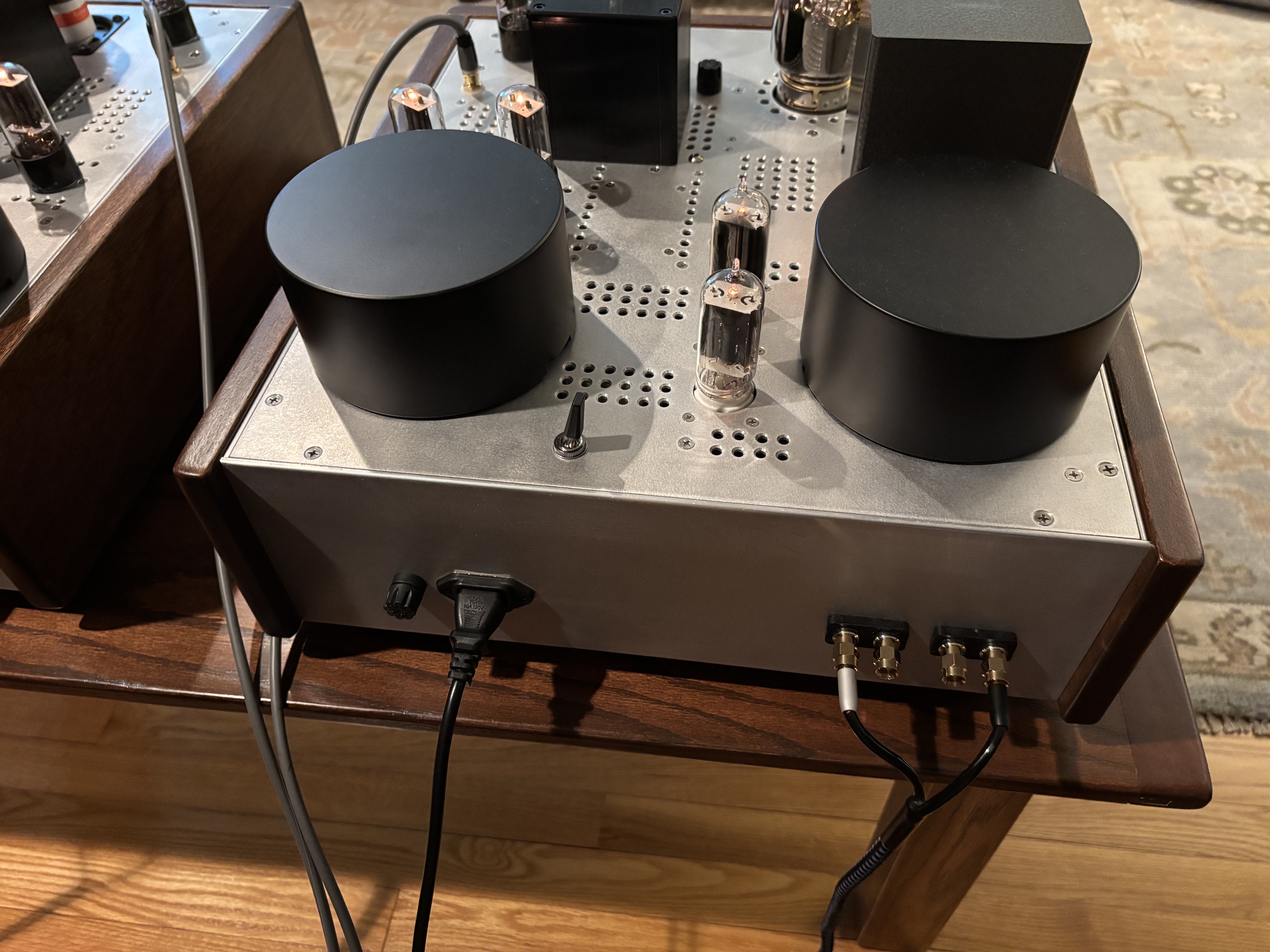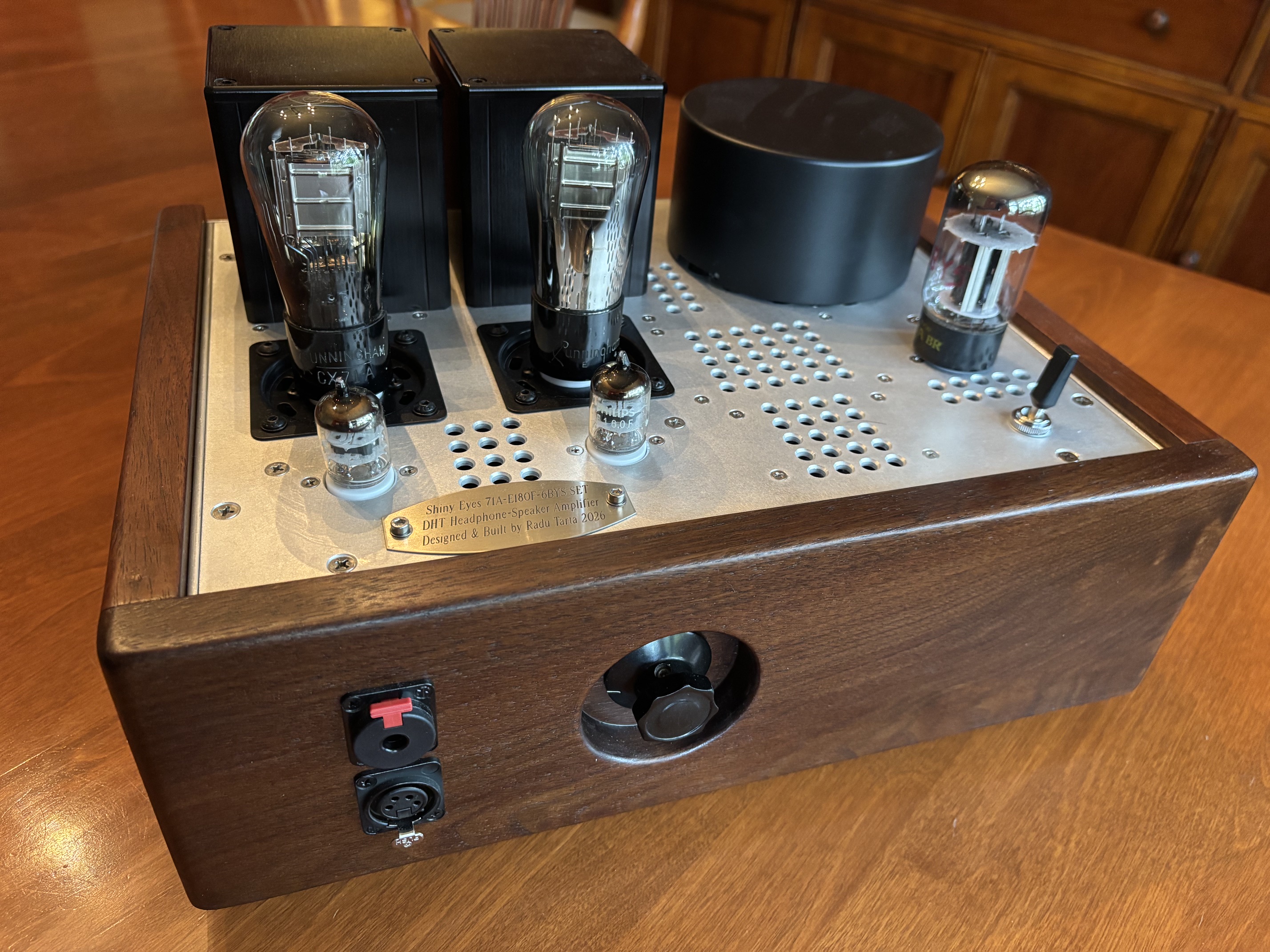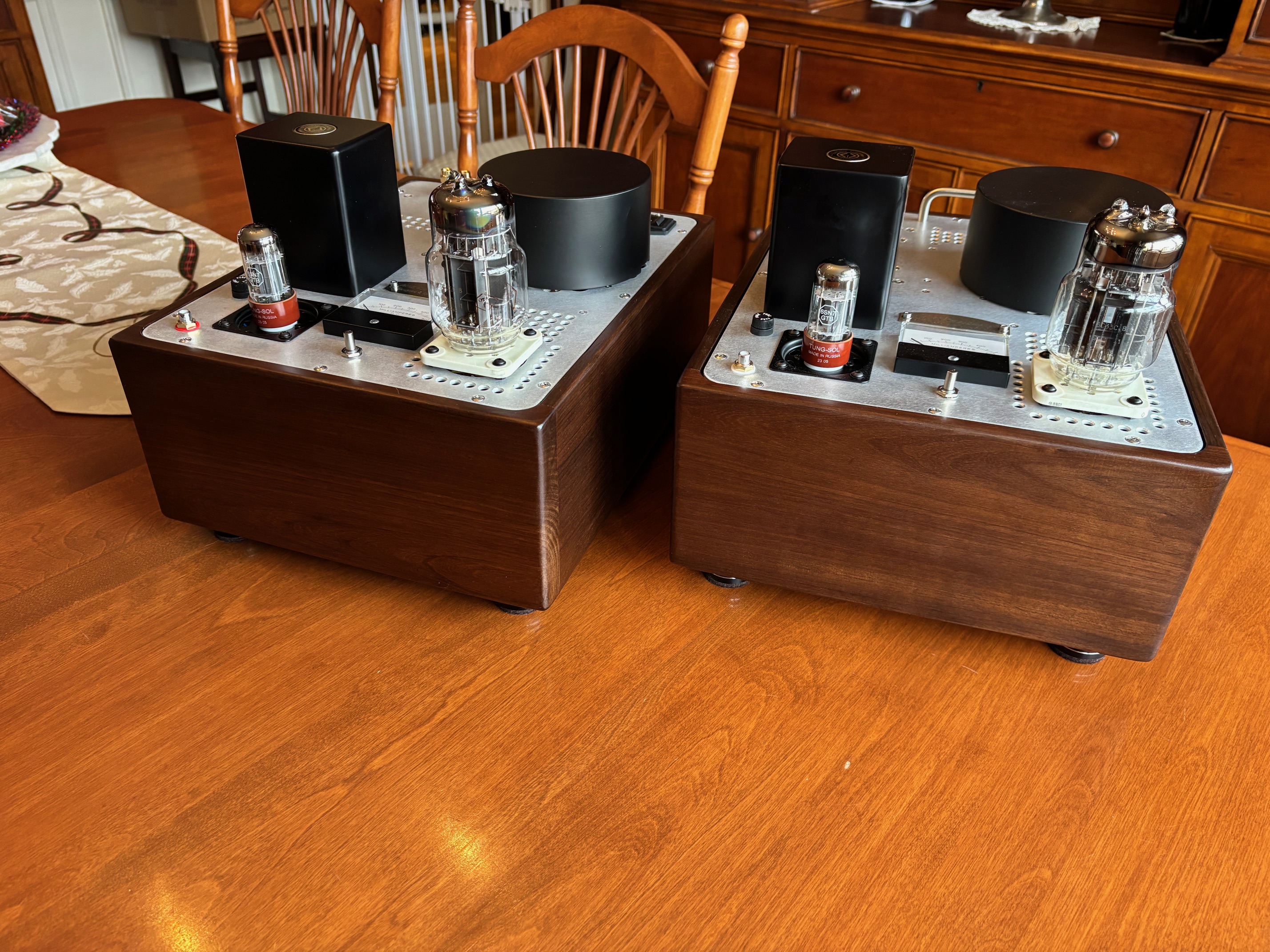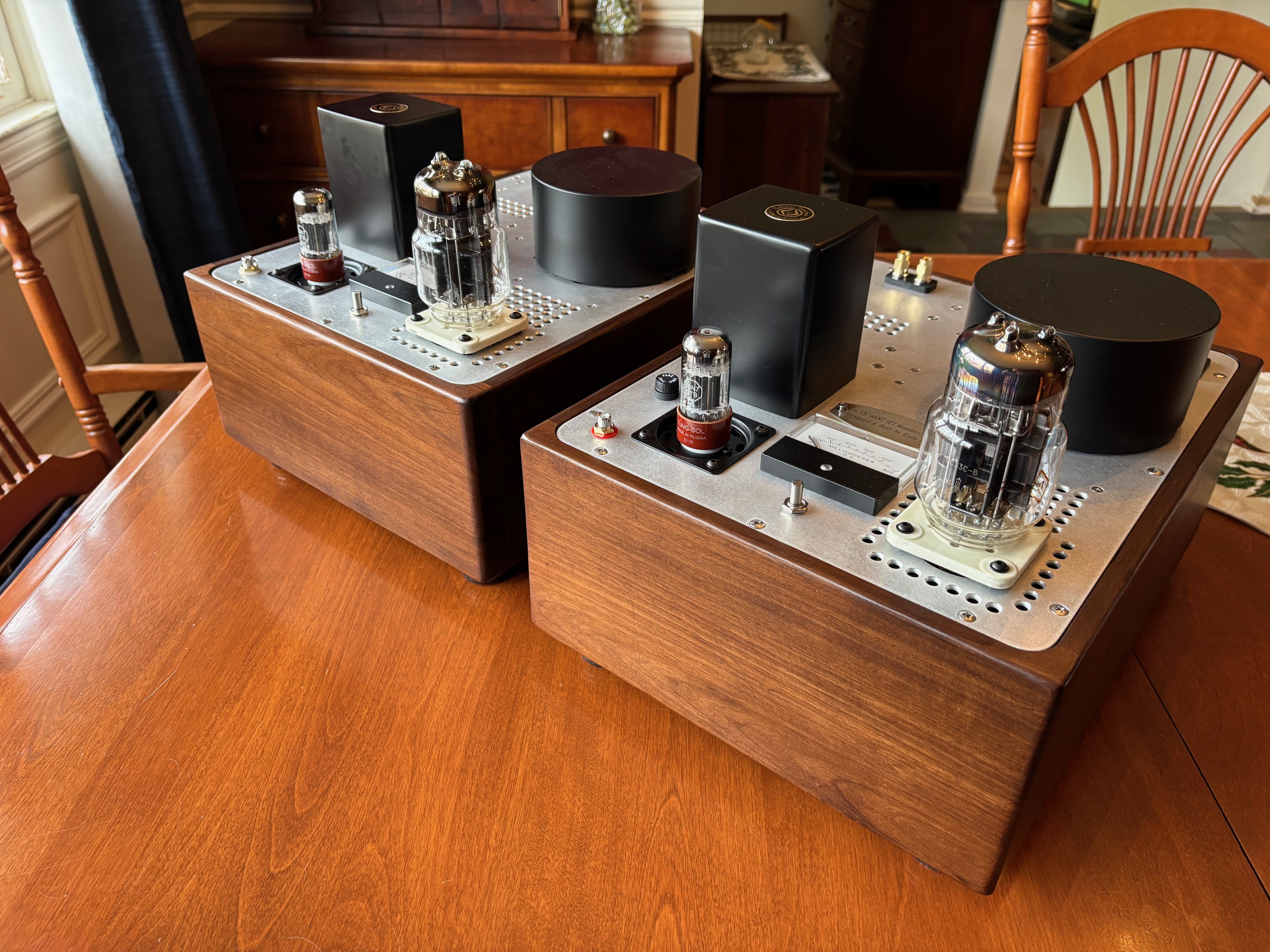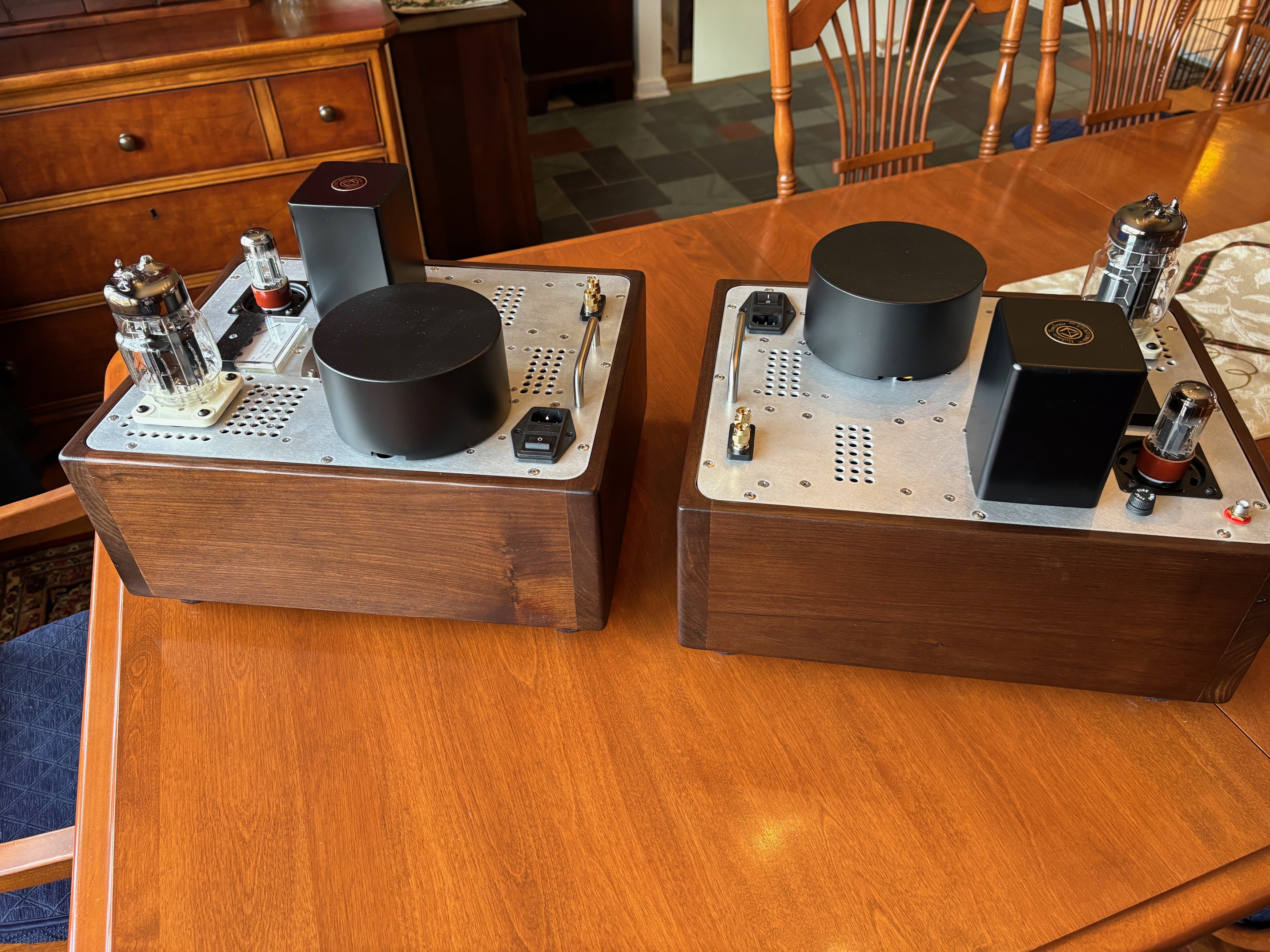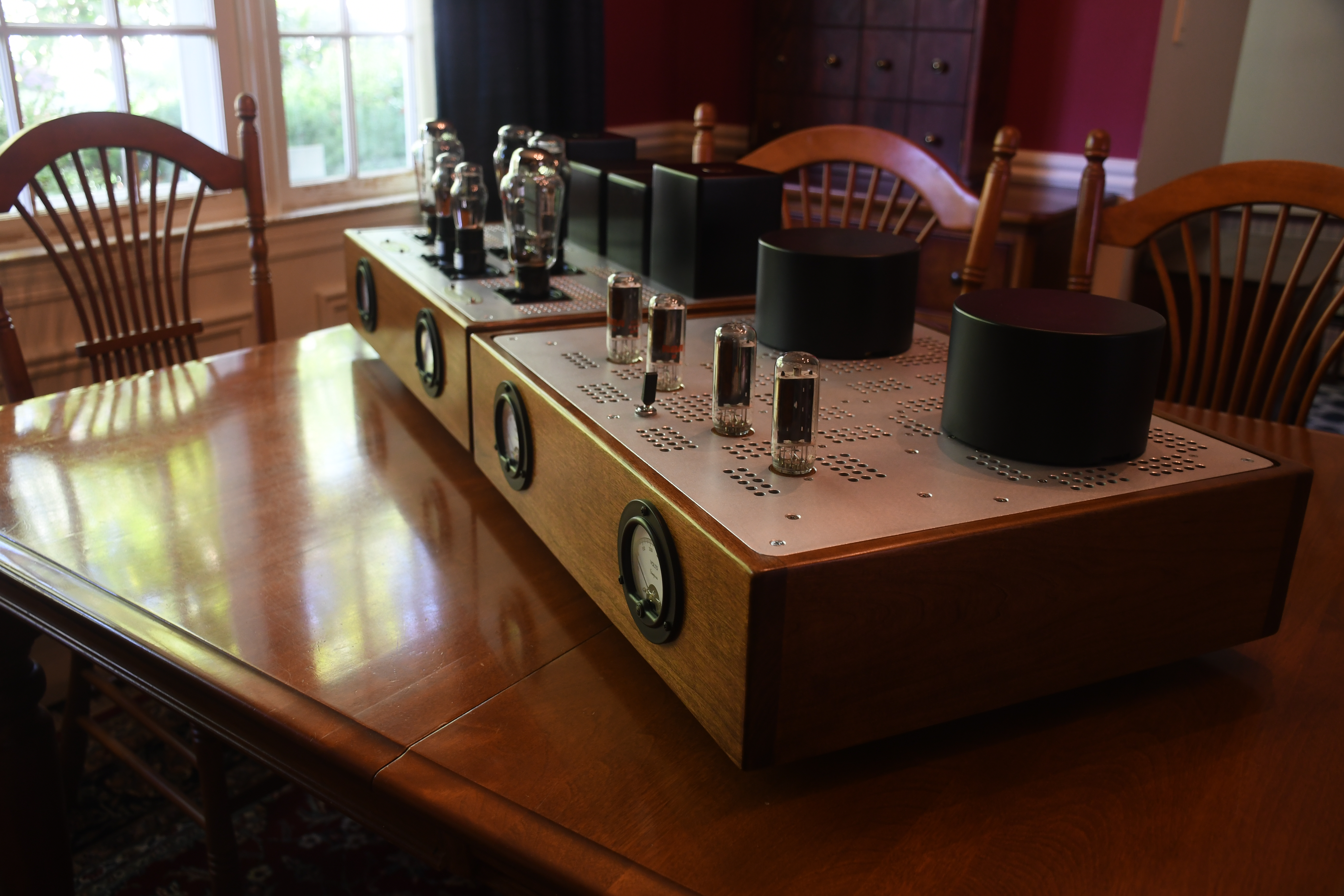
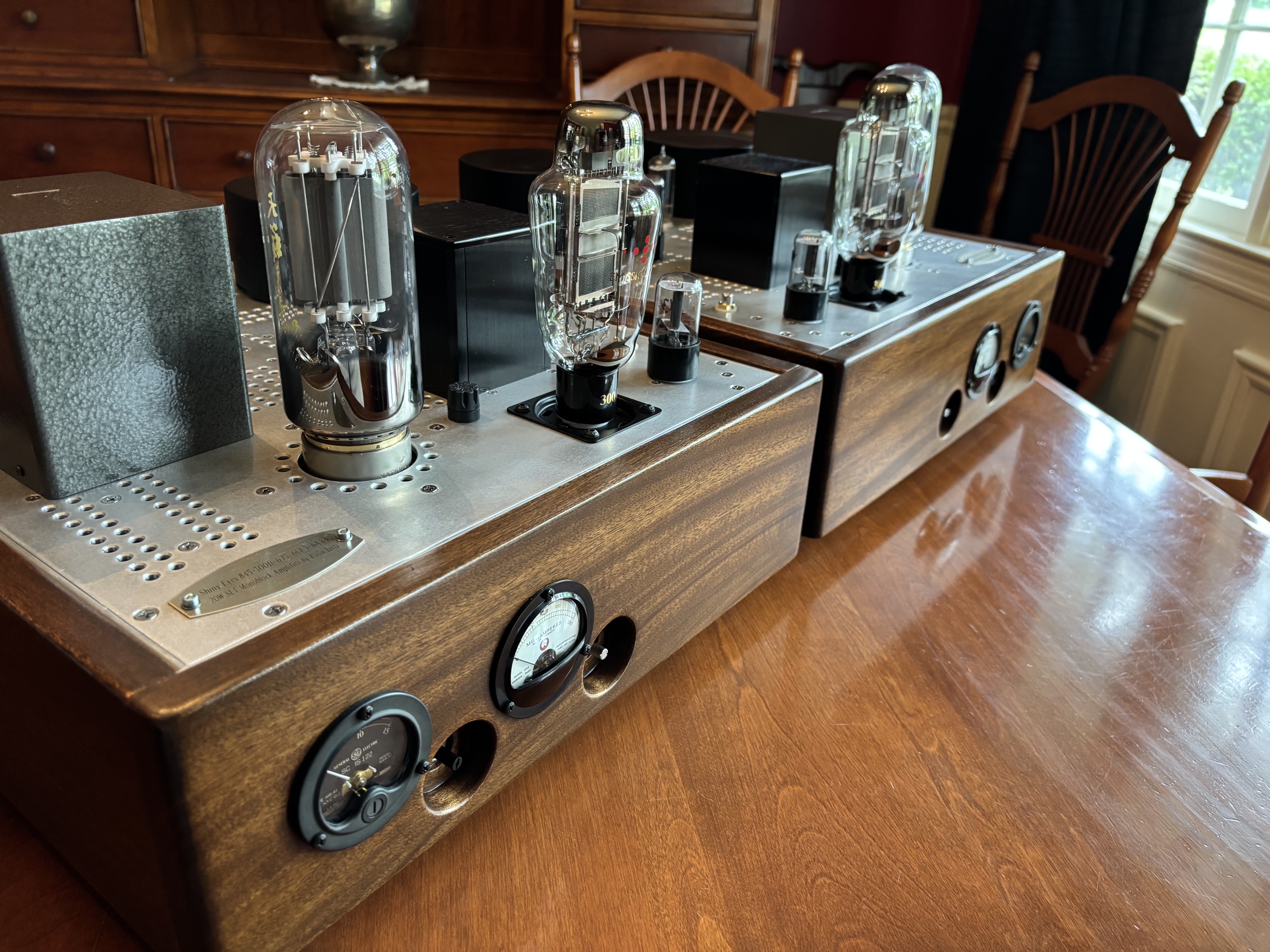
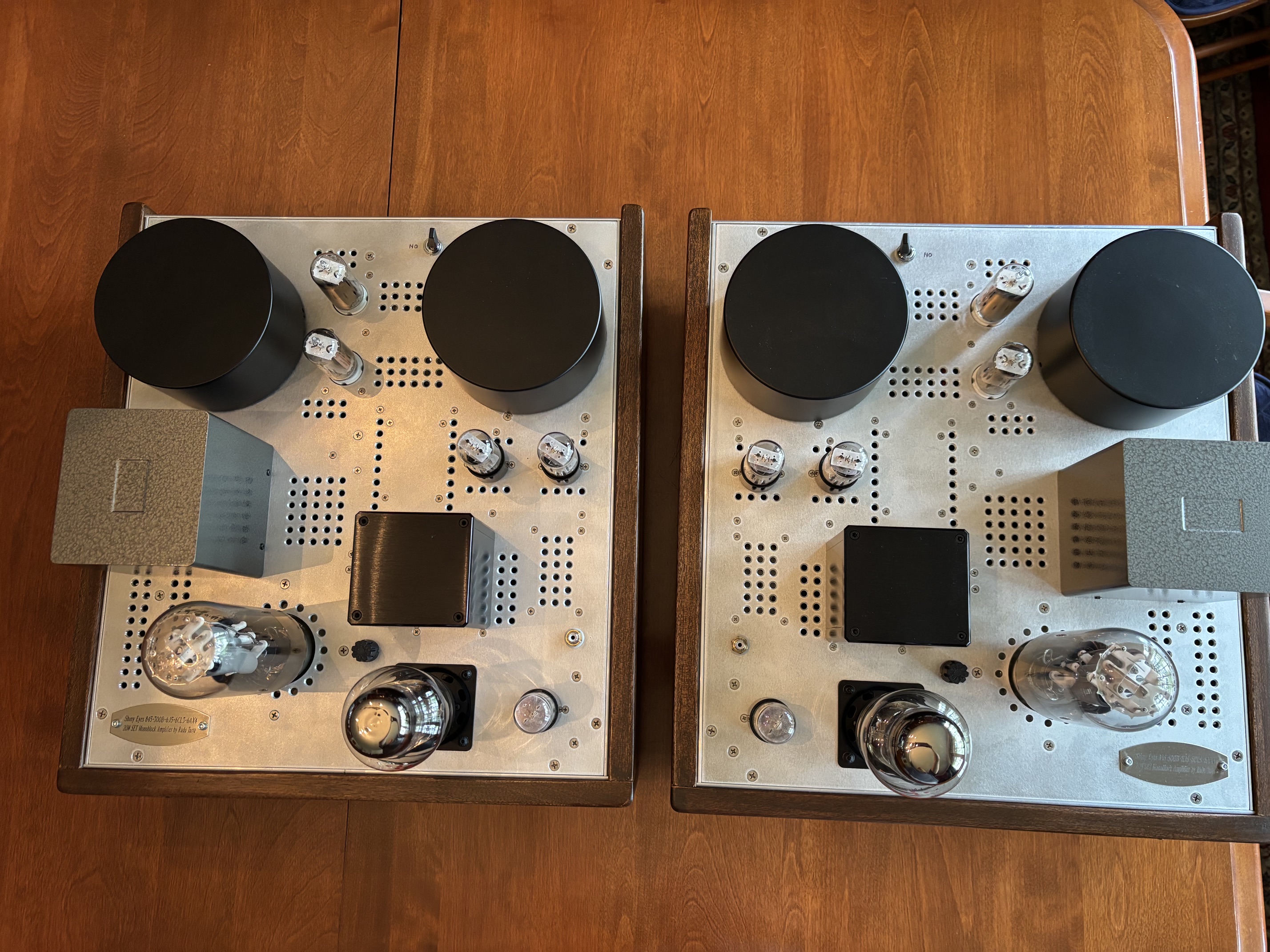
Shiny Eyes 845 SET Amplifier — Monoblocks — 2026

It has been a while since I started thinking about designing a high-performance, reliable 845 DHT amplifier. From the very beginning, I wanted to build an amplifier around the 845 that would combine the power and authority of this transmitting triode with the refinement, low distortion, and musicality expected from a high-end SET design.

As with any serious SET project, the first step was selecting the output transformer. Once the output transformer was chosen, the required B+ voltage, operating point, and power-supply requirements could be established around the characteristics of the 845. I ultimately settled on the ISO Tango FC-30-10S output transformer, which led to a B+ of approximately 1,000 V. The amplifier is capable of approximately 18 W of clean output power before gradually entering clipping.

The second major design decision was the driver. The 845 requires a substantial drive voltage—approximately 100 Vrms to reach full power—while maintaining very low distortion. This significantly limits the number of suitable driver configurations.

I chose a 300B DHT, loaded by a Lundahl LL1677 interstage transformer. The LL1677 was specifically designed with the 300B in mind and provides an excellent combination of bandwidth, linearity, and drive capability. The result is a very clean drive signal to the 845, even when the amplifier is operating close to full output.

For the input stage, the 6J5 was chosen primarily for its gain characteristics and sonic qualities. It provides the gain required while contributing very little coloration to the overall amplifier.

One of my primary goals was to make the amplifier as quiet as possible, with extremely low hum and ripple. Many compact SET amplifiers using 211 or 845 tubes can produce audible hum when paired with high-sensitivity loudspeakers. I wanted to eliminate that limitation as much as possible.

Several measures were taken to achieve this.

1. Separate Filament Power Supplies

Each tube has its own dedicated filament supply.

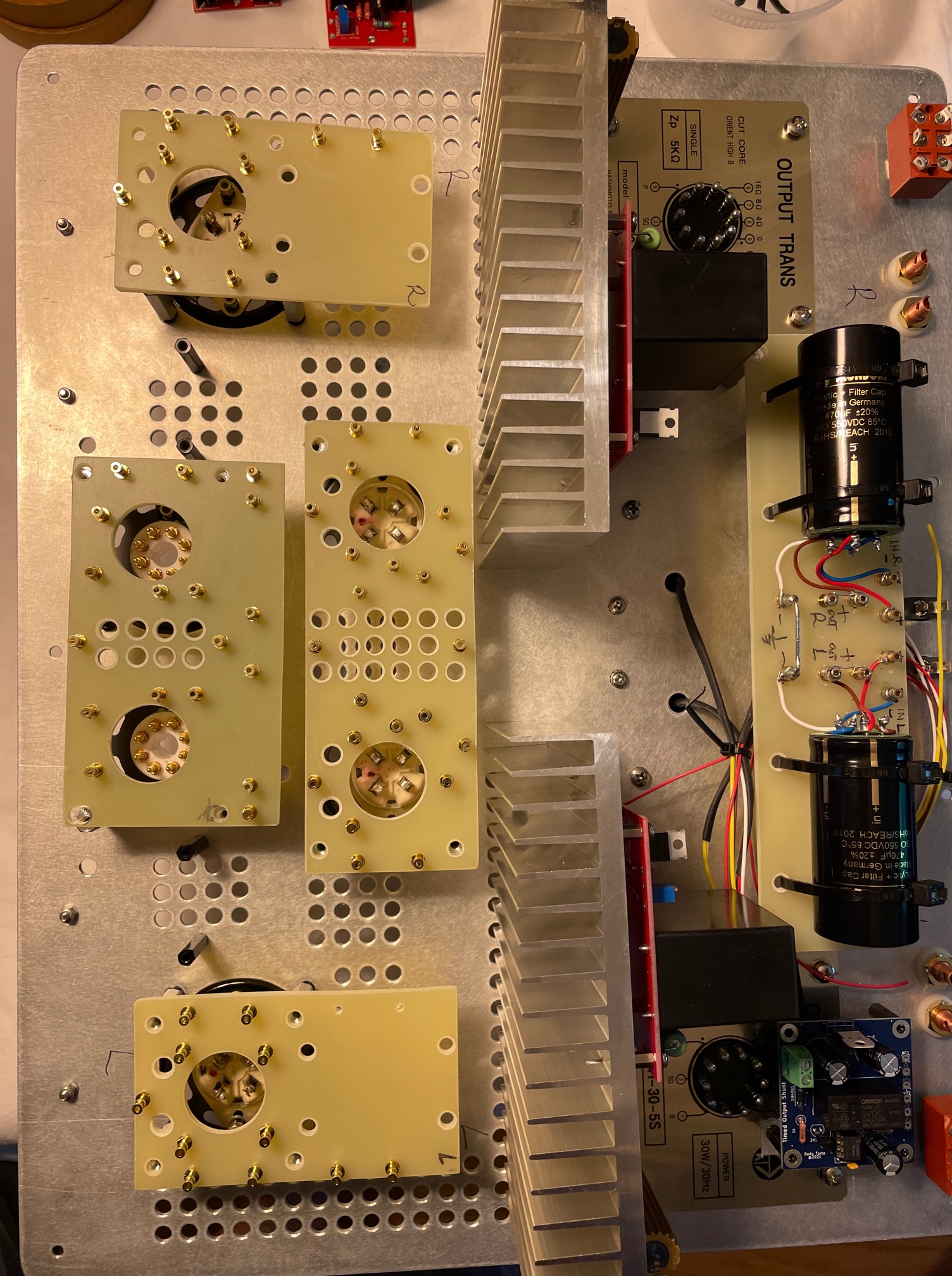
The 845 filament supply uses a 100 VA Antek toroidal transformer, MBR1635 rectifiers, and a CRC filter with approximately 80,000 µF of total capacitance and a ripple-current capability of approximately 12 A. The filtered DC is then regulated by a Coleman filament regulator.

A GE panel meter and precision potentiometer are mounted on the front panel, allowing the 845 filament voltage to be monitored and adjusted. The filament is set to 10 V at steady-state operation, after the amplifier has reached full operating temperature, typically after 30–60 minutes.

The 300B filament supply uses a separate dual-bobbin Triad power transformer and an LT1529 ultra-low-dropout regulator.

The 6J5 filament supply uses a dedicated LD1085 low-dropout regulator.

Separating the filament supplies in this way minimizes interaction between the stages and helps keep filament-related noise from reaching the audio signal.

2. High-Voltage Power Supply

The 845 high-voltage supply uses a hybrid bridge rectifier, combining SF1600 diodes with 6CL3 damper diodes.

Filtering is accomplished with a CLC network using MKP capacitors rated at 1,200 V, selected for their long life, stability, and reliability in a high-voltage environment.

The main choke is a Lundahl LL2742 17H choke, configured in a common-mode rejection arrangement. The combination of the hybrid rectifier, high-voltage MKP capacitors, and large inductance provides exceptionally effective filtering of the high-voltage supply.

3. 845 Bias and Current Adjustment

The 845 operates in a quasi-fixed-bias configuration. The negative bias voltage is adjustable through a Coleman bias regulator, allowing the operating point to be precisely set.

A 150 mA full-scale panel meter is provided, together with a precision adjustment potentiometer. This allows the 845 plate current to be set in the 55–65 mA range.

The negative bias supply has its own dedicated raw power-supply board, further isolating it from the other amplifier circuits.

4. Dedicated Driver and Input-Stage Power Supplies

The driver and input stages have their own dedicated Antek power transformer.

The high-voltage supply uses full-wave rectification with 6AX4 tubes, followed by a CLC filter.

Additional filtering is used for each stage. The 300B driver incorporates a CCS-capacitor filter, while the 6J5 input stage uses an additional RC filter.

The 6J5 is self-biased and loaded by a CCS to achieve very low distortion.

The 300B driver operates at approximately 300 V and 60 mA with constant-current loading. This operating point provides excellent linearity and also allows the use of virtually any 300B, including specialized tubes such as the EML 300B Mesh.

Slow Start and Protection

The amplifier incorporates a carefully controlled slow-start sequence. This provides several important benefits: reduced stress on tubes and other components, elimination of unpleasant turn-on and turn-off transients, and sufficient time for the 845 filament voltage to be checked and adjusted before the high voltage is applied.

Because of the considerable cost of the output transformers, I also included a 200 mA protection fuse in the output stage. Its purpose is to protect the output transformer in the event of an 845 failure that could result in excessive current through the transformer primary.

Construction and Layout

Every component was selected according to its specific function and its potential influence on the final sound.

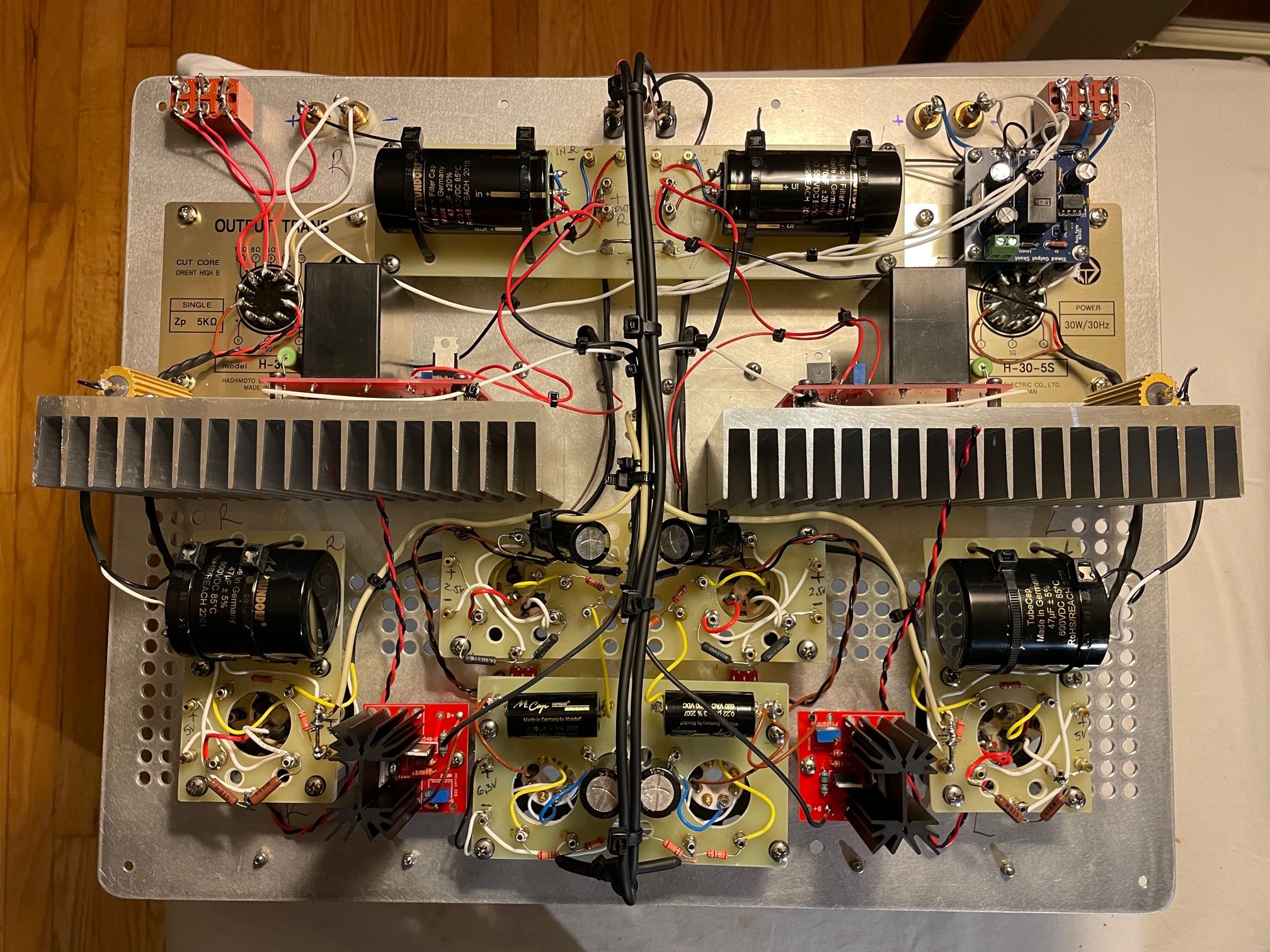
The physical layout was given the same level of attention as the circuit design. Particular consideration was given to:

  • Minimizing power-supply ripple and noise coupling
  • Keeping signal paths short
  • Separating sensitive signal circuits from high-current power-supply wiring
  • Managing the substantial heat generated by the 845
  • Proper grounding and circuit isolation
  • Mechanical placement of transformers, chokes, and other magnetic components

The goal was not simply to build a technically impressive amplifier, but to create a complete system in which every part of the design contributes to the final result.

The Result

The result is an amplifier that combines power, control, smoothness, and refinement in a way that is characteristic of a well-executed 845 SET, while maintaining unusually low noise for an amplifier of this type.

It sounds forceful yet smooth, clean yet detailed, powerful yet musical. The presentation has excellent impact and authority without becoming aggressive or overly analytical.

With 18 watts of clean single-ended power, the amplifier should be capable of driving a wide range of loudspeakers, including many moderately sensitive designs.

Specifications

SpecificationPerformance
Maximum clean output power18 W/channel
Input sensitivity for maximum output0.7 Vrms
Output impedance3.5 Ω
Frequency response±0.5 dB, 20 Hz–20 kHz @ 8 W
THD1.9% @ 8 W
Dominant distortion component2nd harmonic
Harmonic characterSmooth harmonic decay
Power consumption210 W/channel

The measured THD and harmonic spectrum will vary somewhat depending on the individual 300B and 845 tubes used. Higher-quality, more linear tubes can produce measurably lower distortion and may also provide a cleaner and more refined presentation.

Shiny Eyes 845 SET Monoblocks — 2026

A design built around the 845 not simply for its power, but for the combination of authority, musicality, simplicity, and refinement that a properly executed DHT single-ended amplifier can deliver.

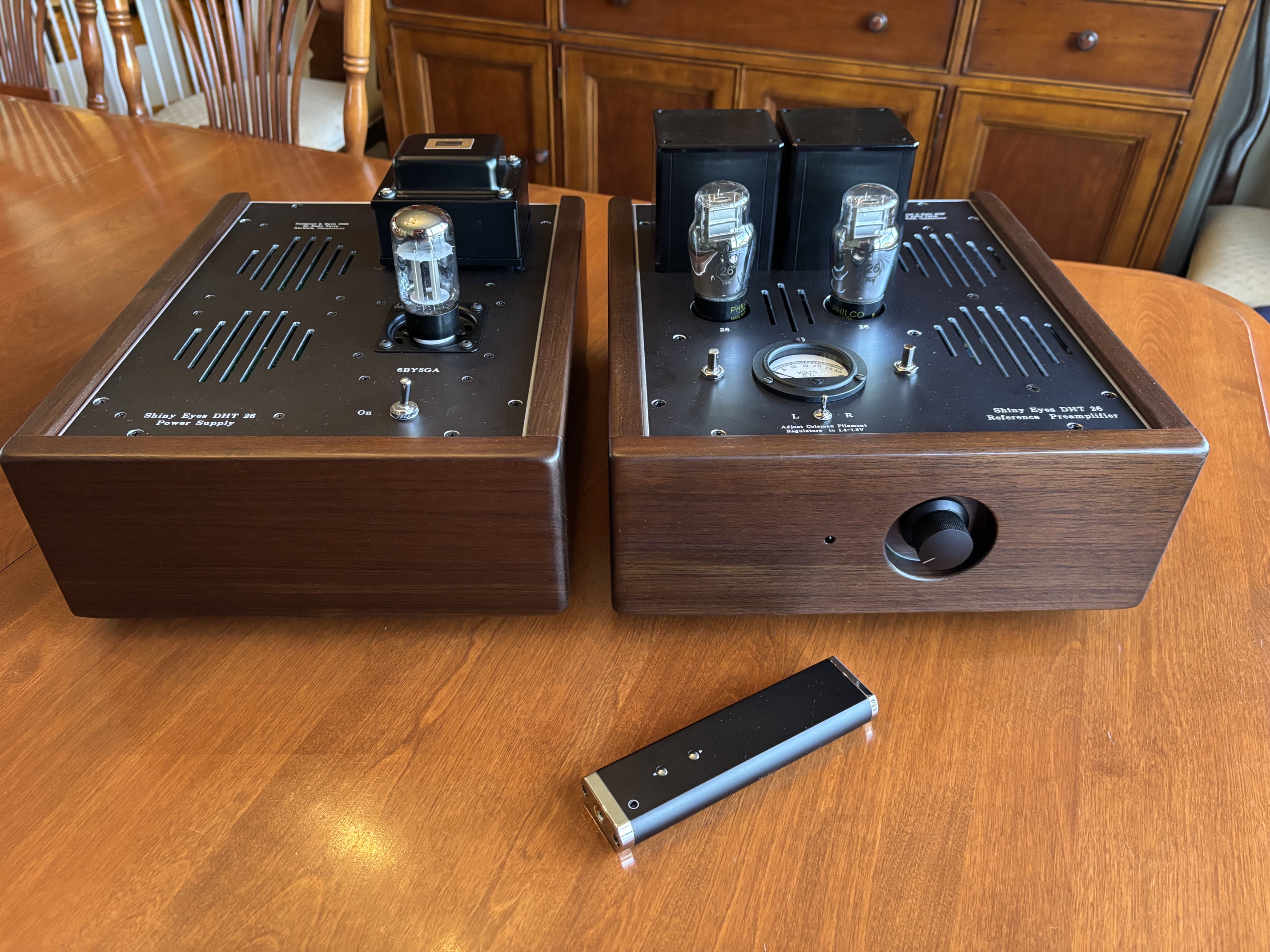
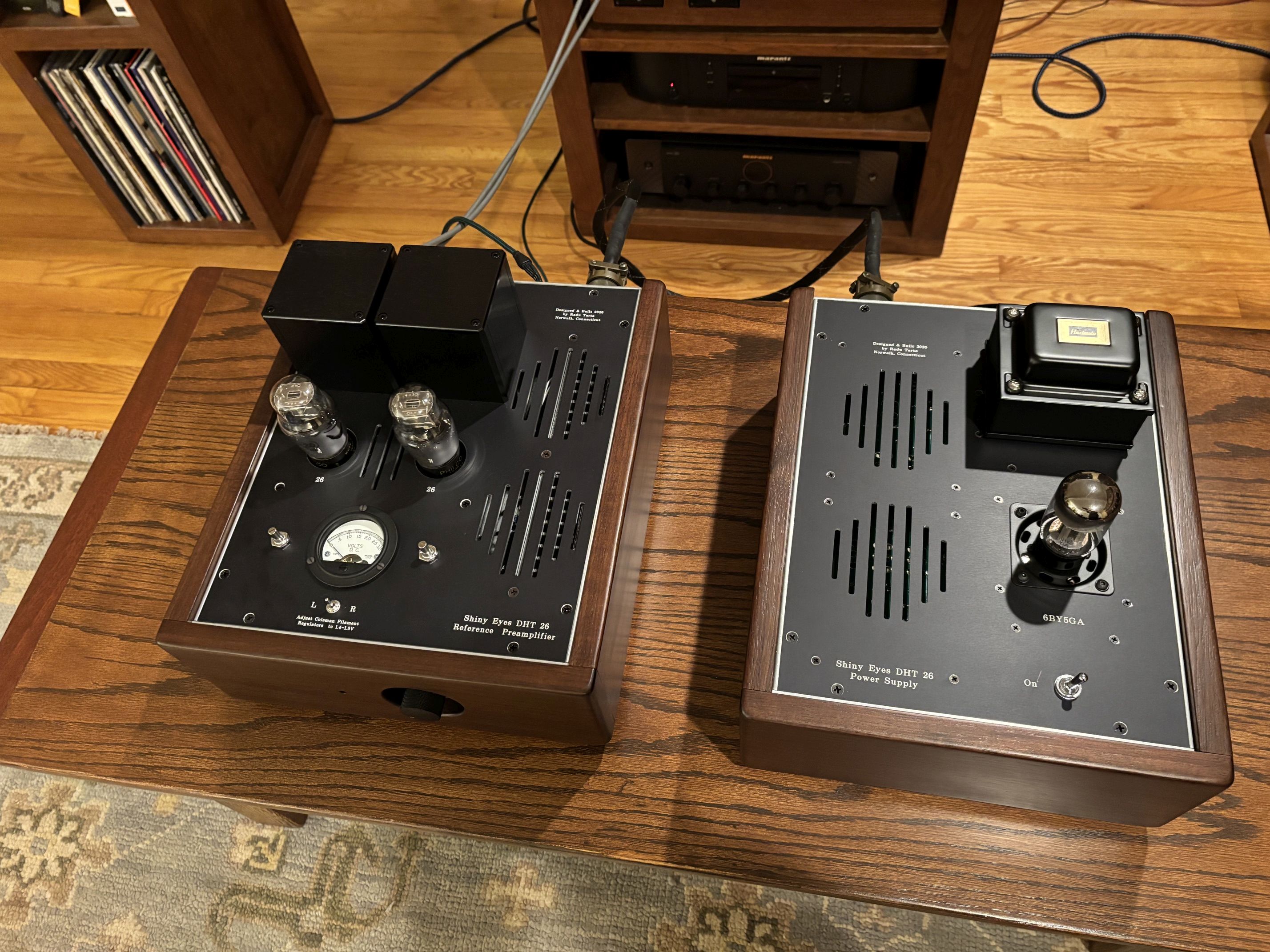
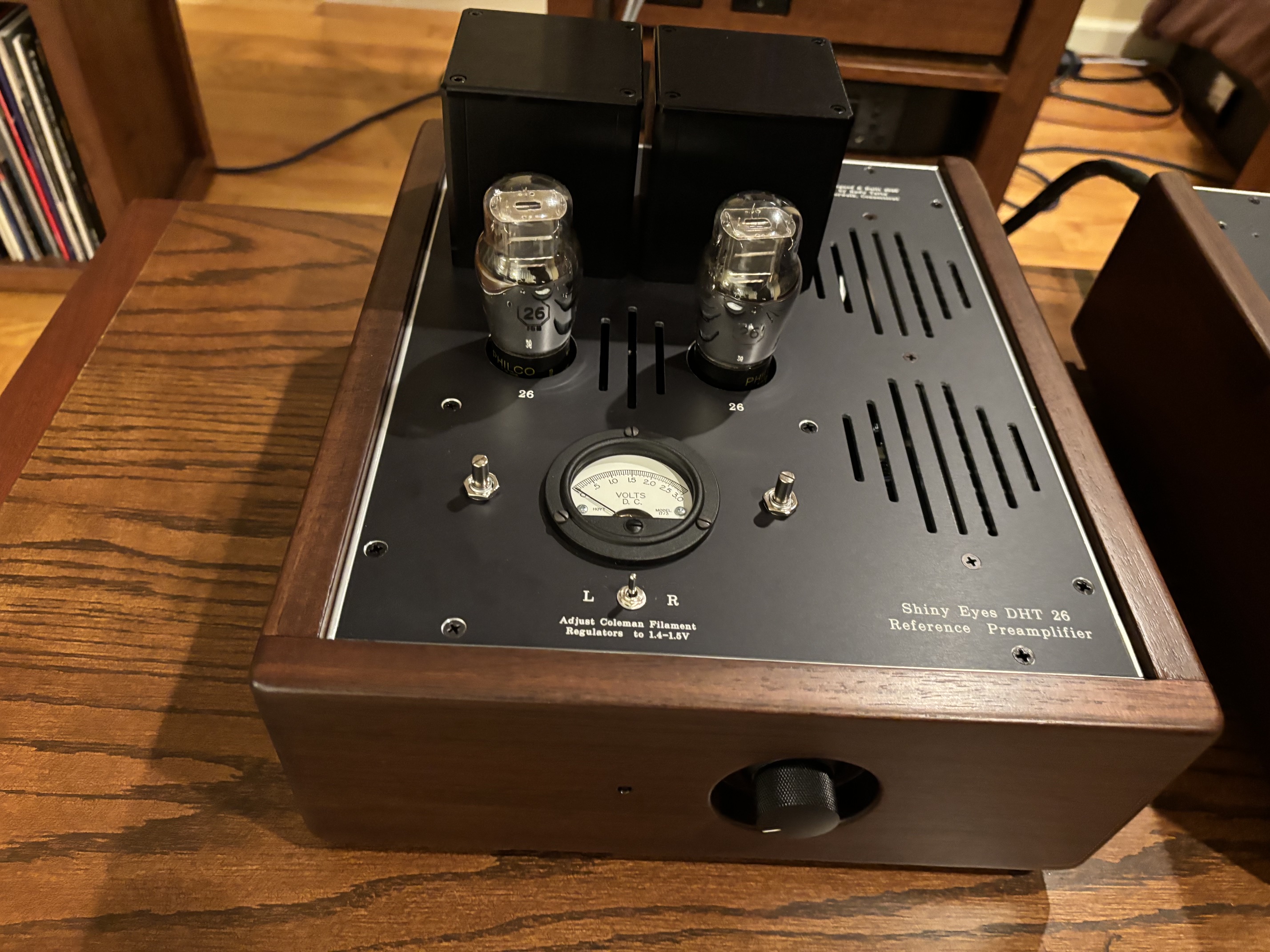
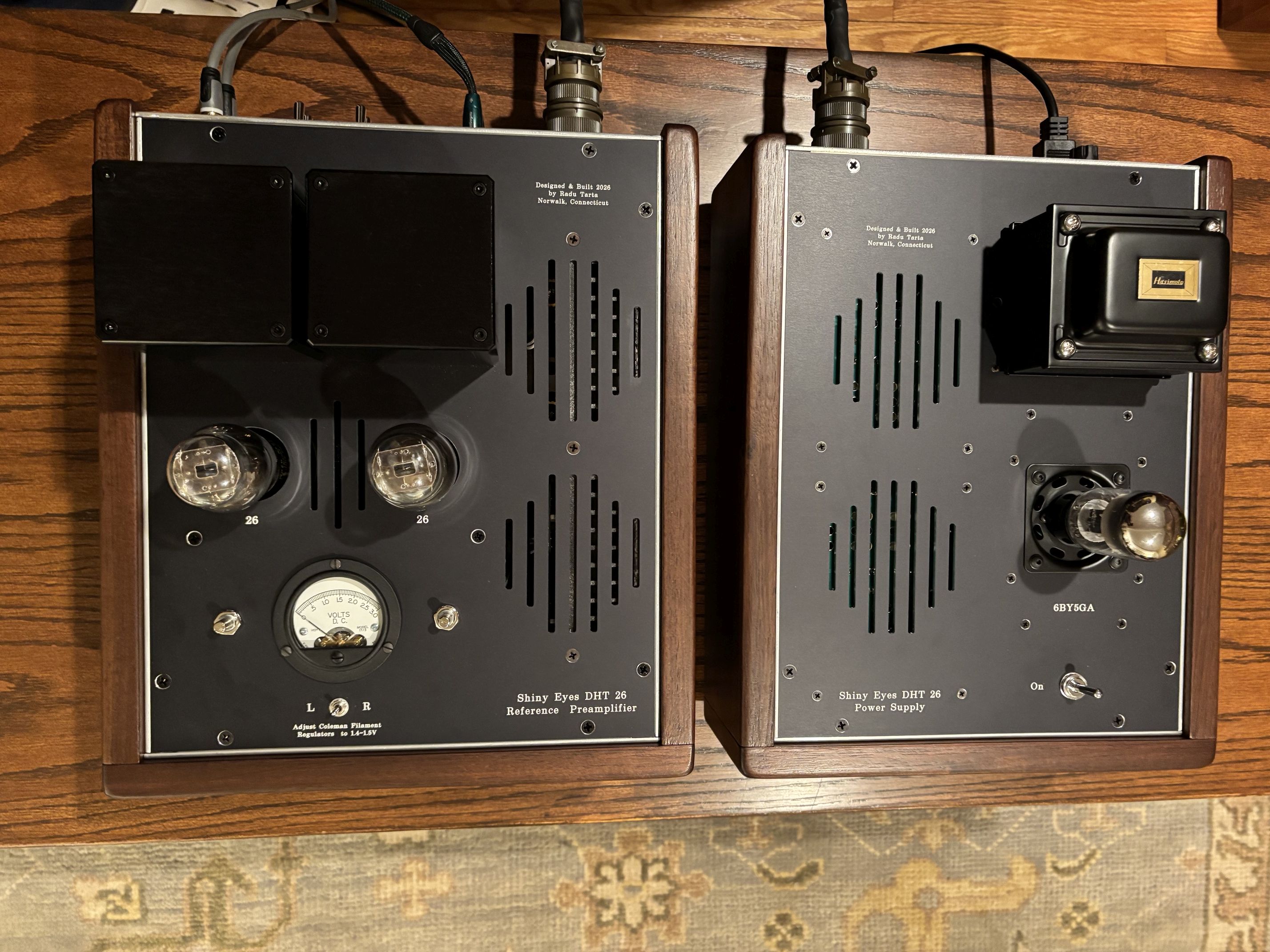
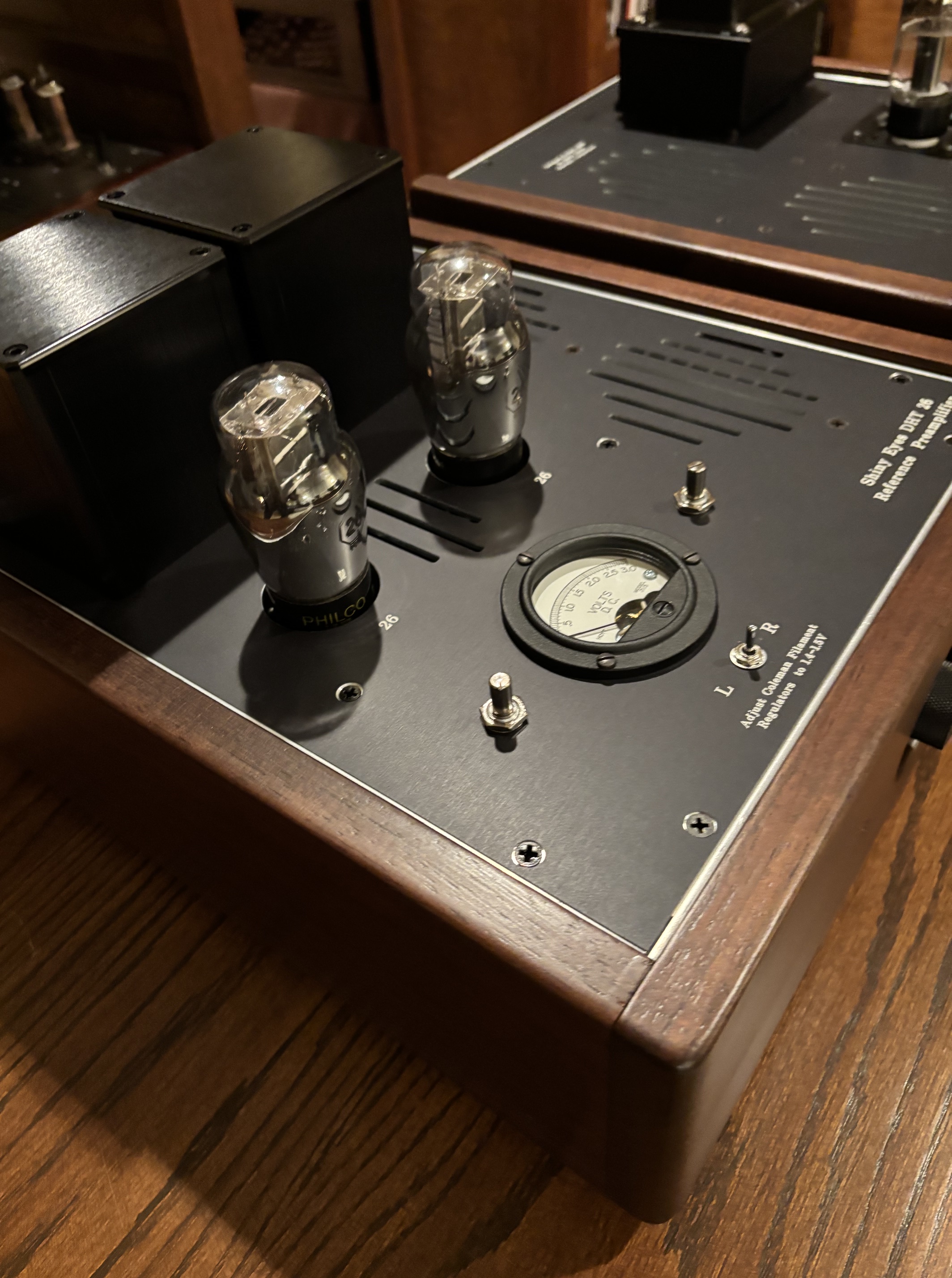
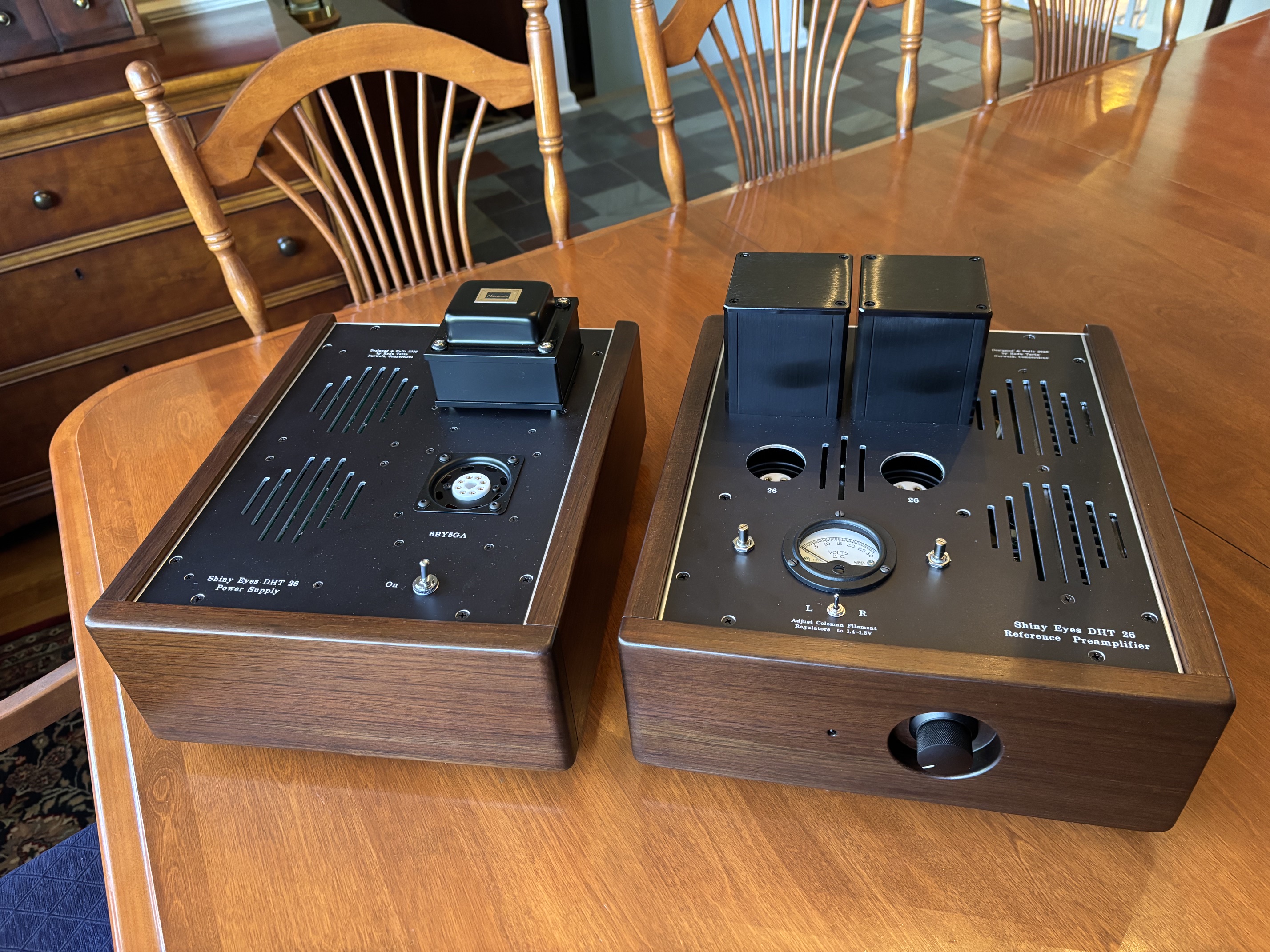
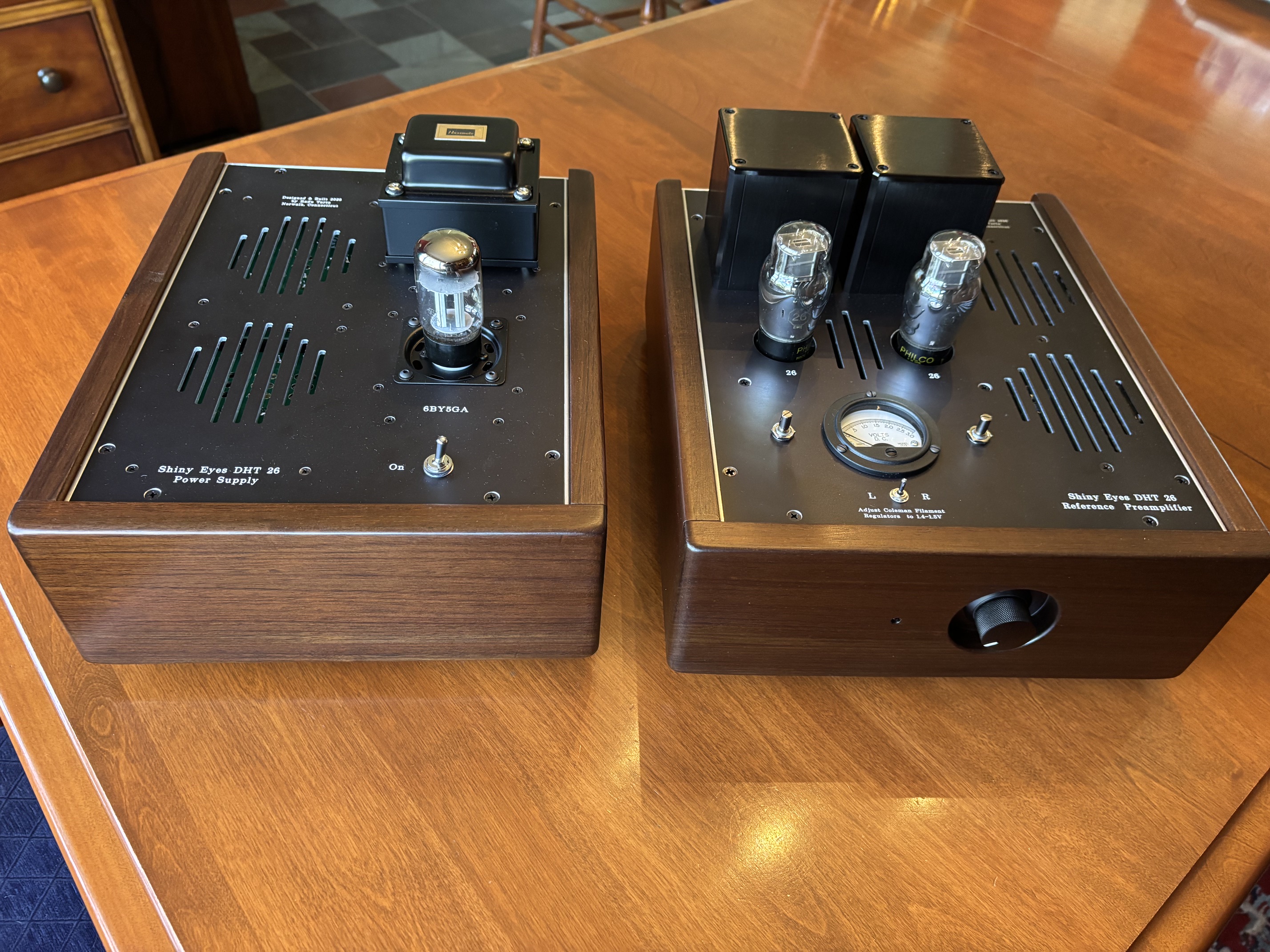
Special 26 DHT Preamplifier — Engineered with a Separate Power Supply for Superior Performance

This is a truly one-of-a-kind preamplifier built around the legendary Type 26 direct-heated triode (DHT), renowned for its exceptionally pure, natural, and transparent sound signature.

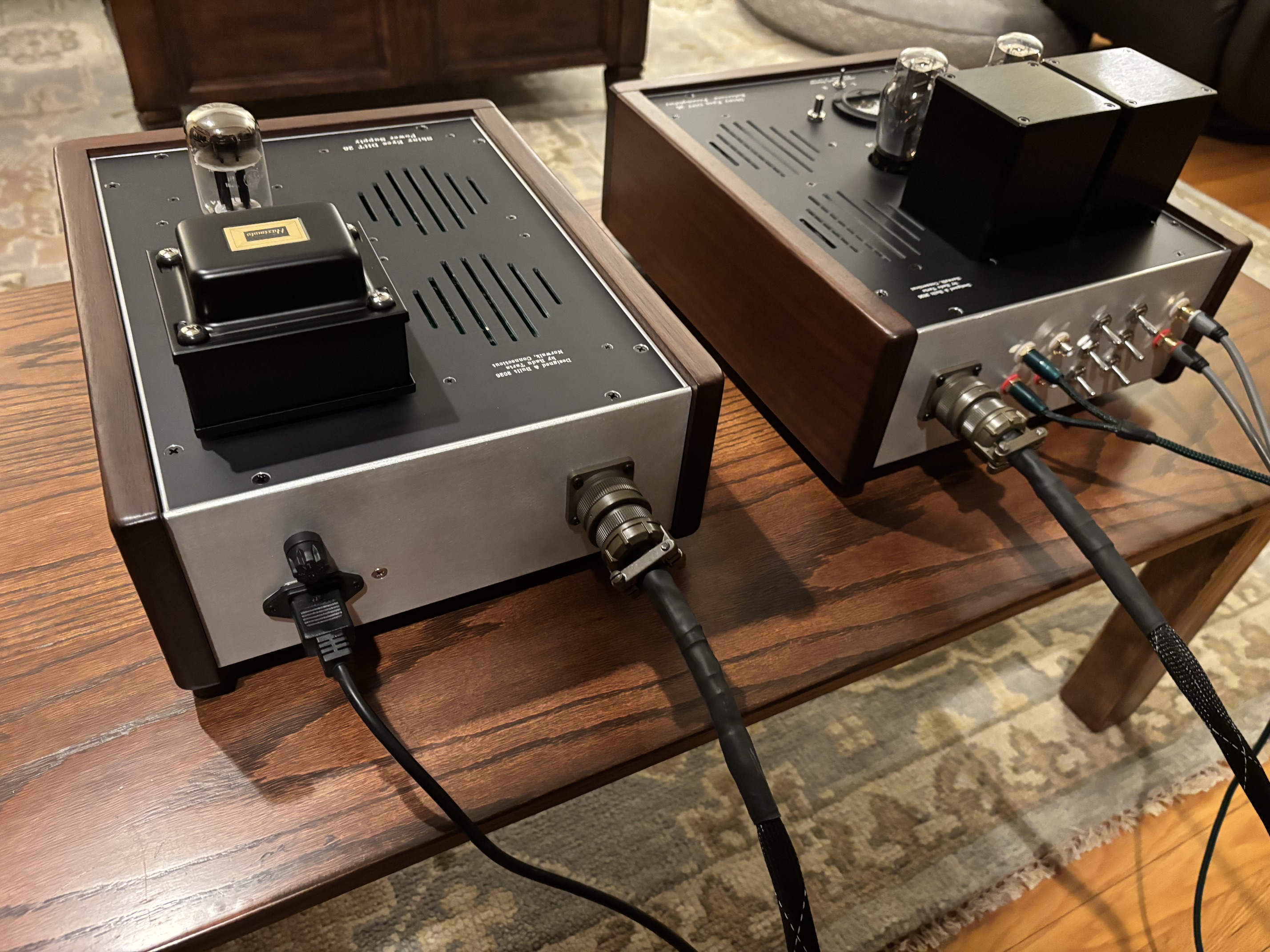
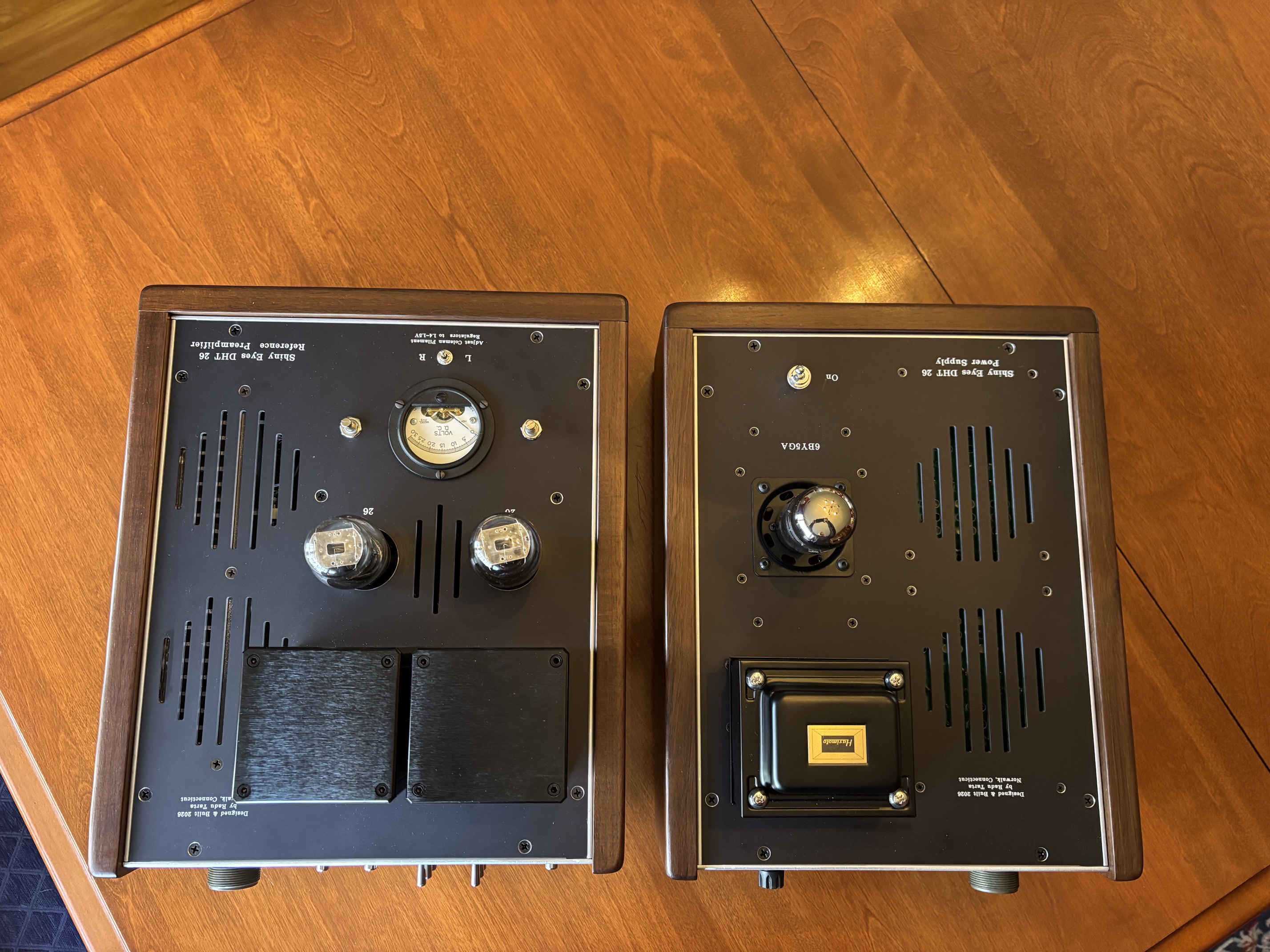
The design utilizes a fully separated dual-chassis architecture, with the power supply housed independently from the main preamplifier section. The custom screened umbilical cable carries DC only, minimizing noise and ensuring optimal isolation from AC radiation — a critical consideration when working with sensitive DHT tubes such as the Type 26.

Special attention was given to achieving ultra-low noise and minimal microphonics. Since Type 26 tubes are highly susceptible to hum and interference from nearby AC fields, the isolated power supply configuration significantly improves performance.

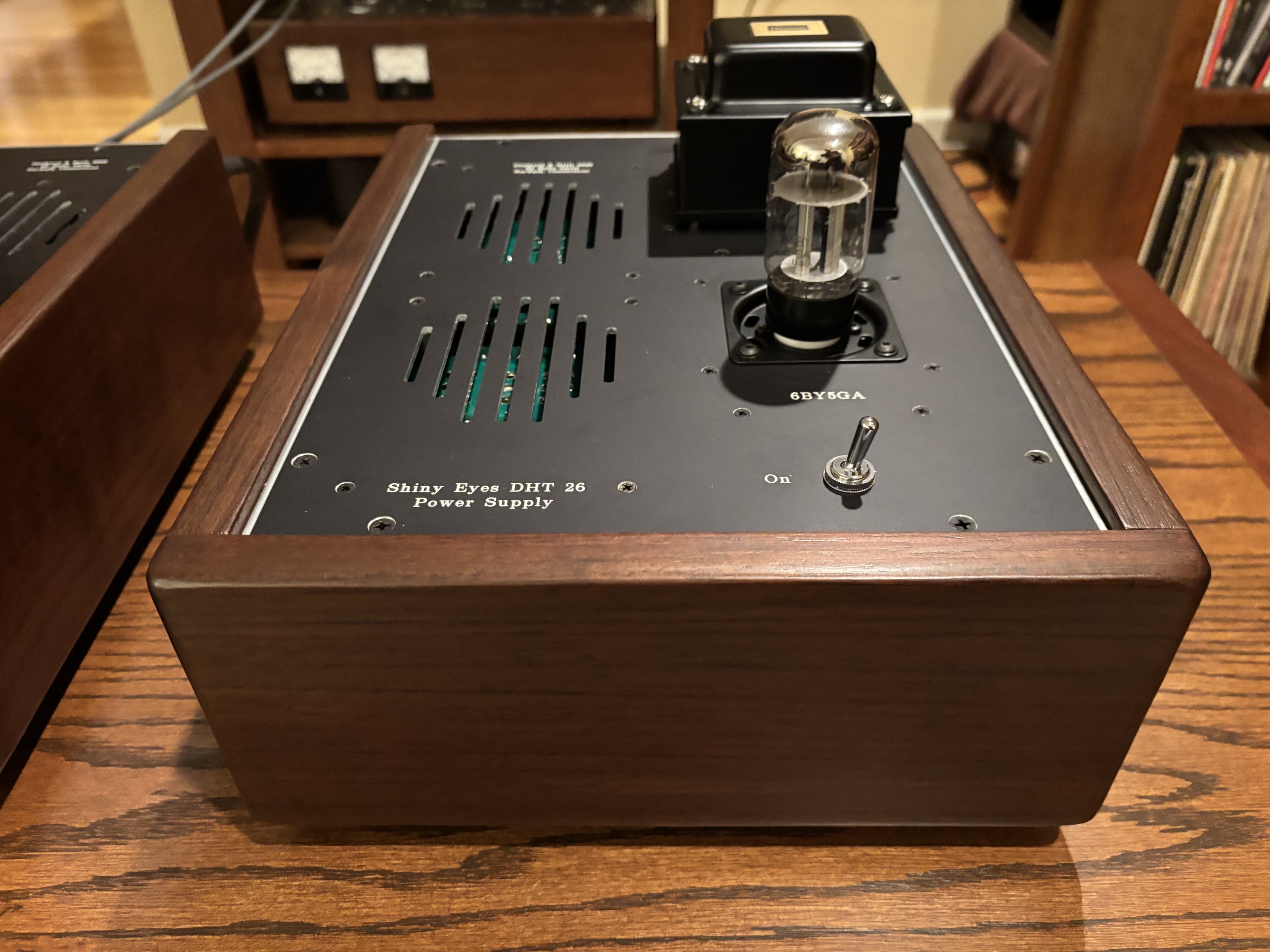
The power supply chassis contains:
• Independent filament supplies for each Type 26 tube
• Regulated DC supply for the remote-control circuitry
• Dedicated high-voltage supply section

Each filament supply employs 40,000uF of filtering capacitance alongside highly regarded Coleman filament regulators operating as constant current sources (CCS). High voltage rectification is handled by a 6BY5GA tube rectifier feeding a CLCLC filter network, followed by a MOSFET shunt regulator capable of reducing ripple to microvolt levels.

Protection circuitry includes:
• One rear-panel 1.5A slow-blow main fuse
• Two independent 0.75A slow-blow filament supply fuses

The main power transformer is a premium Hashimoto unit equipped with an internal thermal fuse for enhanced safety. Because this fuse is non-replaceable, the use of a properly calibrated, high-quality 1.5–1.6A slow-blow fuse is essential to prevent irreversible transformer damage.

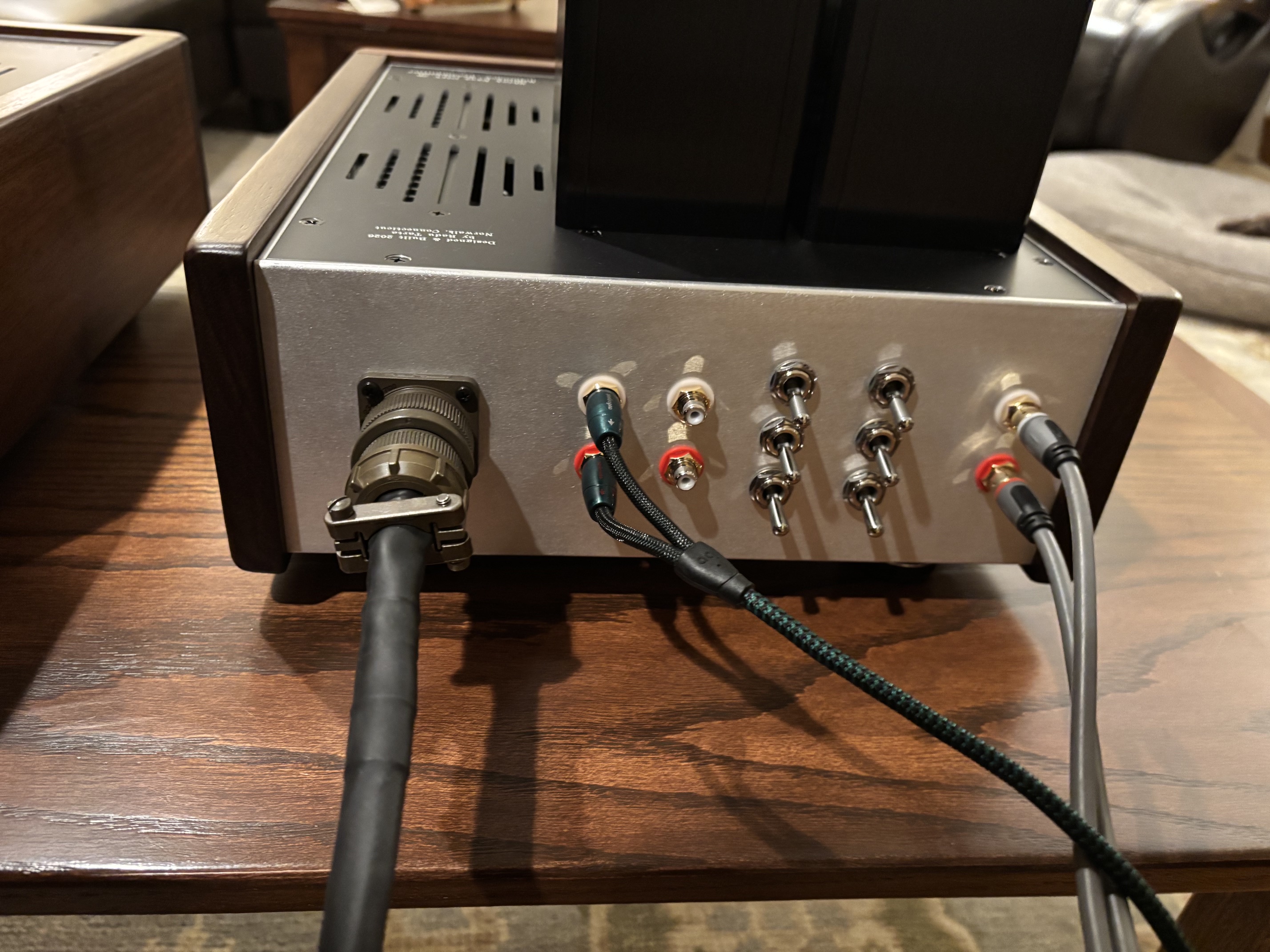
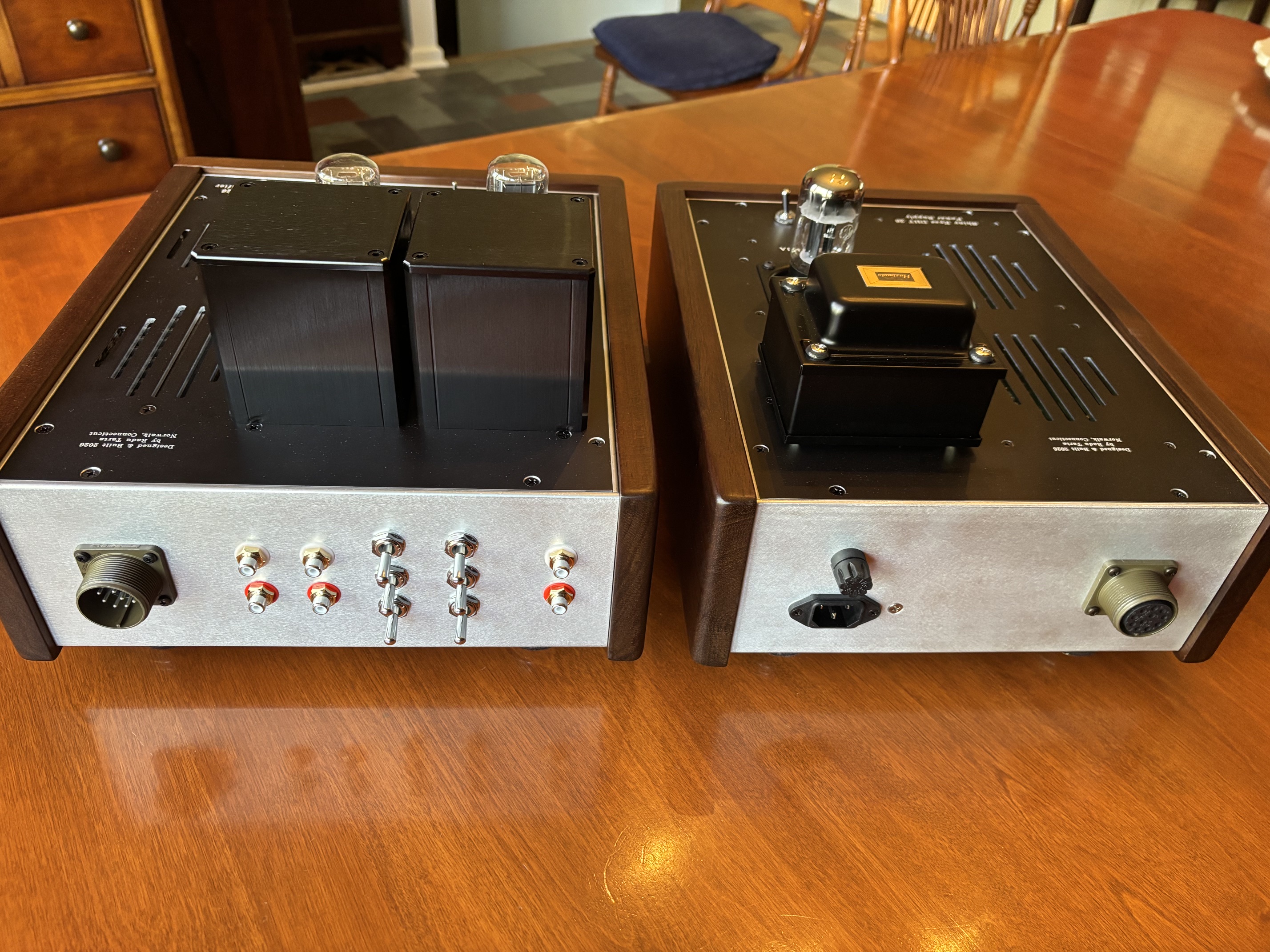
The power supply connects to the preamp chassis via a custom-built screened umbilical cable terminated with military-grade Amphenol connectors. Each connector is uniquely matched to its enclosure to prevent incorrect connection and ensure operational safety.

The main preamp chassis incorporates:
• High-voltage shunt regulator
• Single-stage amplification circuit
• Remote-controlled volume control

The signal path is intentionally minimalist and completely free of coupling or decoupling capacitors. This was achieved through:
• Filament bias topology using a low-value 10-ohm resistor without bypass capacitors
• Lundahl LL2763NC nanocrystalline output transformers

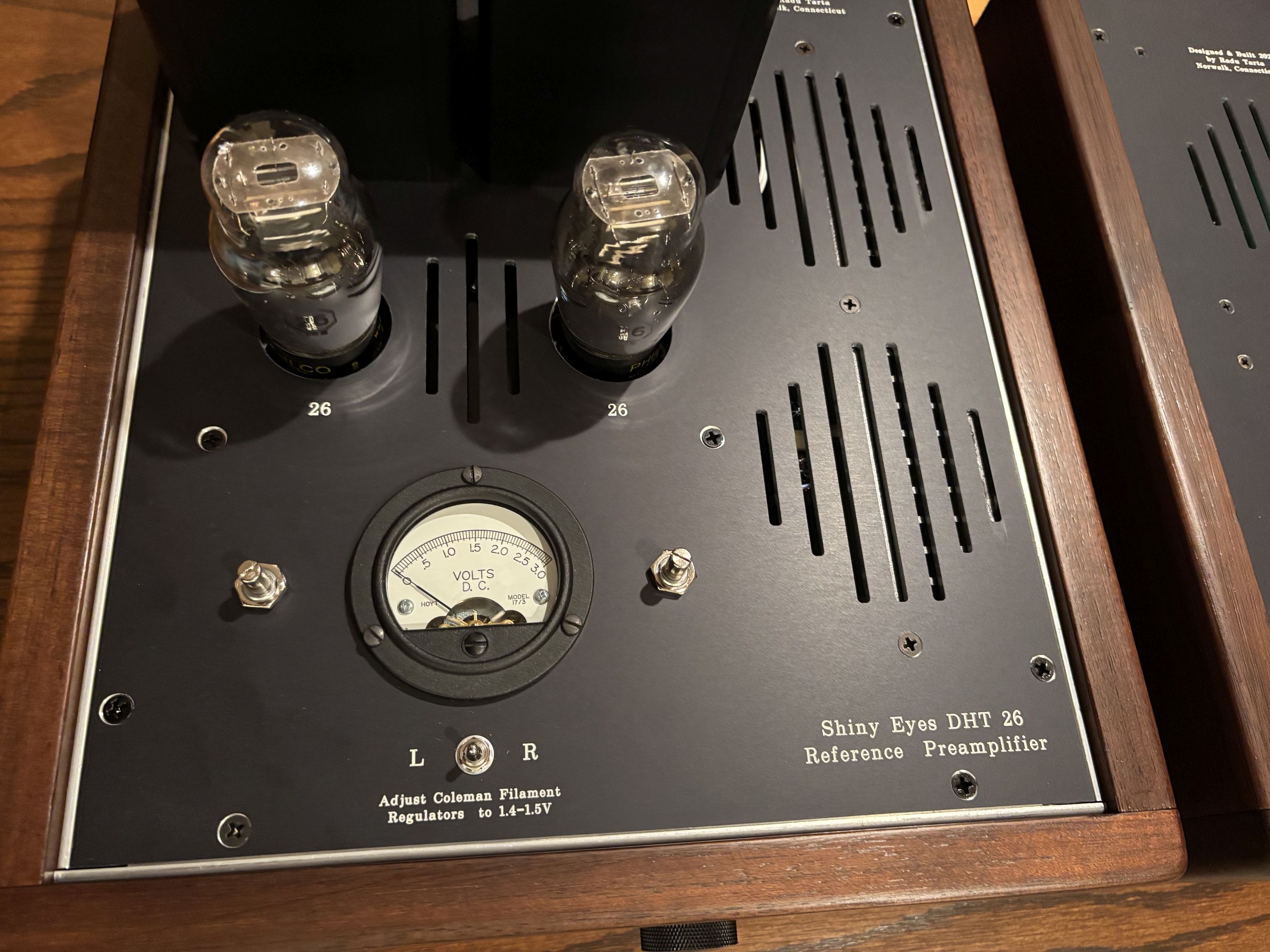
A Hoyt USA analog panel meter monitors filament voltage for each channel via a left-center-right toggle switch:
• Left: left channel measurement
• Center: meter disengaged
• Right: right channel measurement

Precision potentiometers on each side of the meter allow fine adjustment of filament voltage between 1.4V and 1.5V. Lower filament voltage reduces microphonics and may be adjusted down to approximately 1.2–1.3V depending on tube characteristics, while maintaining visible filament glow. A 1.4V setting generally provides the best balance between low microphonics and optimal output impedance.

The Lundahl output transformers feature four secondary windings with selectable gain configurations accessible via rear-panel switches:
• High gain: 12–13dB, 2:1 output ratio, 2400-ohm output impedance
• Low gain: 6–7dB, 4:1 output ratio, 600-ohm output impedance

To further reduce vibration sensitivity, the tube sockets are mounted on a floating sub-plate suspended by four neoprene damping standoffs. Tubes should be inserted and removed carefully to minimize mechanical stress.

Volume control is handled by a motorized TKD CP-2511 high-end potentiometer paired with a Bent Audio remote-control system known for exceptionally quiet operation.

Additional features:
• 1 input / 2 outputs
• Heavy-duty 1/8” aluminum chassis by Landfall Systems
• Custom CNC-machined and anodized top plate by Front Panel Express
• Hand-finished ¾” Peruvian walnut exterior with General Finishes Antique Oil urethane

Performance Specifications:
• THD: 0.02% (predominantly second harmonic) at 2Vrms output
• Frequency response: 30Hz–30kHz ±0.5dB (-1dB at 20Hz)
• Output impedance: 600 ohms (low gain), 2400 ohms (high gain)
• Gain: 6–7dB (low), 12–13dB (high)
• Power consumption: 70W
• Main fuse: 1.5A slow-blow

Dimensions & Weight:
• Main chassis: 19 lbs — 12.5” x 15” x 9”
• Power supply chassis: 22 lbs — 11.5” x 15” x 9”

The result is a preamplifier with a smooth, clean, highly resolving, and remarkably natural presentation.

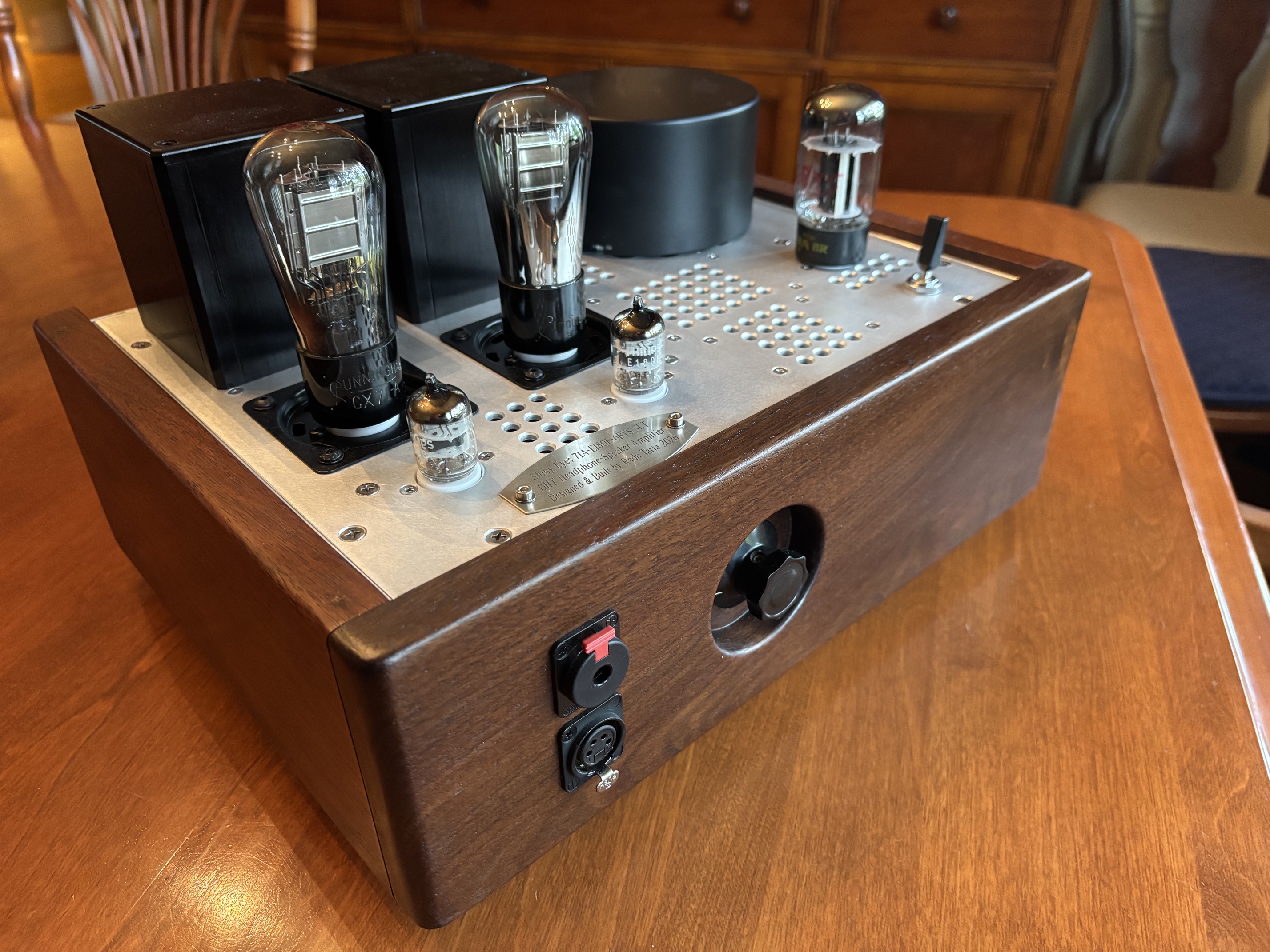
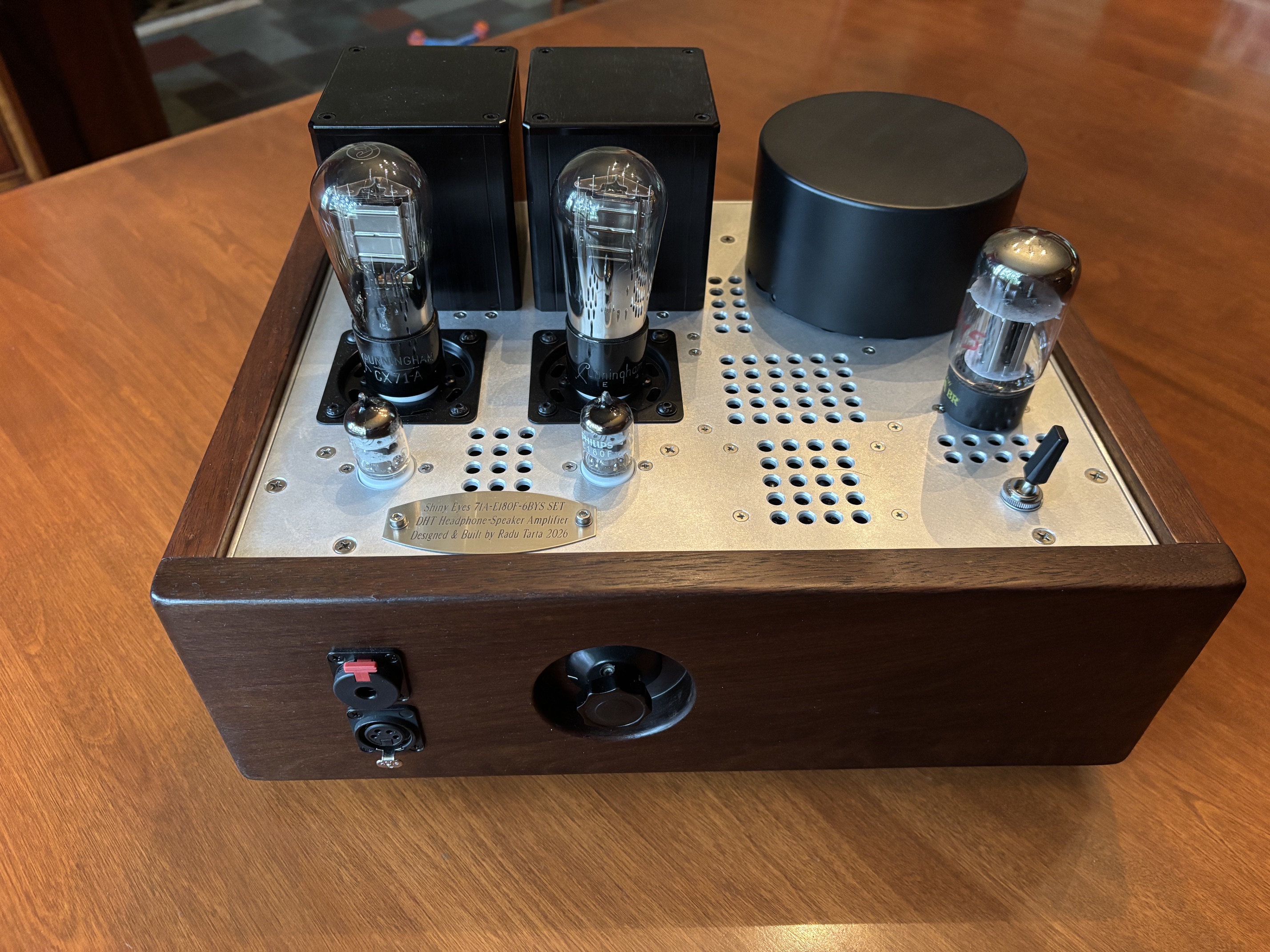
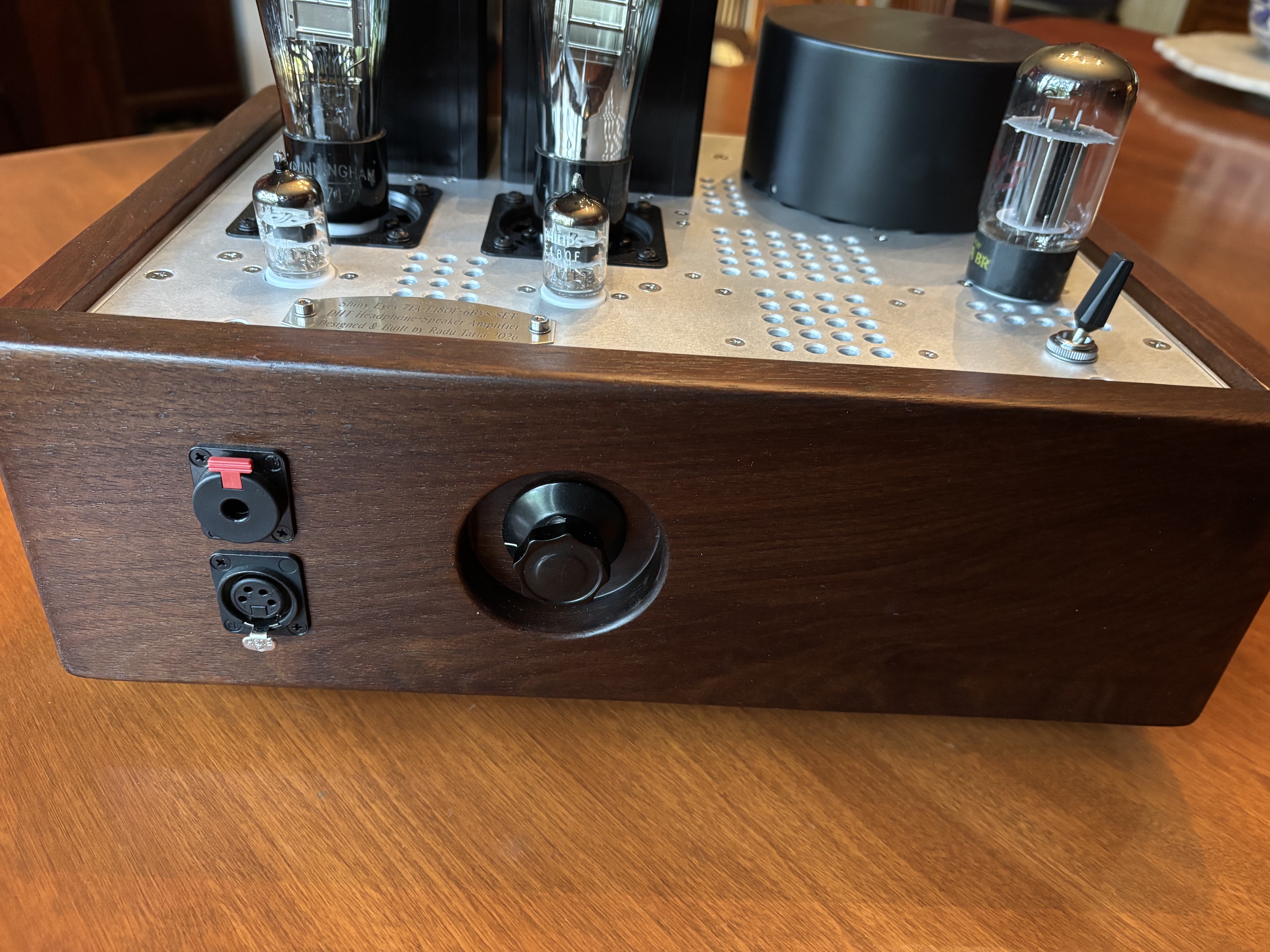
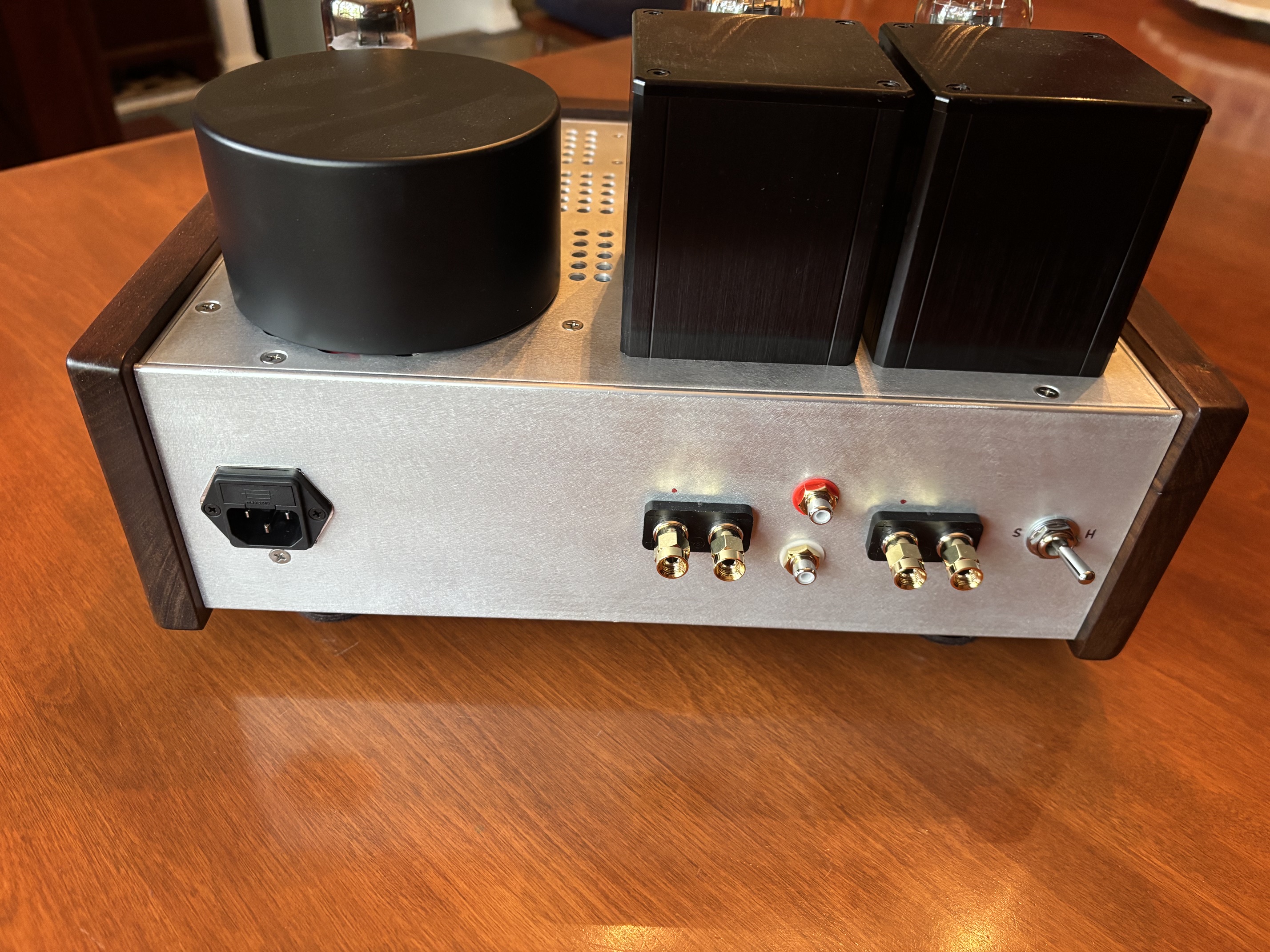
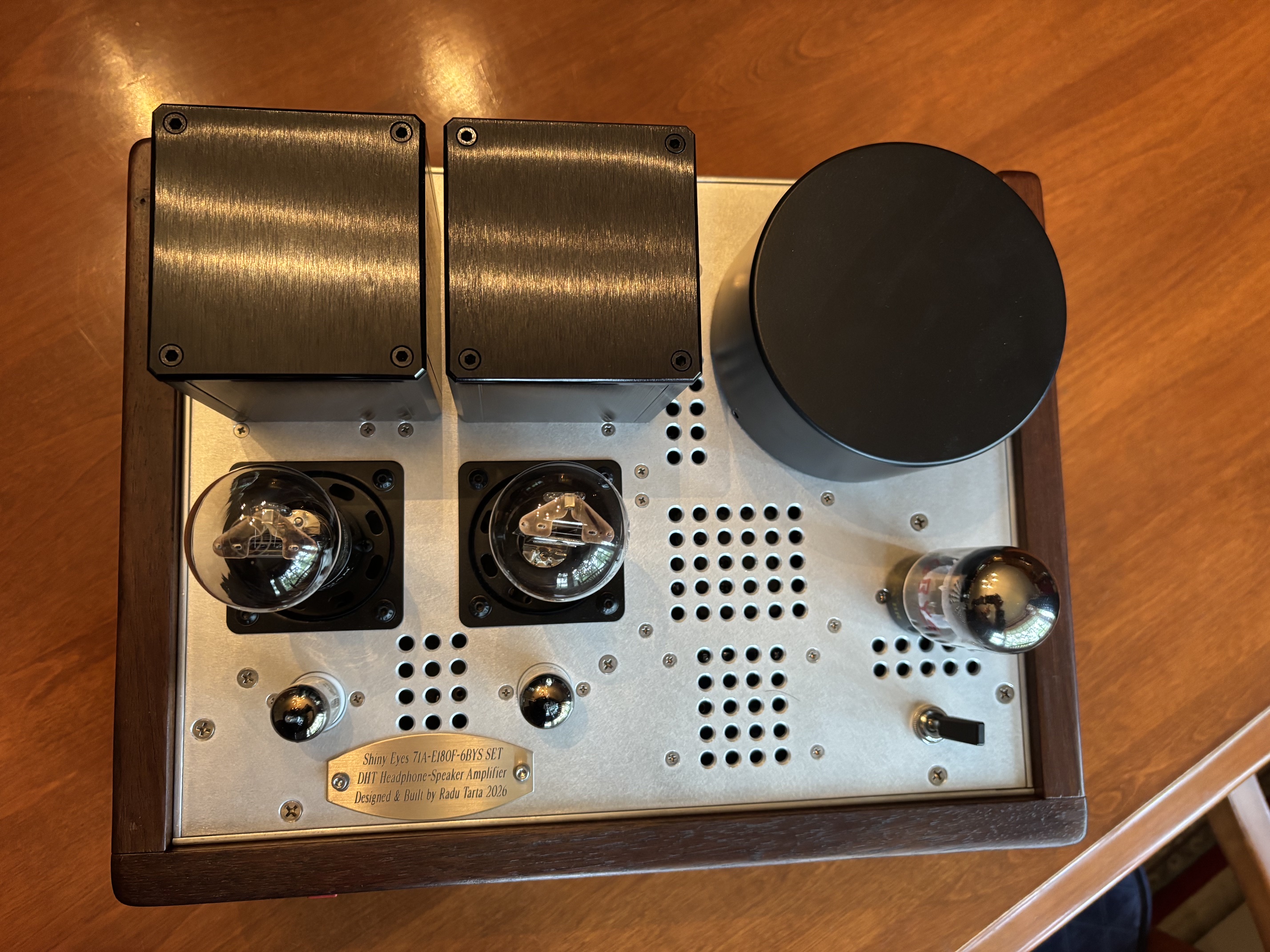
Shiny Eyes 71A DHT Headphone Amplifier – 0.7W of Pure Musicality

I’ve always been drawn to headphones, but until recently, I hadn’t taken the time to fully explore designing dedicated headphone amplifiers. This latest build marks a deeper dive into that passion — and the result is an amplifier that, in my opinion, pairs exceptionally well with the ZMF Atrium.

At its core is the remarkable 71A direct-heated triode — a tube originally developed in the late 1920s by RCA as a low-power output stage for battery-operated radios. Nearly a century later, its character remains captivating.

This amplifier delivers 0.7W through a highly detailed finemet-core output transformer. While primarily designed as a headphone amplifier, it can also drive high-sensitivity speakers with ease. It truly shines with full-range, single-driver speakers without crossovers.

The circuit is configured as an integrated amplifier, using a beautiful NOS Philips E180F driver tube, coupled to the 71A via a Jupiter copper foil capacitor. Volume control is handled by the exceptionally smooth TKD CP2511 potentiometer. The power supply features three separately regulated DC filament supplies, while the high voltage is tube-rectified with CLCLC filtering. The result is an impressively quiet amplifier.

Maximum output is 0.35W into 32Ω, decreasing as impedance rises (for example, approximately 37mW into 300Ω). While 37mW may appear modest on paper, in practice it proves more than sufficient. With the ZMF Atrium, listening levels rarely exceed the 11–12 o’clock position on the volume dial.

Headphone outputs are connected to the 16Ω tap of the output transformer, while speaker outputs utilize the 8Ω tap.

Sonically, the presentation is smooth, delicate, refined, and intimate. It invites long listening sessions across all genres of music — and makes it easy to simply get lost in the performance.

Shiny Eyes 6C33-6SN7 SET Monoblocks

It’s been a while since I wanted to design and build an SET using the famous 6C33 triode. I also liked the idea of having a “winter amp.” It will warm up the room during cold and snowy winter days.

Why monoblocks in this case? I chose to build monoblocks to have better heat management control. In addition, this choice allowed me to maximize the performance of the power supply.

The power supply is made of several blocks:

  1. High voltage for the power tube. This uses an Antek 200VA toroidal power transformer, Sic diode rectified and CLCLC filtered using two, screw terminal, 1000uF/500V capacitors.
  2. High voltage for the driver and gain stage using a separate 30VA power transformer.
  3. Raw negative supply and Coleman fixed bias regulator.
  4. DC regulated supply for the 6SN7 filament.

The signal circuit uses a 6SN7 and 6C33. The first triode of the 6SN7 is a gain stage and the second triode is the driver. They are capacitor coupled to the 6C33, and a -7.5dB GNFB is applied for controlling the distortion and damping factor.
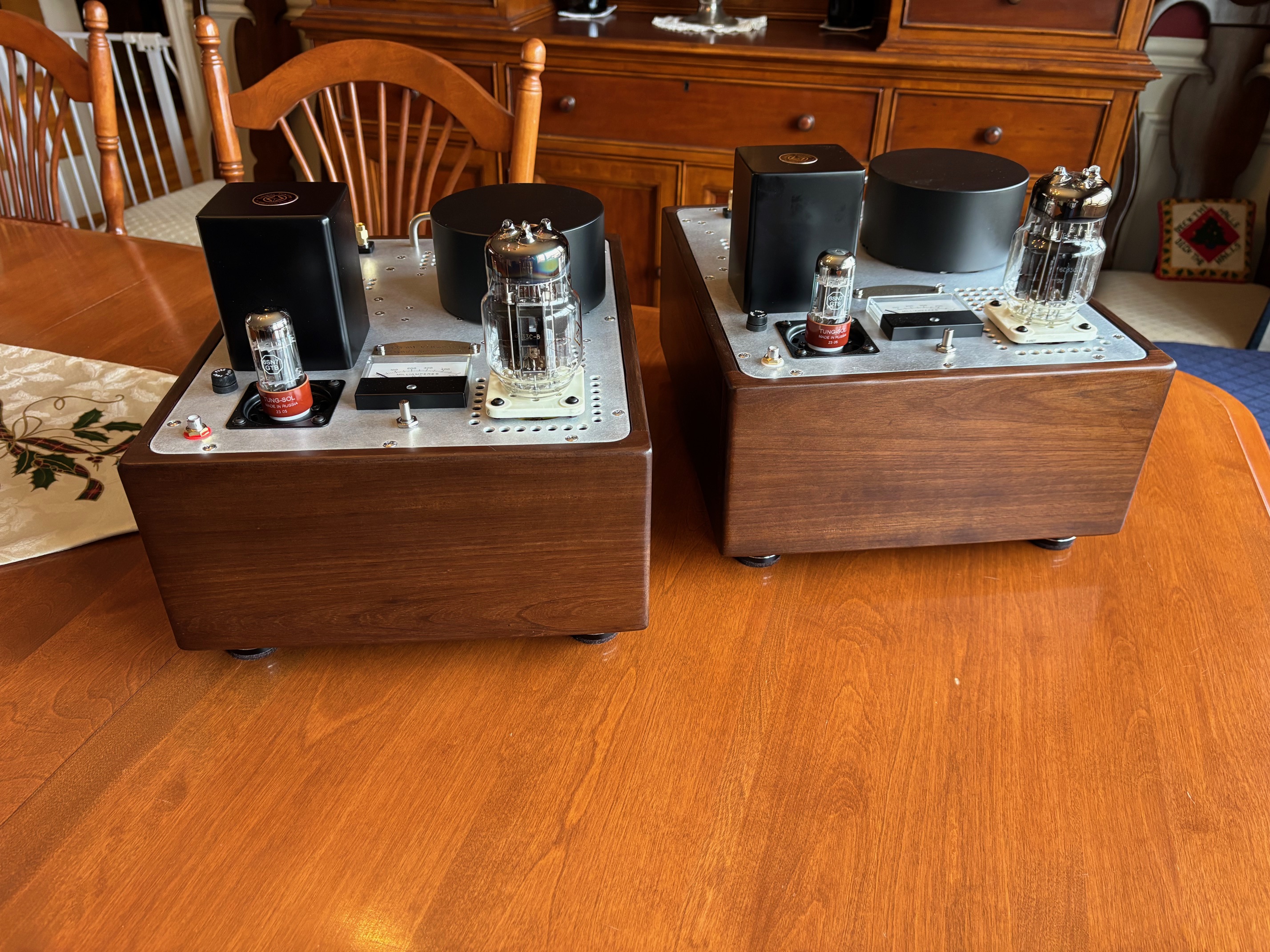
The power triode is loaded on a Hashimoto H-20-600 output transformer for an exquisite sound. The triode has a mixed bias using partially self-bias and partially fixed bias. There is a multi-turn precision potentiometer. A 500mA Hoyt USA panel meter helps adjust the anode current to 200mA.

There is a 135 seconds delay on applying the high voltage to 6C33. That is a necessary practice to protect the power triode from early failure.

All components in the signal path are of high audio quality. The binding posts and RCA are made by Cardas.

Specifications are as follows:

Main Voltage: 120Vac 60 Hz, Power draw: 115W

Main fuse: 3A SB, Anode current fuse: 300mA SB

Max output power 12W

Input sensitivity 0.8Vrms, Input impedance 47kohms

Frequency response: -1dB 20Hz-40kHz

THD: 0.8% at 2 W, 2% at 10W

Damping factor: 5 Size:   12.75x16x11.5 (WxDxH), and 34 lbs

Radu’s Shiny Eyes PSE 4P1L Sublime HP amp and high gain preamp

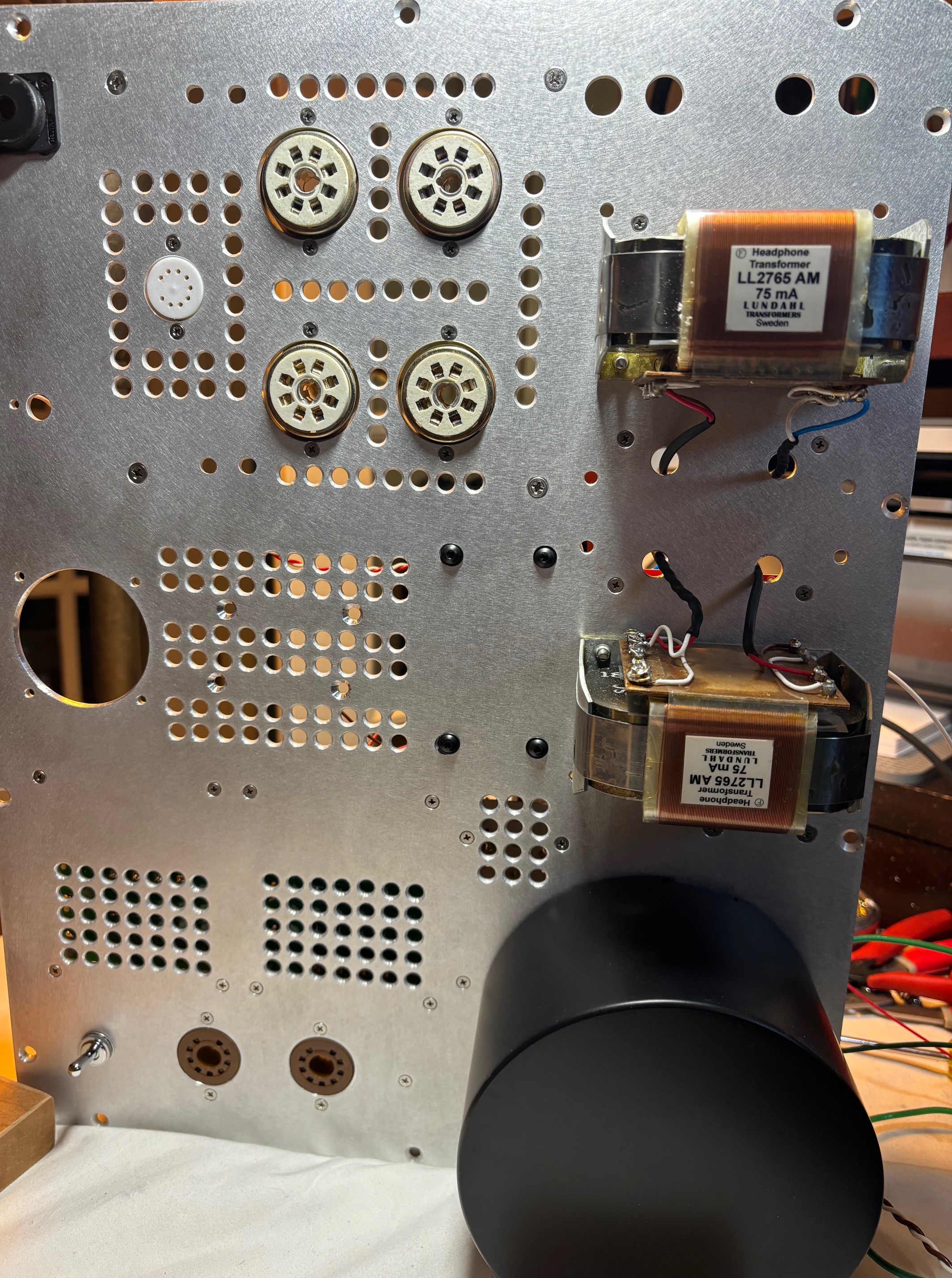
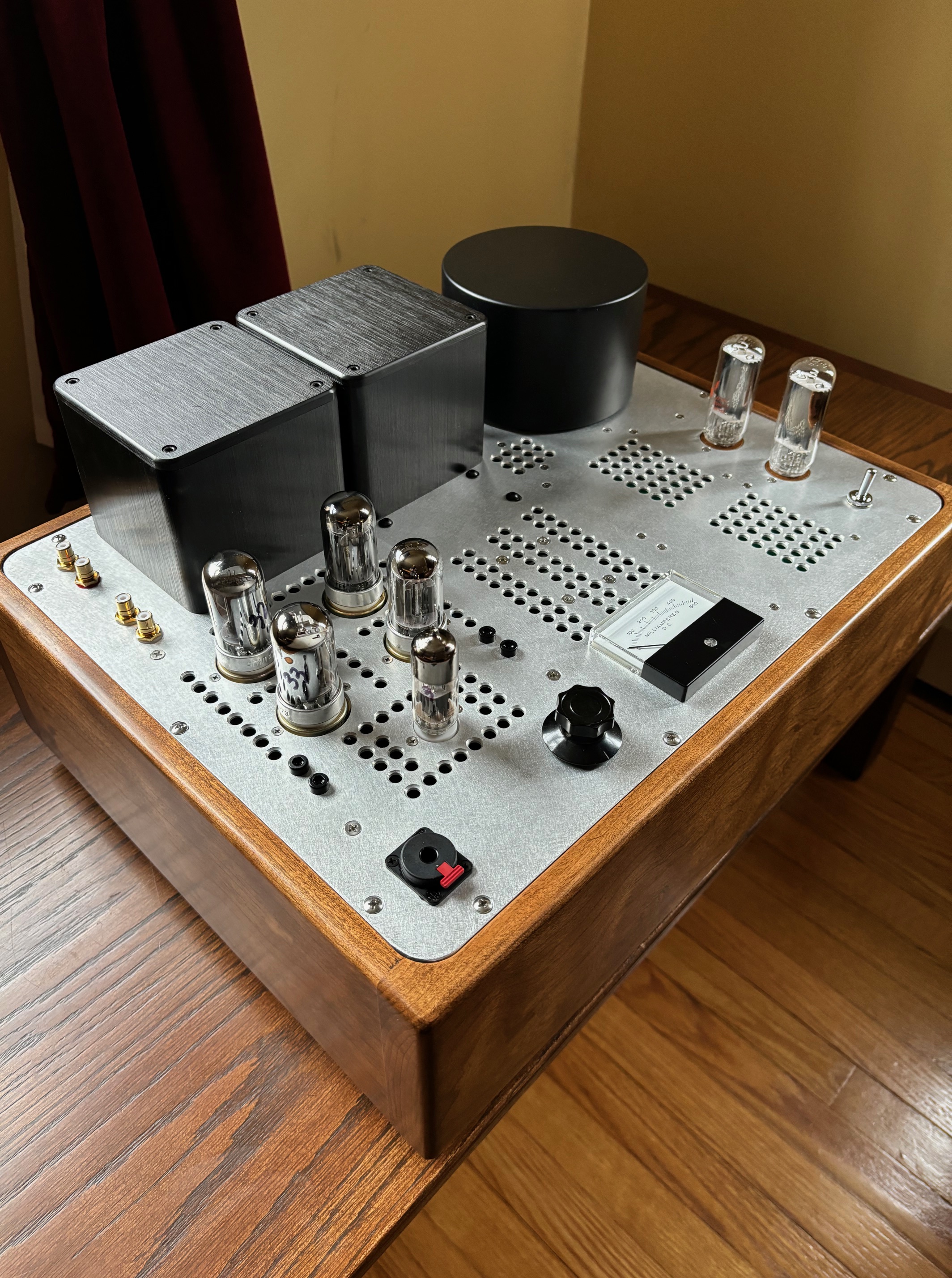
This project started when I found a pair of LL2765/75mA amorphous core waiting to be used. I’ve built a 300B HP amp using these types of transformers. I needed something different. I needed an HP amp that was more versatile and could be used as a high gain preamp and low cost tubes, the power being preferable DHTs. The DHP wired triode 4P1L was the proper tube for this implementation. I’ve been successful building several PSE4P1L amplifiers and tried them on headphones. The result was a very pleasant (2nd harmonic predominant), quick and clean sound. 4P1L in triode mode has quite a bit of input capacitance and 2 in parallel will give the driver about 400pF to deal with. Therefore, the driver must be a powerful one and considering the gain I needed, I chose and tested the 6H30PI and the 6H6P. These are inexpensive tubes and a very good match to the 4P1L. I initially considered a dual chassis HP amp. However, I was confident I can make it quiet in one enclosure, and I did. Despite my efforts to make it as compact as possible, the amp/preamp enclosure is 19.25×15.5×11” ( WXDXH) and weights 45 lbs.

The power supply section takes about 2/3 of the real estate. It has an audio grade 200VA Antek toroidal that powers the high voltage and the DC filament regulator for the driver. There are 2 separate supplies for each of the 2x4P1L filaments and it is regulated by the highly praised Coleman filament regulators. The high voltage is tube rectified, using TV dampers 6CJ3, and CLCLC filtered using Lundahl LL2742 chokes in CMMR configuration for the highest common mode ripple rejection. This power supply provides DC all around and makes this HP amp/preamp very quiet.

The signal section of the amp is very simple. The driver is loaded on a CCS and it is capacitor coupled to the power stage. The power stage is loaded on the Lundahl LL2765AM/75mA and it is self-biased as well as the driver stage. I implemented it with high quality and appropriate type of parts and materials.

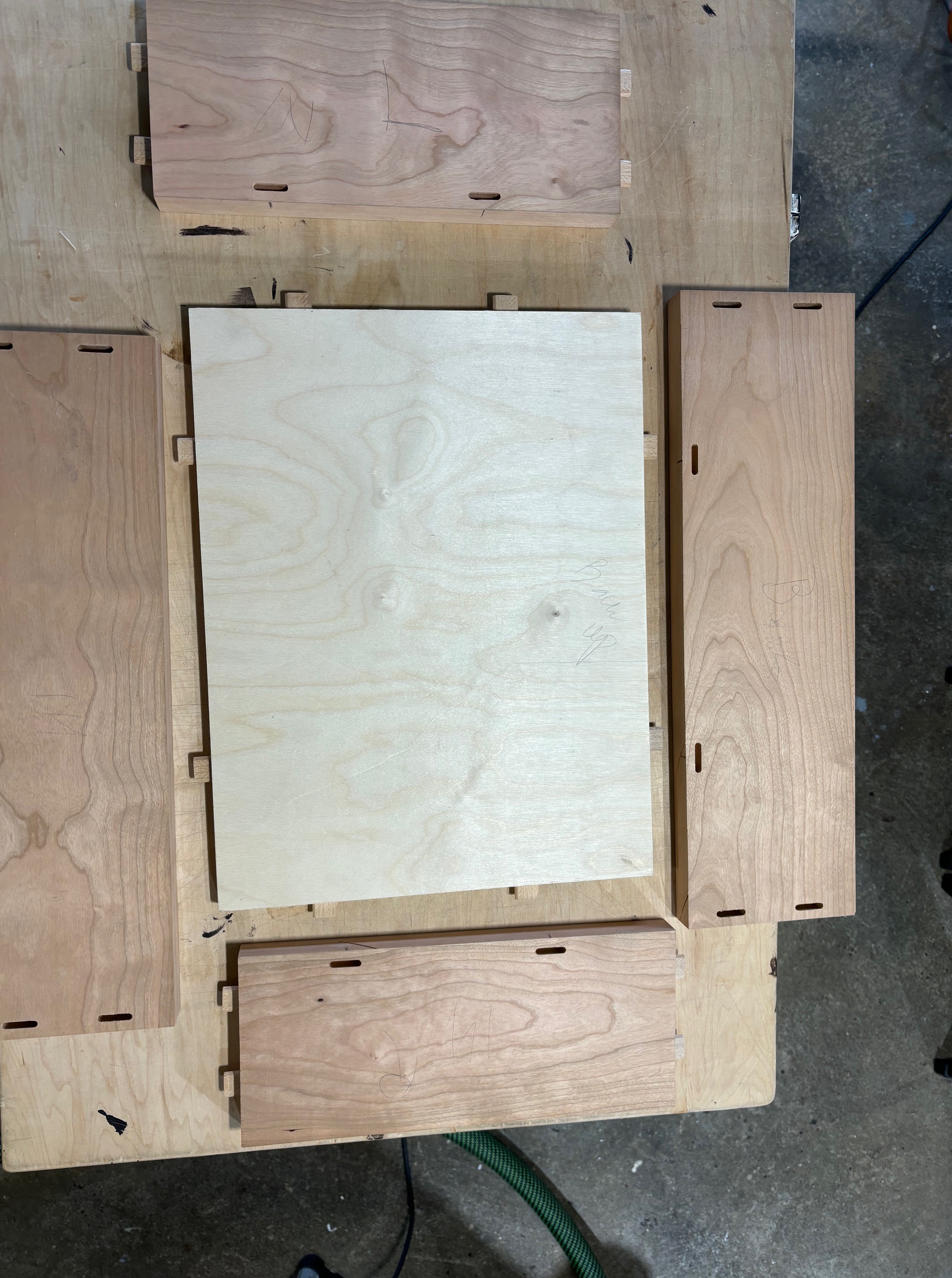
The chassis is made of 5/4” American cherry hardwood stained with General finishes Antique walnut and coated with 5 coats of General finishes oil based topcoat. The top plate is a sturdy 1/8” brushed aluminum that holds all the equipment besides the IEC which is installed on the back of the wood chassis.

The exquisite sound headphone amp is provided with a high Quality Neutrik phone jack. The volume pot is a TKD CP2511 and a 1.5” NOS bakelite knob. There are few features on the top plate:

  • On the left side is the mains On/Off switch
  • In the middle there is a 500mA NOS Hoyt panel meter. This measures the high voltage supply current which should be around 170mA
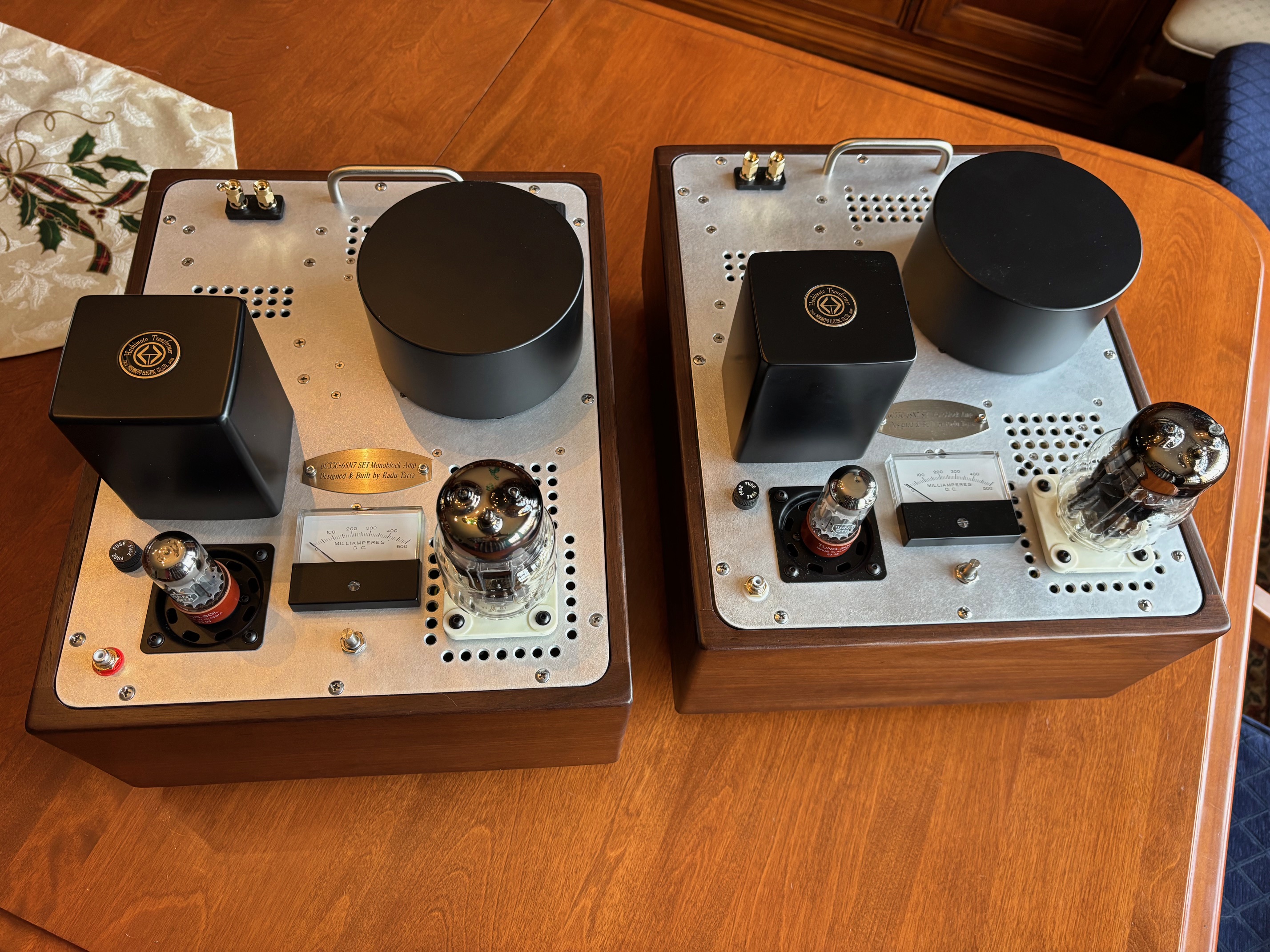
  • On the right side there are 2 sets of RCAs. One in the back is the input and the other the output when used as a preamplifier.
  • On each side of the 4P1L tubes there is a set of tip jack insulated test points. Measuring the voltage (either side) you will basically read the total plate current of the corresponding channel. The voltage in mV corresponds to the current in mA.
The spec measurements of this device showed the following:

  • Maximum output power is 3W on 32 ohms headphones, 0.56W on 120 ohms and 0.22W on 300 ohms
  • The input sensitivity is about 0.9Vrms (6H30PI driver) and 0.6Vrms (6H6P driver) for full power output.
  • Output impedance of this HP amp/preamp is around 7 ohms
  • The frequency response is 20Hz-20kHz +/- 0.5dB
  • The THD is 0.55% at 1W on 32 ohms, 0.81% at 2W on 32 ohms
  • The overall gain is 19dB when using the 6H30PI driver, and 22dB when using the 6H6P driver
  • The max output voltage is 8Vrms
  • Power consumption 130W

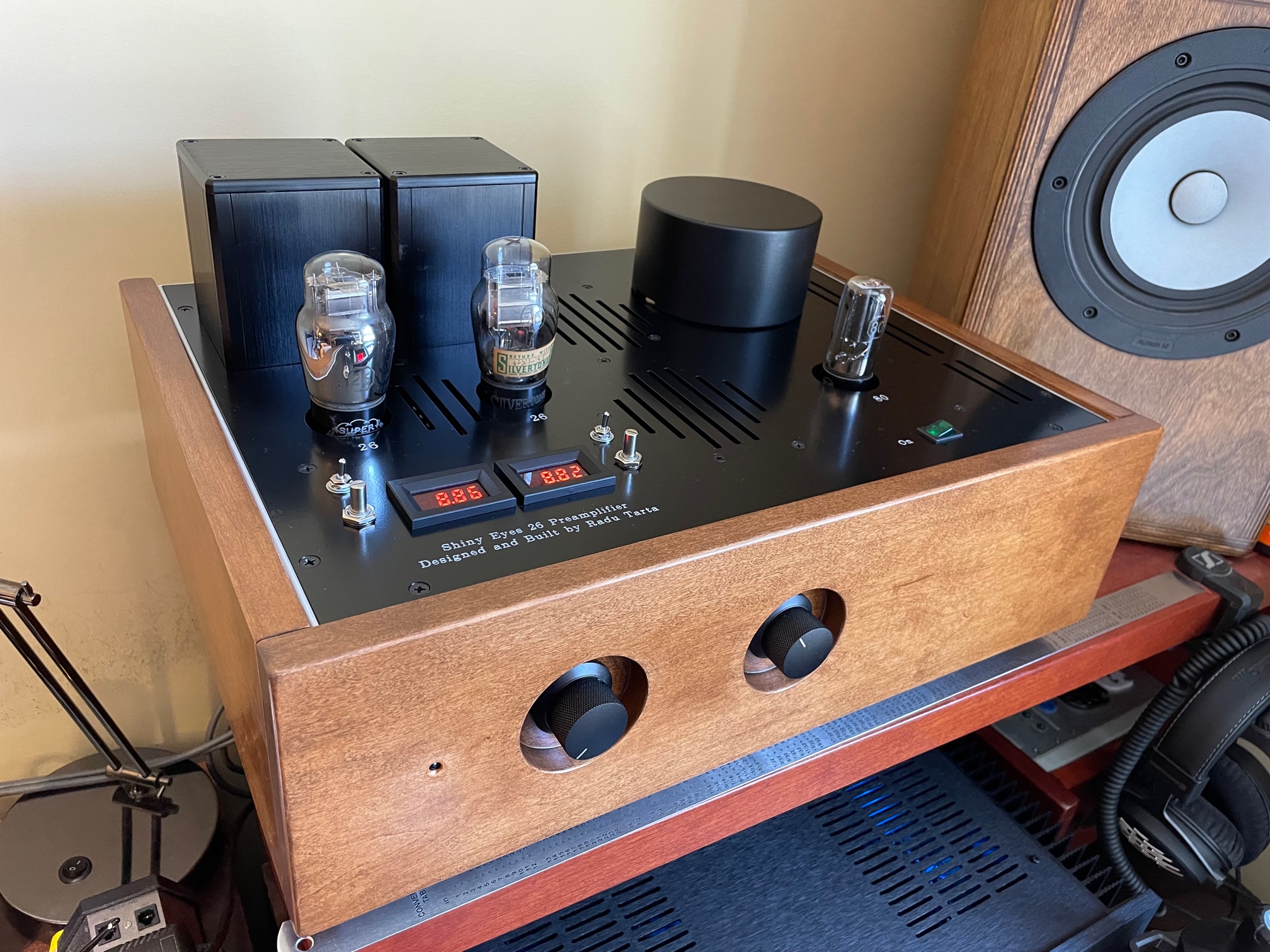
Shiny Eyes 26 DHT Preamplifier

This is a “one of a kind” preamplifier. It uses the 26, an early DHT, capable of a pure sound . Who ever is familiar with the 26 sound can say that it excels in musicality and emotion.

At the demand of the client, the preamplifier was carefully designed in one enclosure. Despite the challenges of a single enclosure DHT preamp, the 26 device is as quiet and as little microphonic as possible. 26 tube is known for picking up noise/hum from proximity to the AC radiating area. I highly recommend a dual enclosure scenario, with a separate power supply. However, if used with low power tube amps that have low to medium overall gain, this preamp will perform great.

The preamp has 2 distinct zones (looking from above): on the right hand side is the power supply zone and on the left hand side is the main signal path zone.

The power supply area is packed with separate supplies for each filament of the 26 tube, the regulated DC for the remote control unit and the high voltage unit. Each 26 tube filament has a raw DC supply using 40,000uF of filtering capacitance per channel, and a much praised Coleman filament regulator. The high voltage supply is using a type 80 tube as rectifier and a CLCLC filter, followed by a special Mosfet shunt regulator that brings the ripple down to uV levels.

The signal path of this preamp is as short as it can be, and free of coupling or decoupling capacitors. That was possible by:

  •  Using filament bias circuit, where the filament is in series with the low value (10 ohms) bias resistor. This resistor doesn’t need to be decoupled. The filament current is adjusted by the Coleman regulator (which is a CCS-constant current source).
  • Using a line output transformer by Lundahl LL2763/7mA

The line output transformers are made by Lundahl in Sweden, and they have 4 balanced secondary windings. There are 3 4PDT switches on the back panel, aligned with the left and right RCAs. If they are all toggled upwards, the gain of the preamp is 12-13dB, and if they are downwards the gain of the preamp is 6-7dB. The high gain position implies a 2:1 output ratio and the output impedance of the preamp is 2200 ohms. The low gain position implies a 4:1 output ratio and the output impedance of the preamp is 600 ohms.

The input of the preamp is DC coupled using a motorized Alps Blue Velvet remote control by Bent Audio. This is a high quality, super quiet remote.

The preamp is provided with 3 inputs switched by a high quality Seiden selector switch made in Japan.

The enclosure is a very sturdy 1/8” thick aluminum chassis by Landfallsystems.

The top plate is custom CNCed and anodized at Front Panel Express. The sides and front are wrapped with ¾” American cheery hardwood that was stained with General Finishes Antique walnut gel stain and coated with 4 layers of oil based urethane.

The preamp will sound smooth, clean and clear sound with 0.05% THD second harmonic predominant at 2Vrms output.

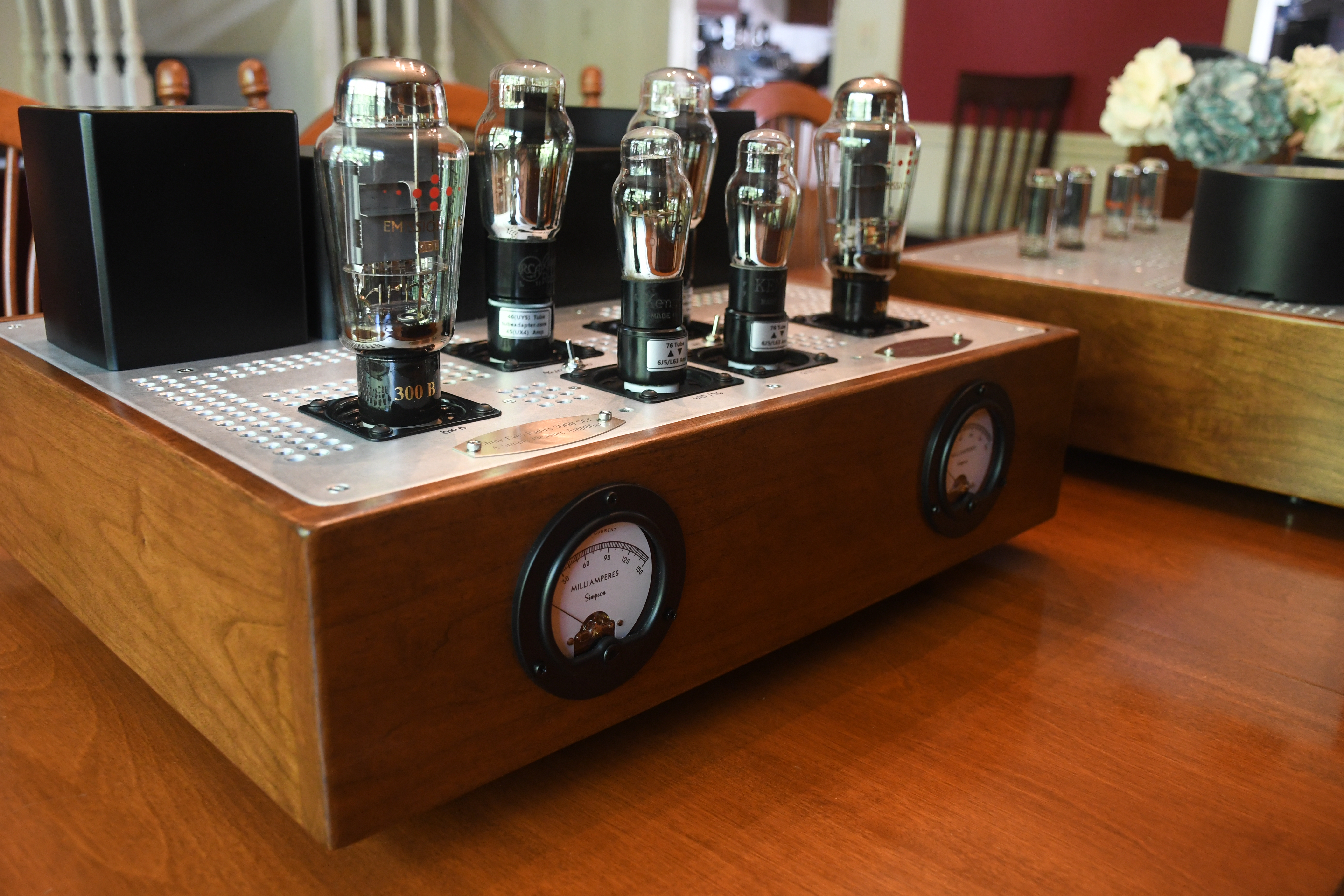
Shiny Eyes Radu’s 300B SET—a Simple Pleasure Amplifier

I designed this amp for whoever needs a single amplification device. You can use it with a passive preamp, AVC/TVC recommended, but not absolutely necessary. A good stepped attenuator ( remote or not) will perform excellent too.

This amp is a delight for tube rollers. However, my intent was to offer many choices of appropriate drivers for a better sounding 300B amp. The amplifier is a 3 stage one, having the 300B as power stage, loaded on a Hashimoto H-30-5S. The driver stage has a 4 pin socket to use with the 45 tube, or an 5 pin to 4 pin adapter to use with either 46 or 47 in triode mode. The driver is loaded on a LL2753/30mA and has a switch to toggle between the 45 and the 46/47 drivers. The first stage is a gain stage and has an octal socket for use with the 6J5, or a 5pin to octal adapter for using the 76 super triode. As one can see, there are many combinations possible with the hope that one will find their preferred sweet spot. Sure enough certain combinations will not provide full gain to use with a passive volume control, and a preamp with gain will be required.

This amp was designed to give as low distortions as possible and keep the 300B plate dissipation low enough so the tubes will last along time.

The amp is providing clean 6W. The input sensitivity, worst gain case scenario (76-45-300B) is 1.7Vrms, and best gain case scenario (6J5-47-300B) is 0.34Vrms. The output transformers have 4-8-16 ohms taps so any options can be wired. Having a 5Kohms primary, one can always use 4 ohms speakers on the 8 ohms tap or 8 ohms speakers on the 16 ohms tap and get almost double the power for a bit higher level of distortions. I tested the amp on 4 ohms Buchard S400 MKII used on the 8 ohms tap and is sounds as good as it can be. Sure enough more sensitive full range speakers will be a better match to a low power DHT amp.

The amplifier has 2 enclosures and 2 umbilical cords between the power supply and the main amp. Each enclosure has two nice looking Simpson panel meters. The power supply meters show the high voltage on each channel. The main amp meters show the plate current of the 300B on each channel. These meters are coming in handy to show the proper operation of the amp. Any problems will reflect on these meters indication.

The power supply is dual for the high voltage ( see two toroidal 200VA transformers and two sets of 6CJ3 rectifiers) having a CLCLC filtering using 4 pole Mundorf HV+ capacitors. There are 5 independent low voltage regulated supplies to provide power to all filaments. Therefore the umbilical cords are carrying DC only. The way is designed this amp is super quiet.

This amp is built with lots of TLC and provide an exquisite sound when using the appropriate speakers.

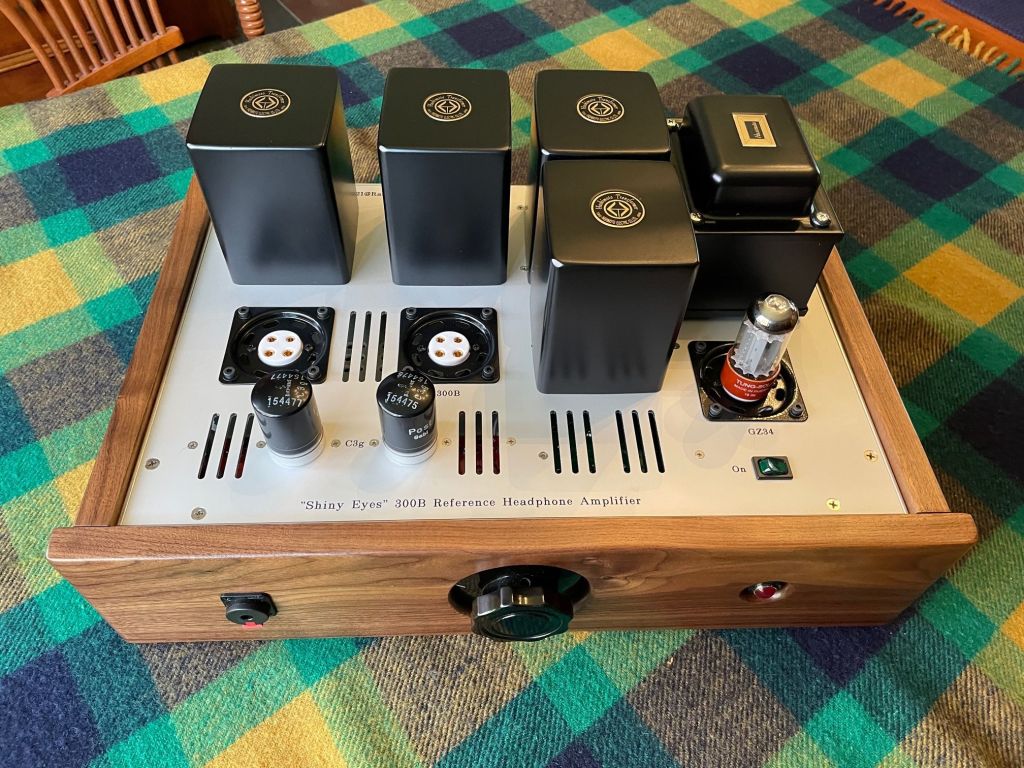
End-game DHT Headphone Amp

Description

This is a high end, 300B low power headphone amplifier with a 32 ohms output at max 6.75W. It has also 8 ohms speaker output which makes it a versatile amplifier.

The amplifier is uses all Hashimoto transformers and chokes, and it is assembled on a sturdy, high quality, 1/8″ aluminum made by Dave at LandFallSystems, and wrapped on walnut front and sides.

 The amplifier has a vintage look which it is emphasized by a large Bakelite knob and an aircraft dimmable Dialight red panel indicator.

This amplifier was designed with TLC in order to provide best out of the 300B tubes. It is a single ended design and consequently the sound is pleasant, detailed and easy to listen for long hours, with a predominant second harmonic.

The power supply has a powerful 5AR4 or GZ34 rectifier, followed by a CLCLC filtering using two Hashimoto 10H chokes, and two 4 poles Mundorf HV+ high fidelity capacitors. There are 3 separate 6.3Vdc regulated supplies for the 300Bs and C3g tubes, an excellent choice for zero hum. The filament supply for the 300Bs is using super regulators from Belleson.

The audio section of the amplifier uses the C3g pentodes in triode mode loaded on a cascode CCS for minimal distortions. The C3g is used as gain stage/ driver and it is capacitor coupled to the 300B, using two excellent MiFlex KPCU copper foil Poly/Paper in oil capacitors. The final/power stage is using the 300B self-biased using Mills resistors and Mundorf Mcaps capacitors. The 300B is loaded on a specialized Hashimoto headphone transformer.

All the small parts are audio grade and tested for the best sound. I used Takman Rex, Takman Rey, Mills, AMRG, Vishay Milspec and 5W Kiwame for the supply bleeders.

The amplifier is integrated with one RCA and one XLR input, and the volume control is a ladder type TKD CP2511 potentiometer, which is very smooth and clean sounding.

The XLR is transformer coupled to the RCA, using a high quality Jensen JT_11P-1 line input transformers. There is a switch provided to allow using either the RCA or XLR input. The XLR inputs have a ground lift switch which is recommended by Jensen technical stuff to keep it on lift position.

The bottom plate has over 100 holes for natural convection and 4 custom feet using wood and vibration isolators.

The amplifier delivers 6.75 maximum on 32 ohms (14.7Vrms), 4.3W on 50 ohms, and 1.8W on 120 ohms and 0.86W on 250 ohms headphones.

The amplifier will also deliver maximum 6.75W on 8 ohms speakers. There is a switch provided to use either speakers or headphones. However, depending on the grounding scheme of the audio chain it might have no audible effect.

Specifications and measurements

The following measurements are only to give you a sense of the approximate performance. I used a computer software and interface and this comes with some artifacts and noise that are not present when the amp is connected in an audio path. One, if owns high quality audio analyzer, can take more precise measurements

  • Input impedance RCA : 50kohms, unbalanced
  • Input impedance XLR : 13kohms, balanced
  • Frequency response: 20Hz-20kHz @ –0.5dB
  • Input sensitivity: 0.44Vrms at 1.1W power output
  • Max Input sensitivity: 1.12Vrms at 6.75W power output on 32 ohms
  • Gain max 22.5dB (13.3x)
  • AC voltage 120V, 50/60Hz
  • Dimensions: 19.25″x14″x10″ (W x D x H)
  • Weight: 55 lbs.
  • Main fuse 3A slow blow

Lead time: 3-4 months.

Please email me to discuss details at : simplepleasuretubeampsRCT@gmail.com

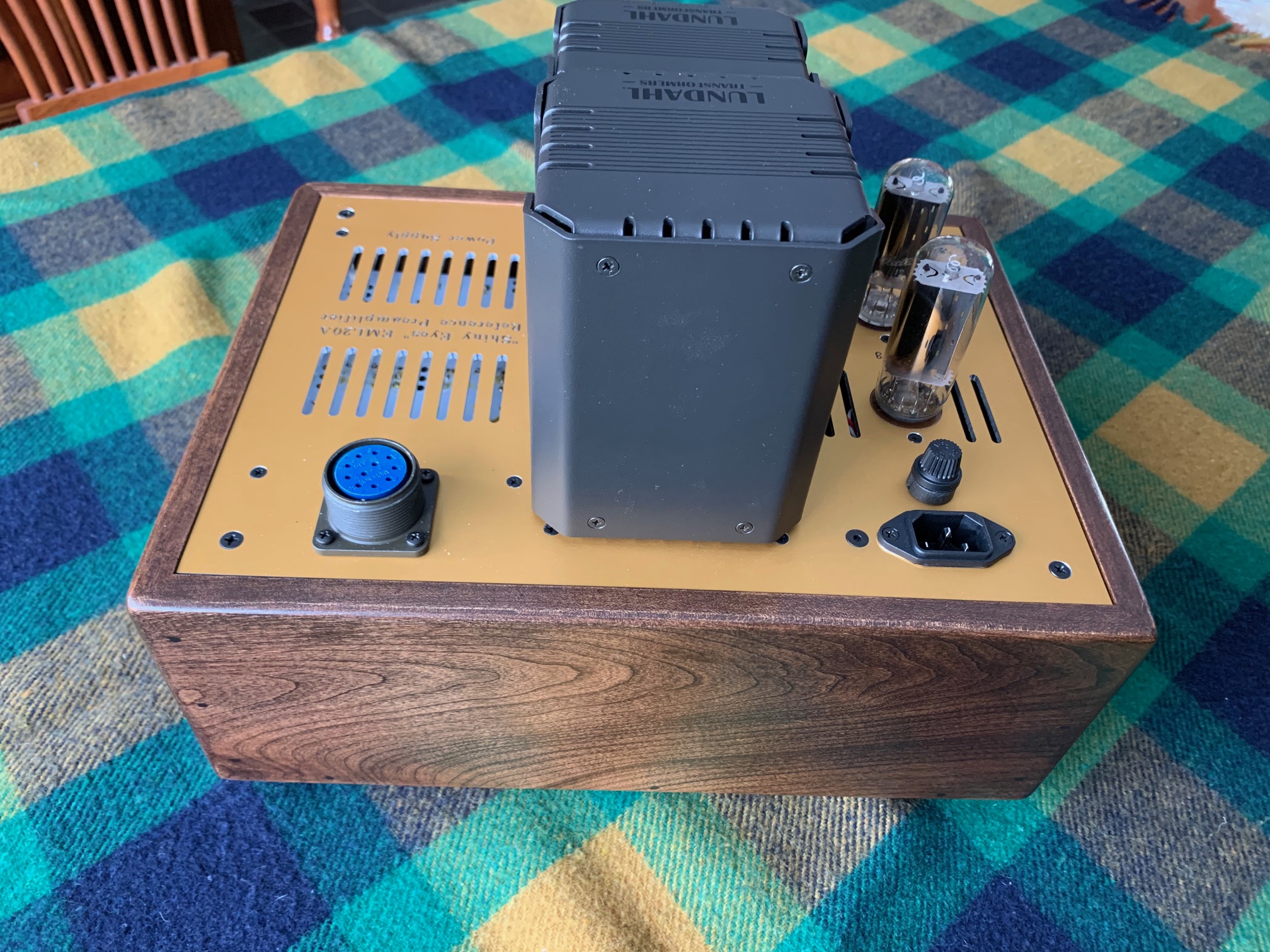
Shiny Eyes EML20A Preamplifier

The EML20A is an excellent choice for a single stage preamplifier that can satisfy the most exigent audiophile. This DHT has enough gain to use it with line output transformer and it is indeed, as stated by Emission Labs, one of the lowest distortion tube ever built.

The preamplifier has a separate power supply, which is a great practice inn order to make a quiet DHT preamp.

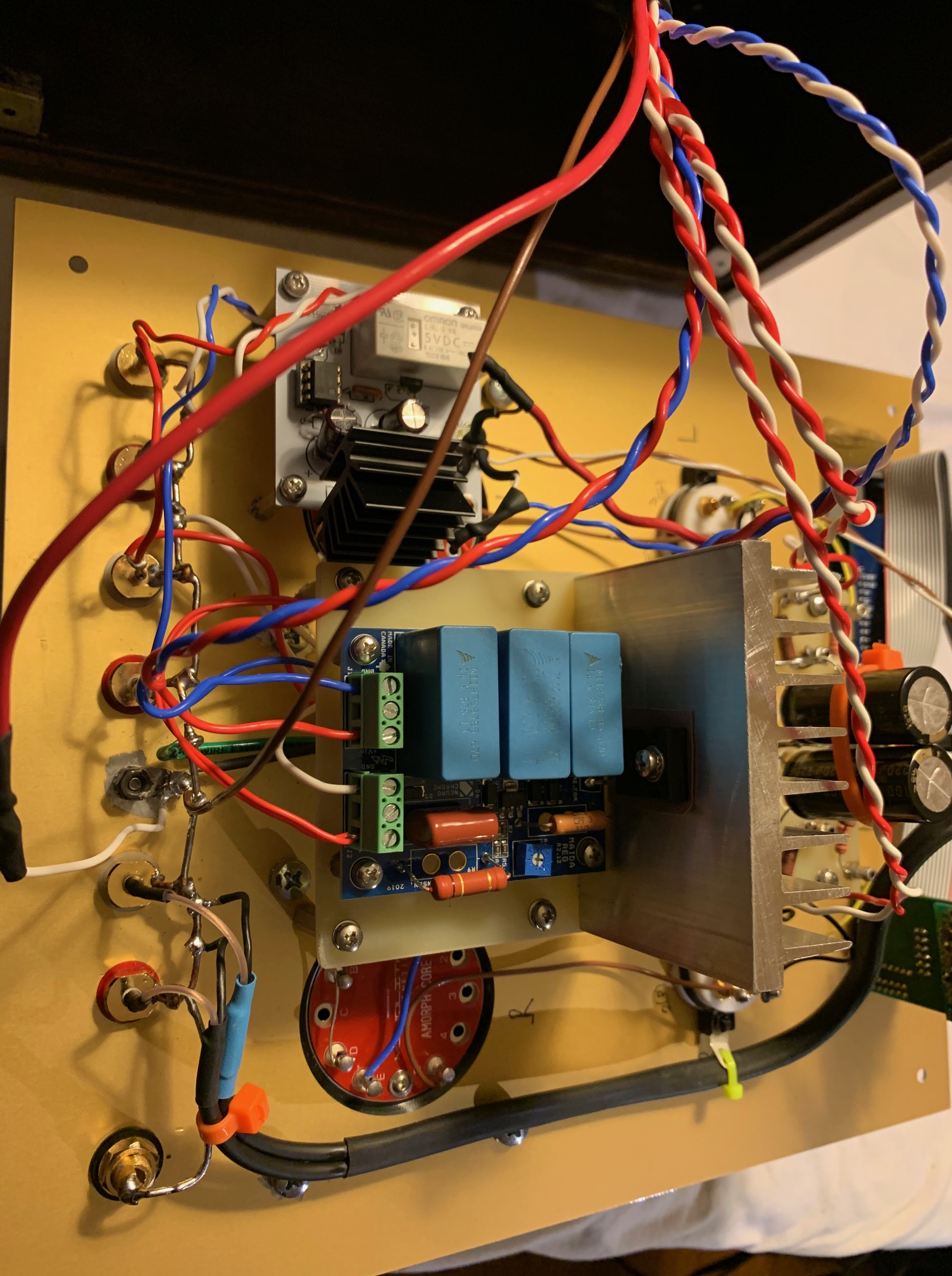
The power supply uses all Lundahl power transformers and chokes for the high voltage section. It is a CLC  supply with the Ludahl chokes in common mode for lower noise. The rectification is hybrid, using two TV dampers 6CJ3 on the positive and SiC 1200V on the negative.

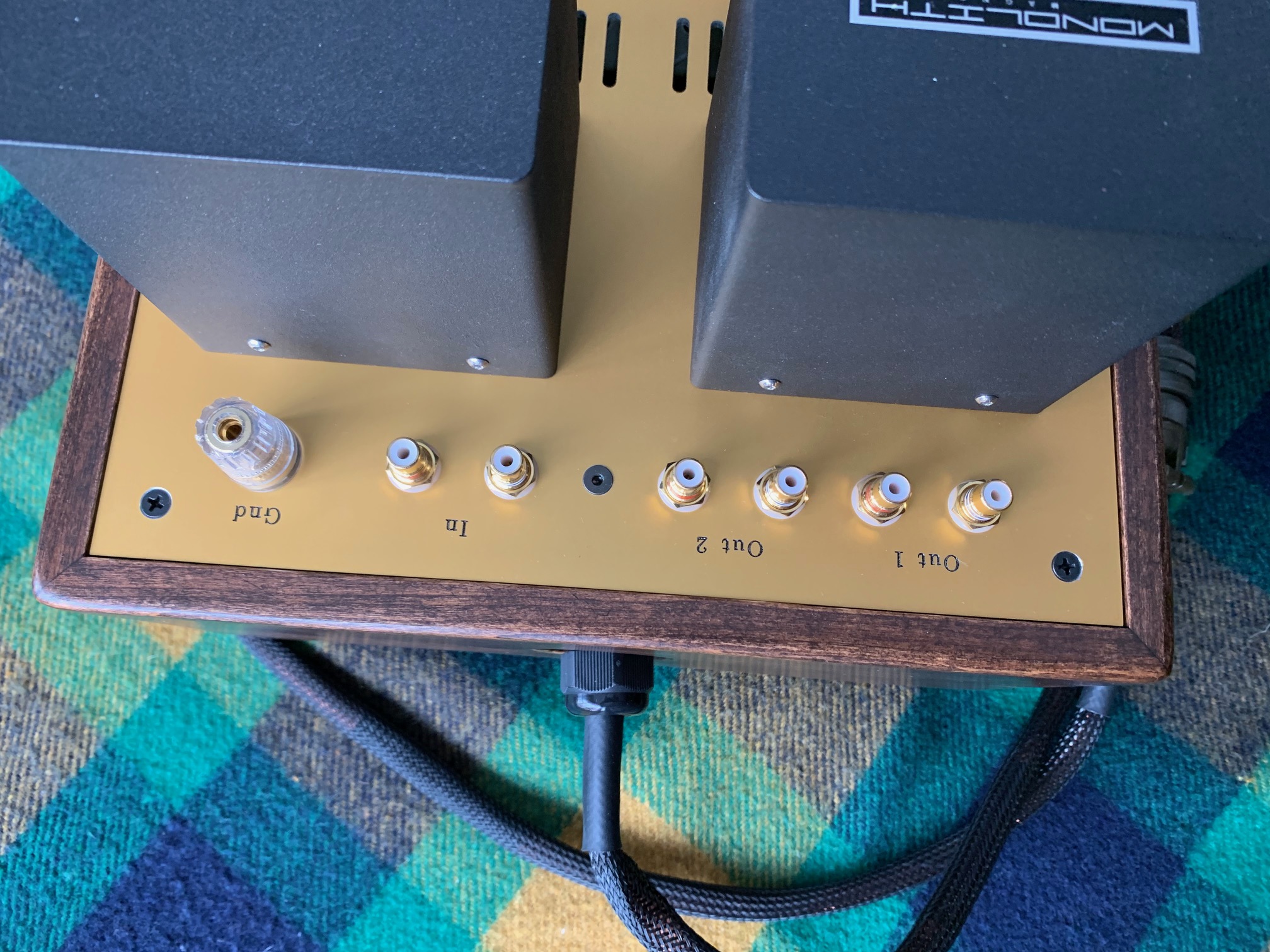
The power supply is connected to the main preamp chassis through a 6 feet umbilical cord using a MIL spec Amphenol connector. The umbilical cord is carrying only DC and it is screened with copper mesh, which a good practice to have a good S/N ratio.

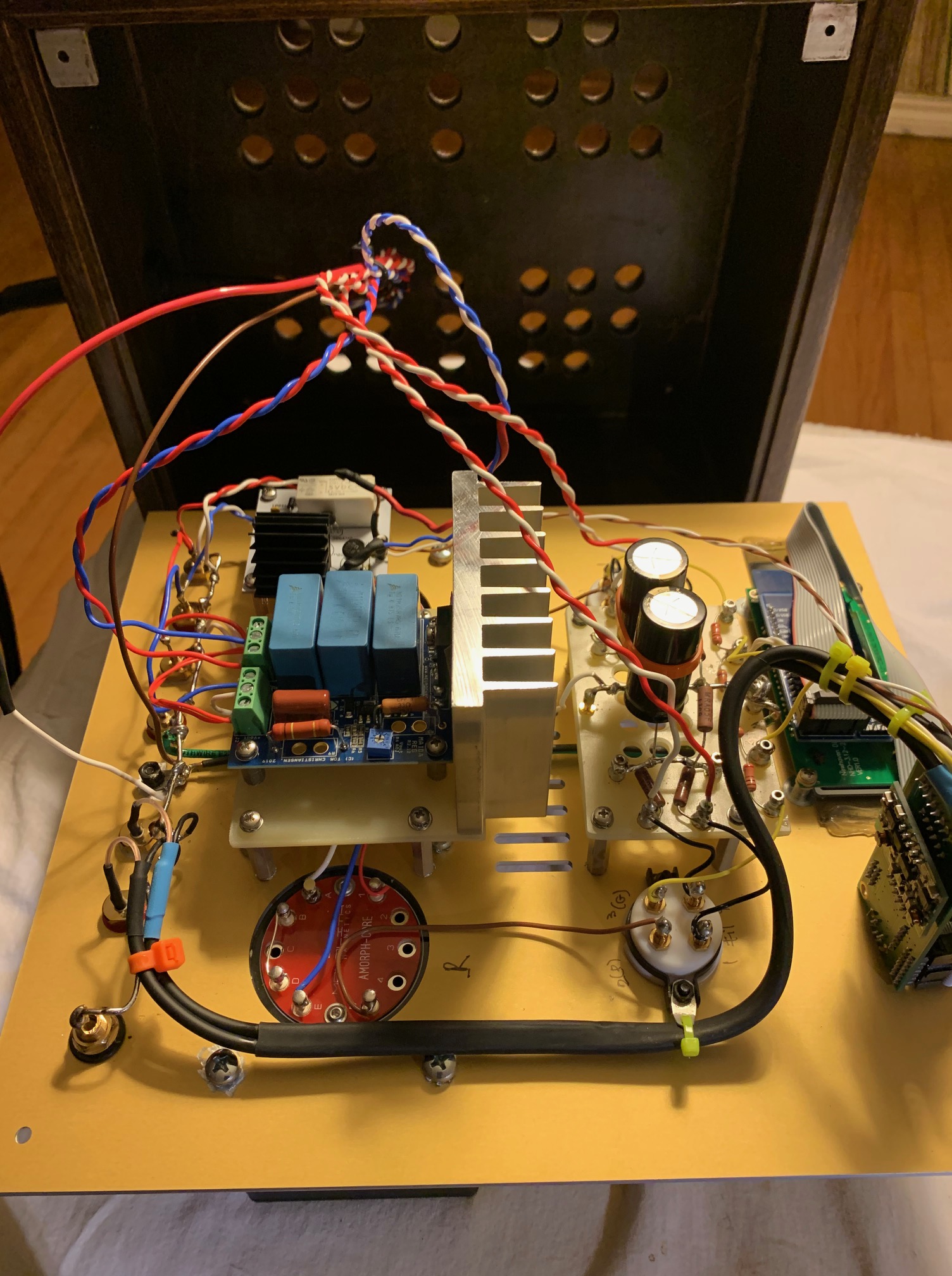
The low voltage supply for the filaments of the EML20As is on a separate board with its own transformer. There is a third DC supply for the Volume remote control and shunt output delay circuit.

The main preamplifier  uses the excellent high gain EML20A mesh in a self biased setup and loaded on a Monolith Amorphous Core LTA 01/25mA line output transformer (wired 4:1).

The cathode bias resistors are Mills MRA-5 and the decoupling capacitor is Elna Cerafine.

The input is DC coupled and the output is transformer coupled. There are no coupling caps for input or output, an no negative feedback ( global or local).

The volume control is ePOT V3 mini by Tortuga Audio using either LDR module or 60k discrete steeped attenuator module. The display is Oled and remote by Apple.

This is one of the simplest one stage preamps that is using an excellent sounding DHT and extremely low distortions, second harmonic being dominant. The gain is 14dB ( 5x) and with a 2Vrms source will provide 10Vrms at a Zout of 375 ohms. Measured THD was 0.02% at 10Vrms output ( 50Vrms on the plate).

“Shiny Eyes” Supreme 300B Headphone SET Amplifier

This  headphone amp was due for many years. It was many years ago when I start fiddling with the idea.

After many experiments and measurements, I concluded  that a SET 300B headphone amp is best fit to my sound taste and design preference.

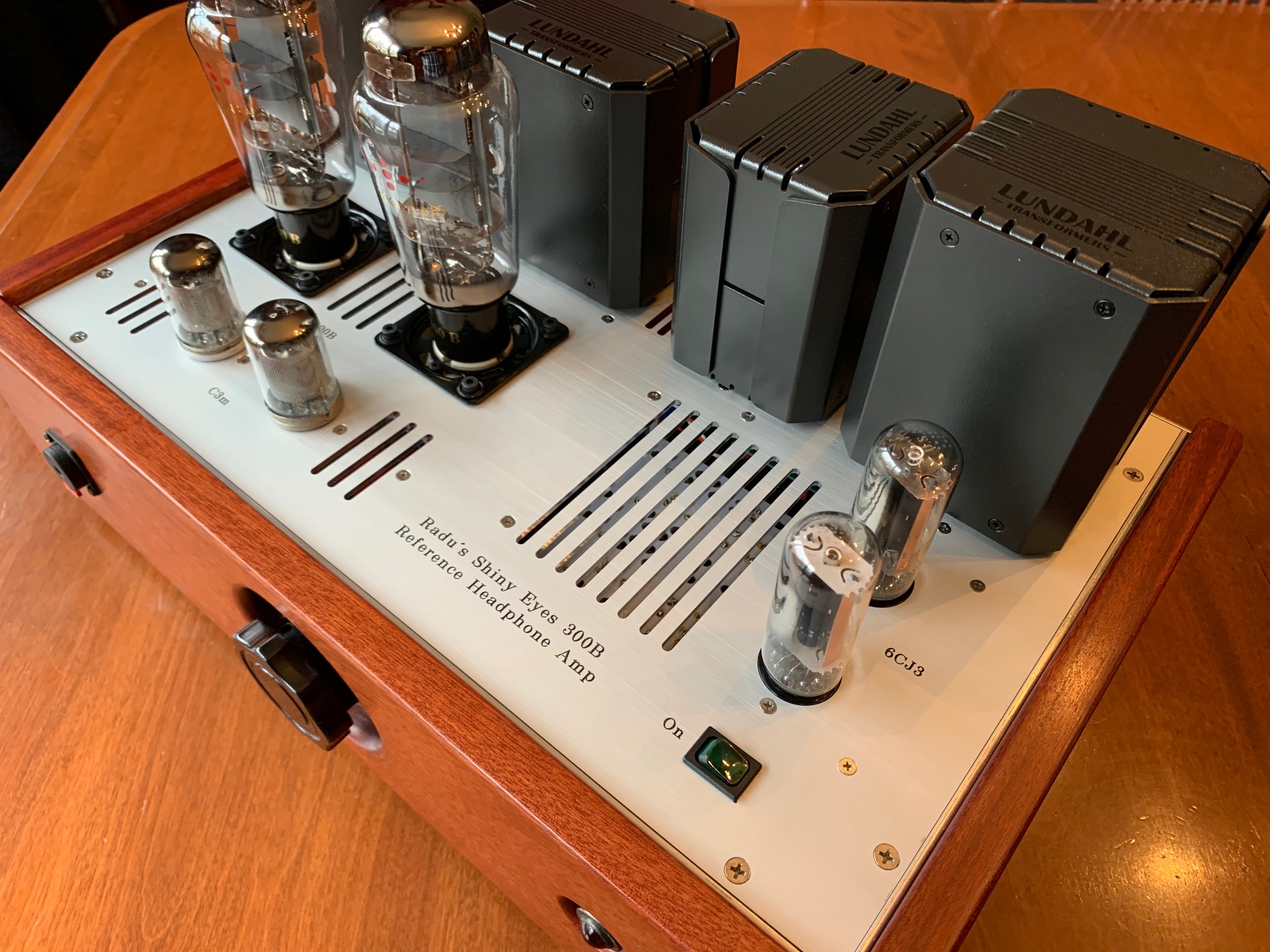
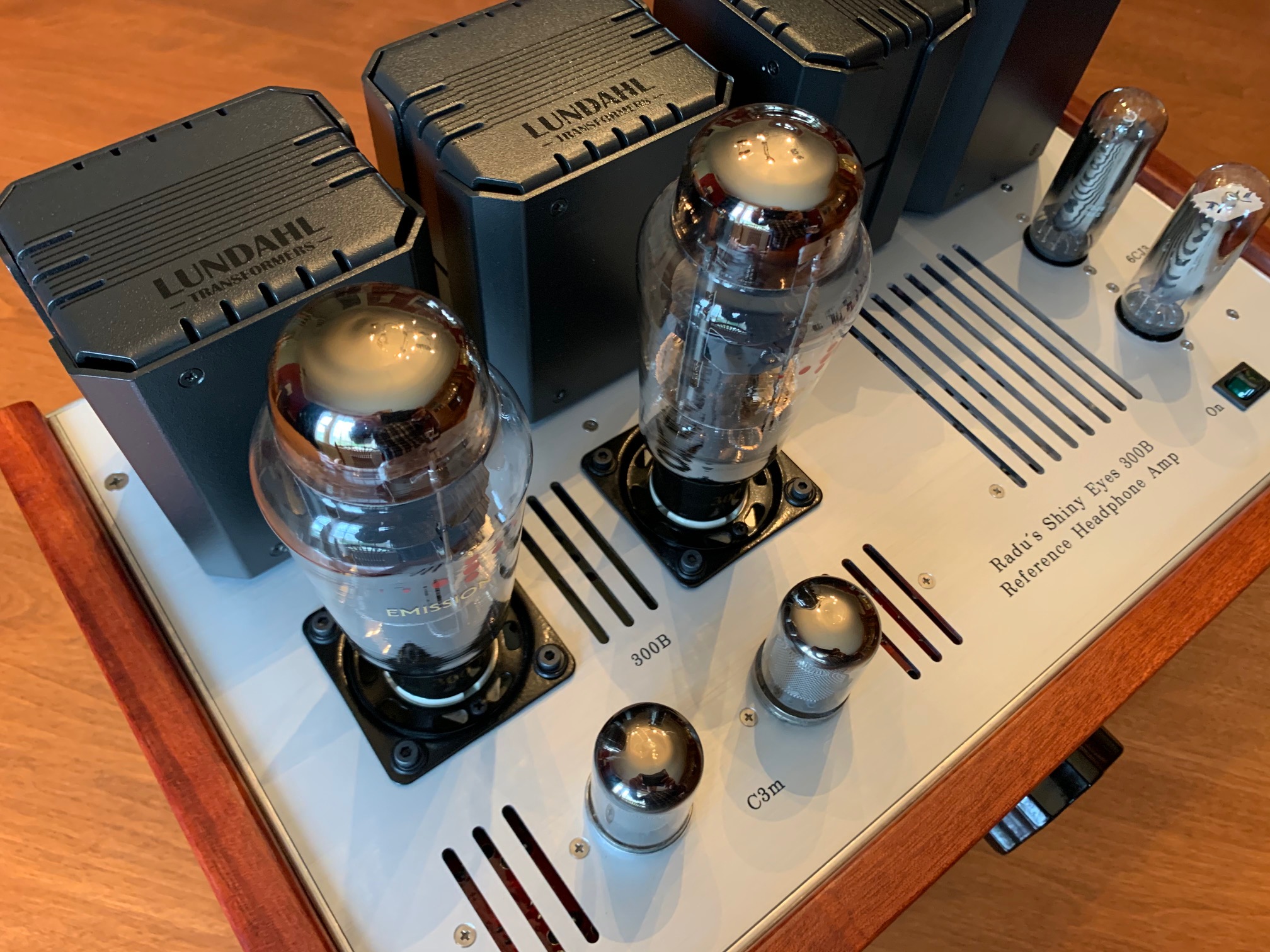
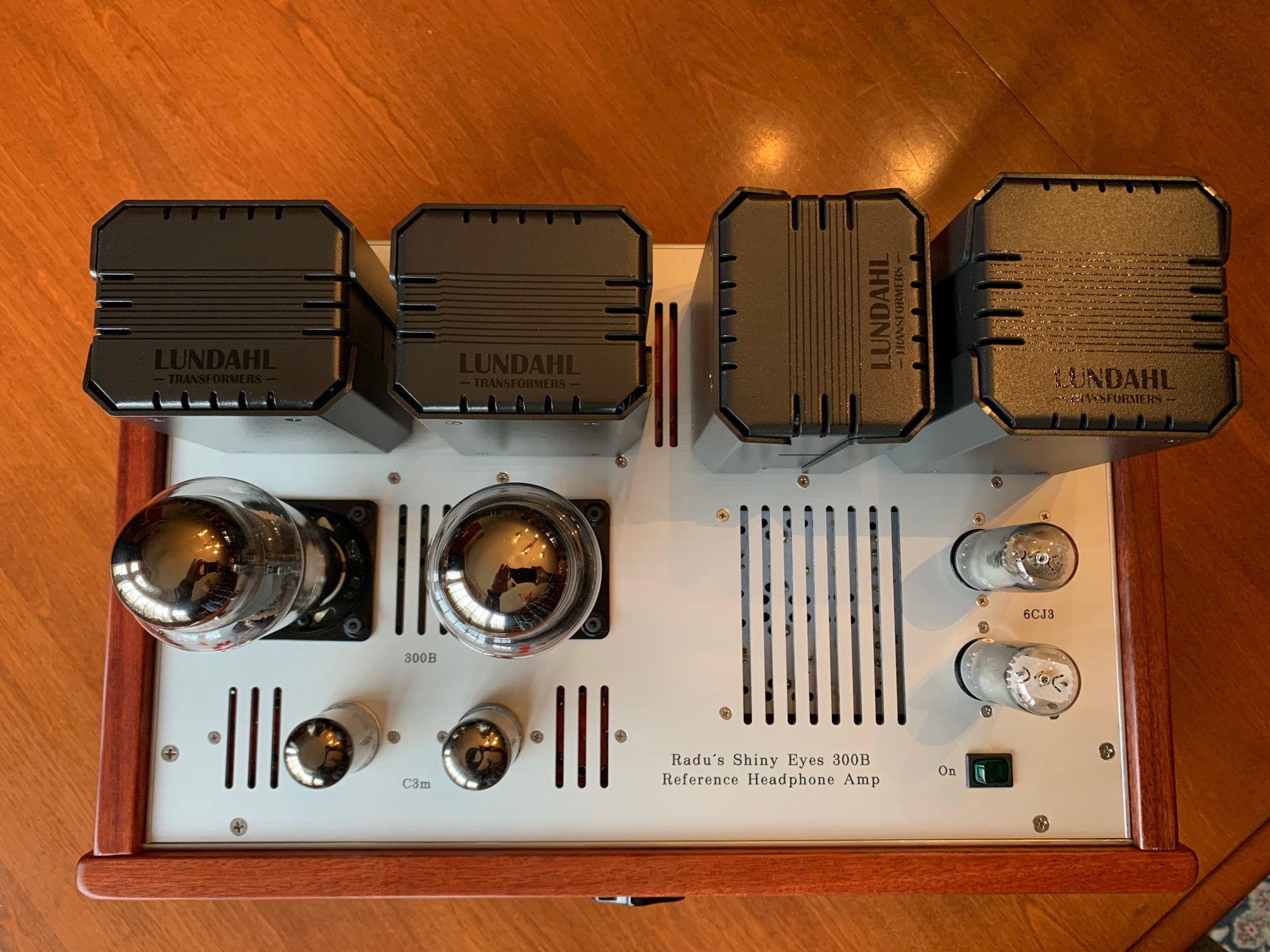
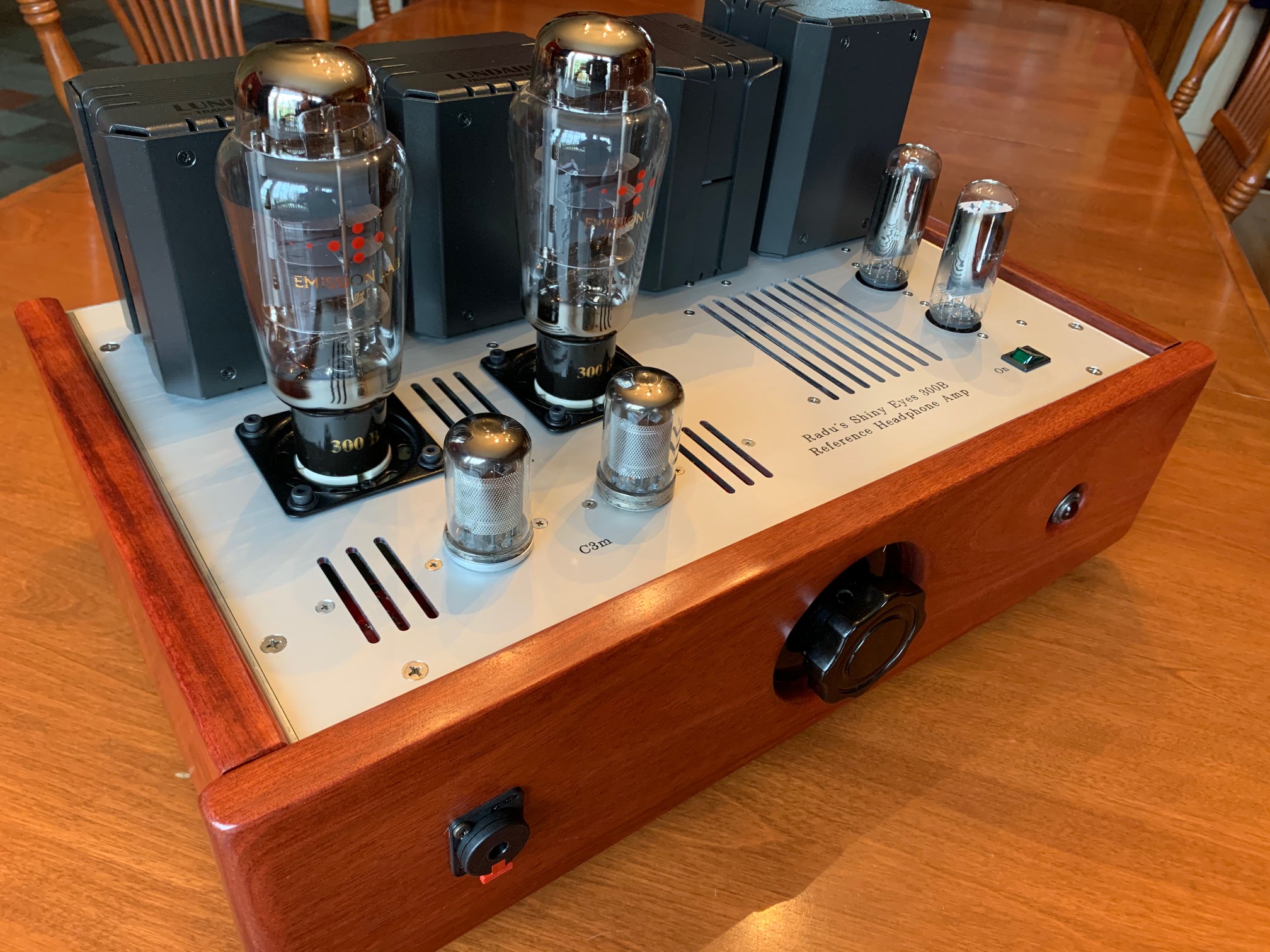
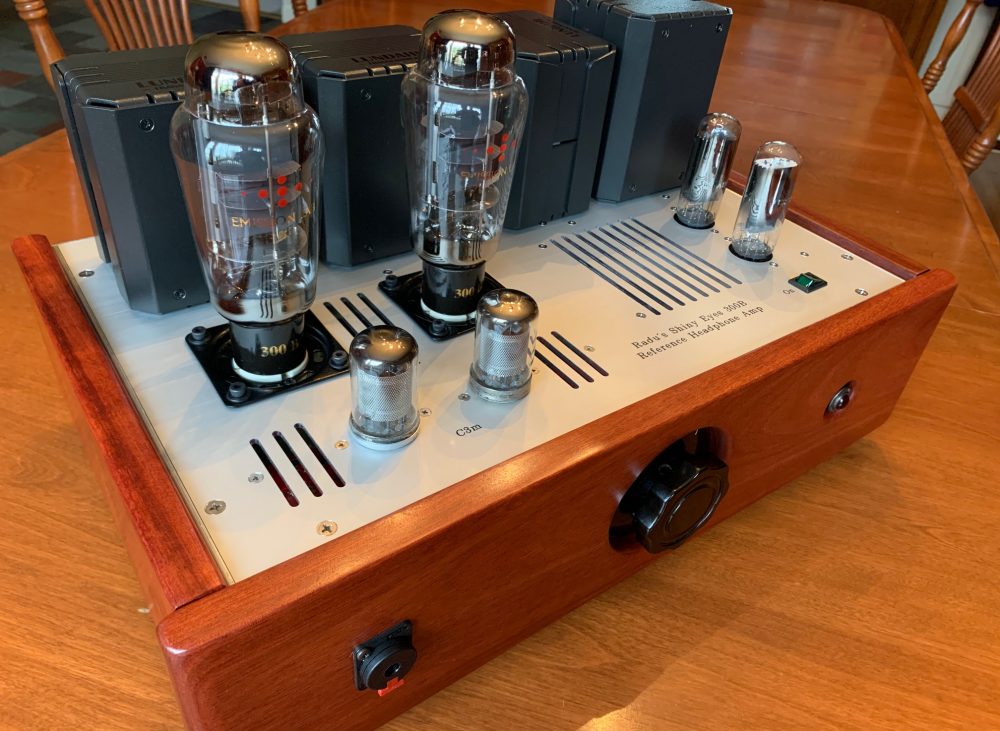
With few things left over or repurposed from previous projects, I’ve managed to finish a C3m – 300B headphone amplifier. It is a one enclosure amplifier using all Lundahl transformers and choke and the long lasting EML300B. If you don’t recognize the C3m in the pictures is because I cut out the aluminum screening can.

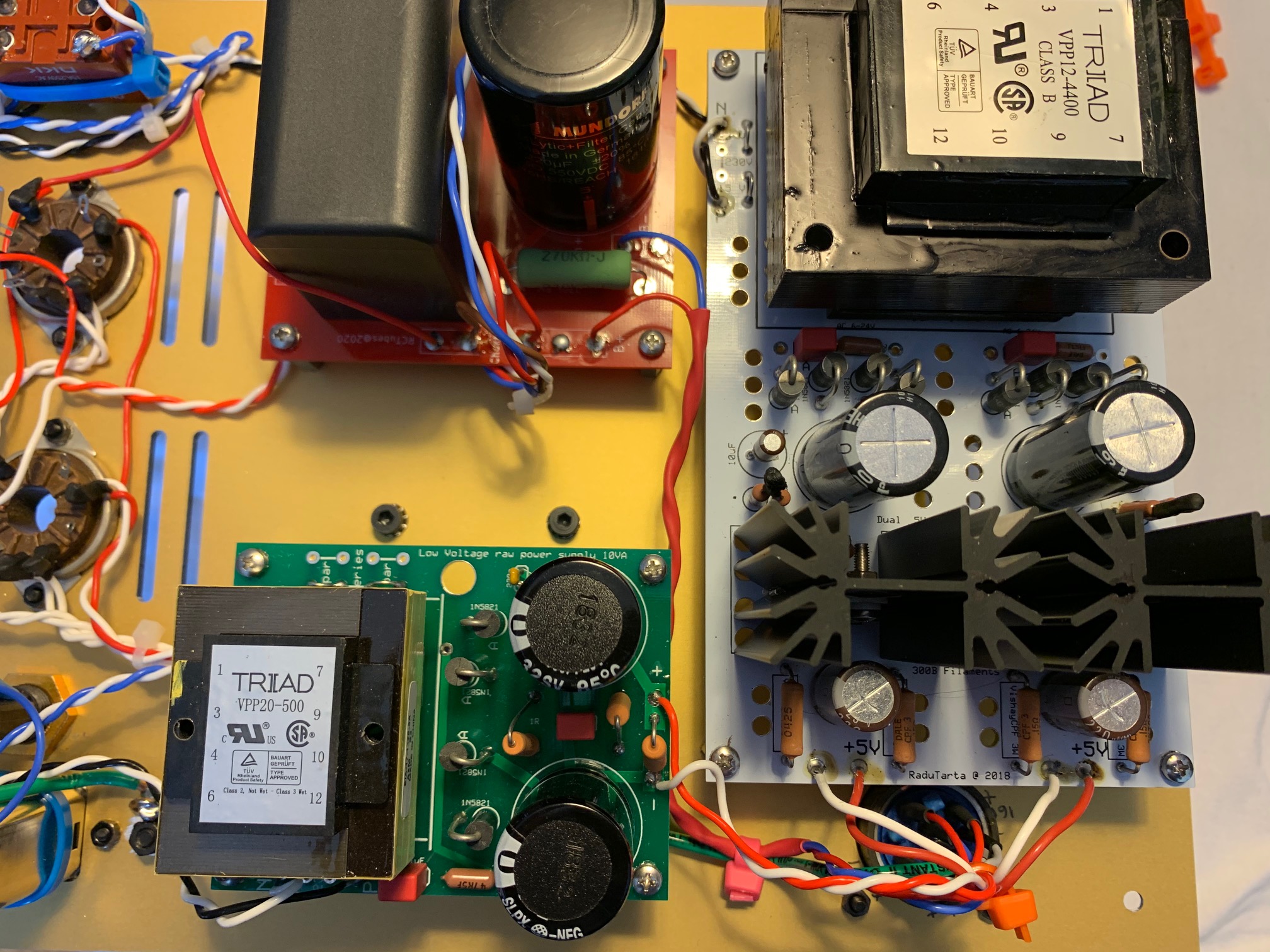
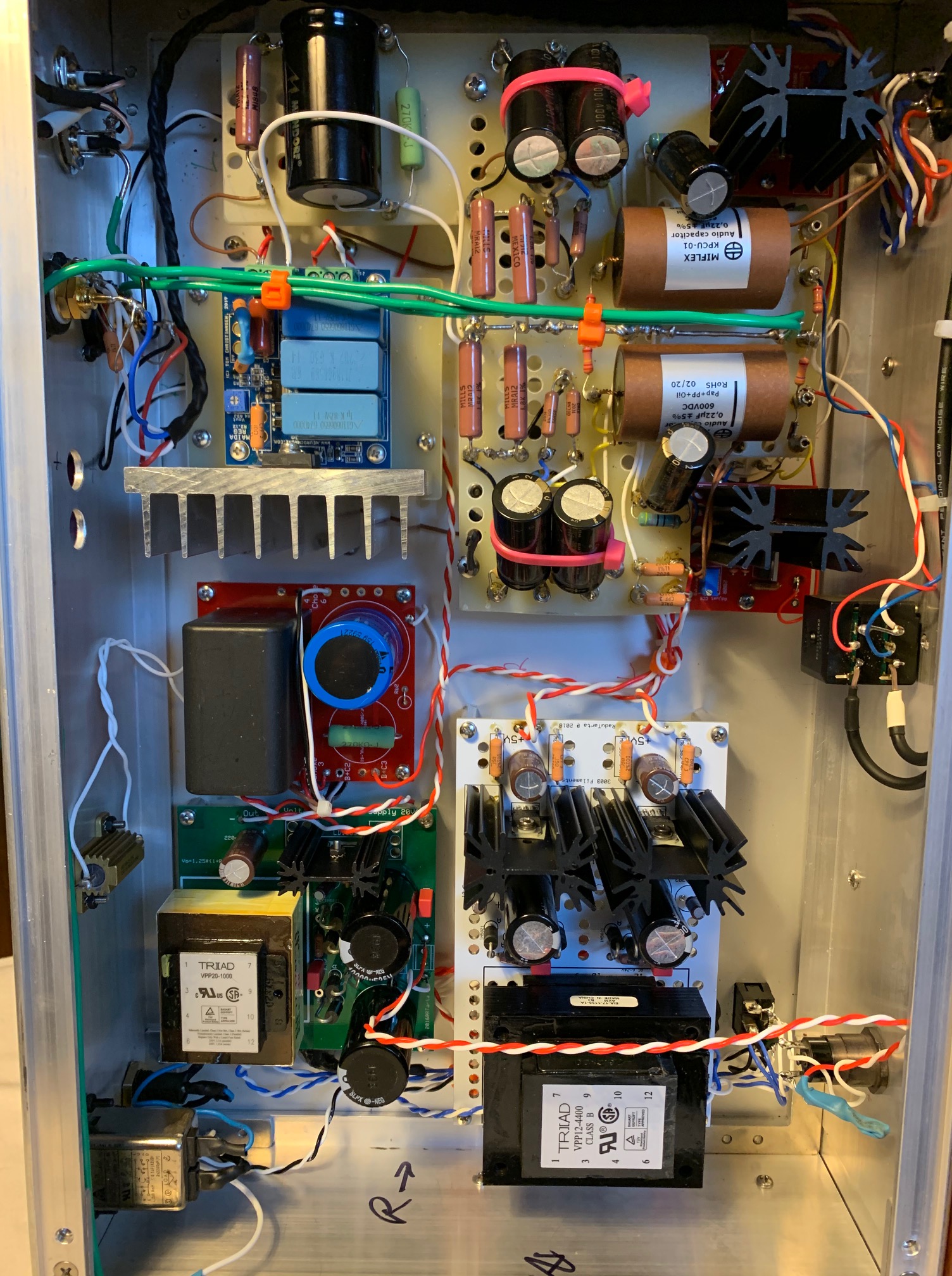
The power supply is using a Lundahl power transformer and choke and a hybrid bridge. The rectifier bridge is using SiC 1200V diodes for the negative and two 6CJ3 TV dampers for the positive. The vacuum tube rectifiers are ramping the B+ in a very slow manner ( about 20 seconds). The filtering is C-L-C with 50uF first cap and 220uF second. I am using a Neurochrome Maida 21st Century regulator which provides 385V with extremely low ripple, and protection at 300mA. This accomplished two of many requirements : a super quiet amplifier and the 300B/output transformers are protected. The filaments of the 300Bs are DC powered from a separate supply using its own transformer and it is regulated. Also the C3m filaments are DC powered from a separate supply using its own transformer and it is regulated. I am very careful about the design of the power supply which is a key to a good sounding SET amplifier.

The main amplifier is using the LL2765AM/70mA wired as 12:1 step down. The 300B is biased at Ua=310-320 V and Ia=65-70 mA, dissipating about 22W on the plate. This gives a lot of headroom for this amp and also a long life for the power triodes. The driver/gain stage C3m is loaded on a cascode CCS and it is capacitor coupled to the 300B using very good sounding Miflex caps. Both tubes are self biased and there no NFB applied.

The enclosure is a excellent built and sturdy by Landfall Systems. I used blood wood hardwood for the front and sides. The top plate was redone, CNC at Front Panel Express for a more professional/pleasant  look.

The amplifier frequency response is 25Hz-25kHz at -1dB, the overall gain is 14-15dB and THD with 1Vrms input is 0.02%, delivering 1W on 32 ohms or 100mW on 300 ohms. The FFT, at a 2Vrms output shows only the 2nd harmonic, all other harmonics are hidden bellow the noise floor. This gives this amplifier an extreme SET DHT sound, very clear, pleasant and clean.

The Zout is 8 ohms. The headphone amplifier can also be used as a preamplifier delivering very clean signal to a lower gain input sensitivity amplifier. Given the very low output impedance, it can drive heavy capacitive loads ( long cables/lines) and amplifier low input impedances.