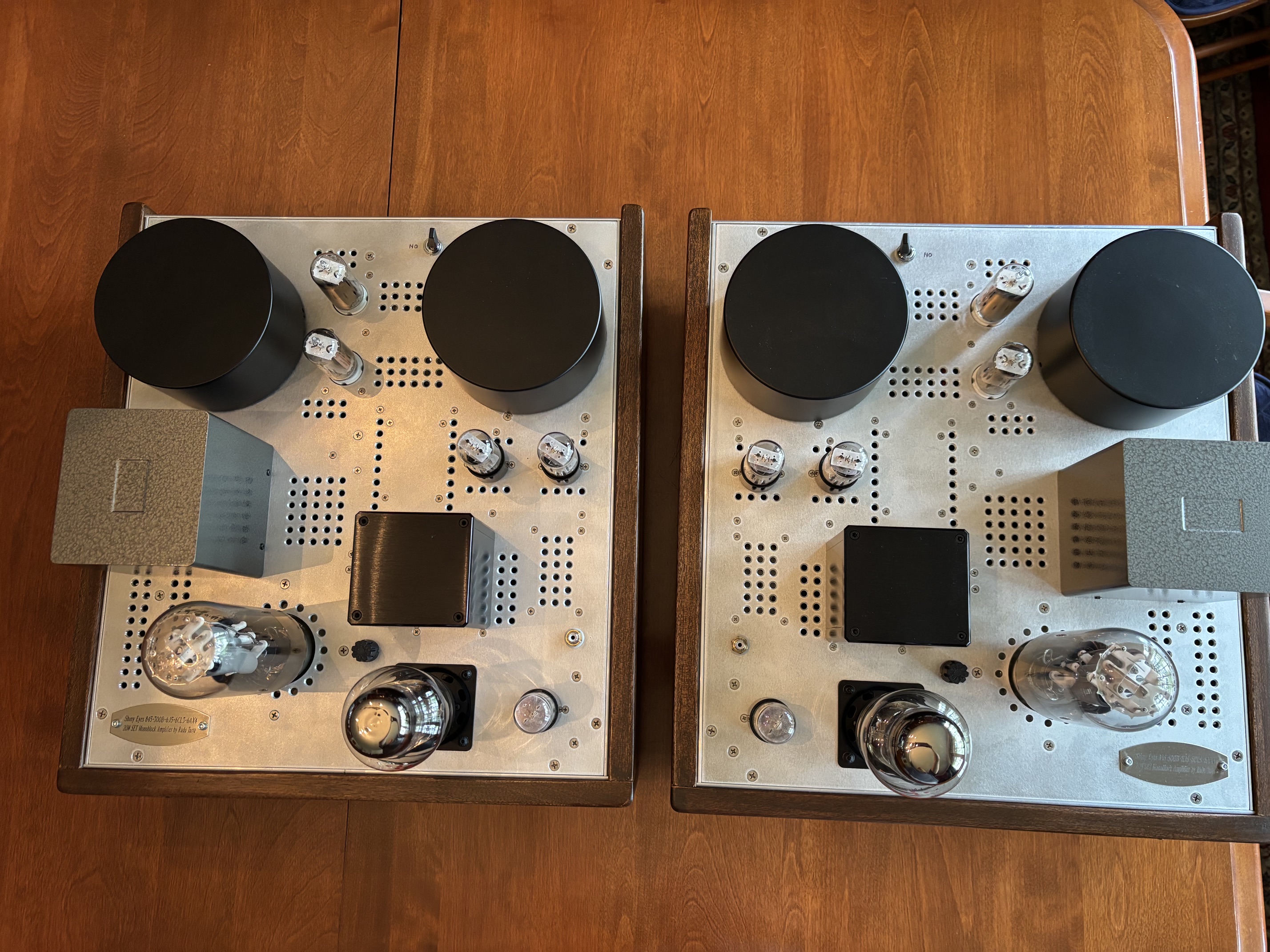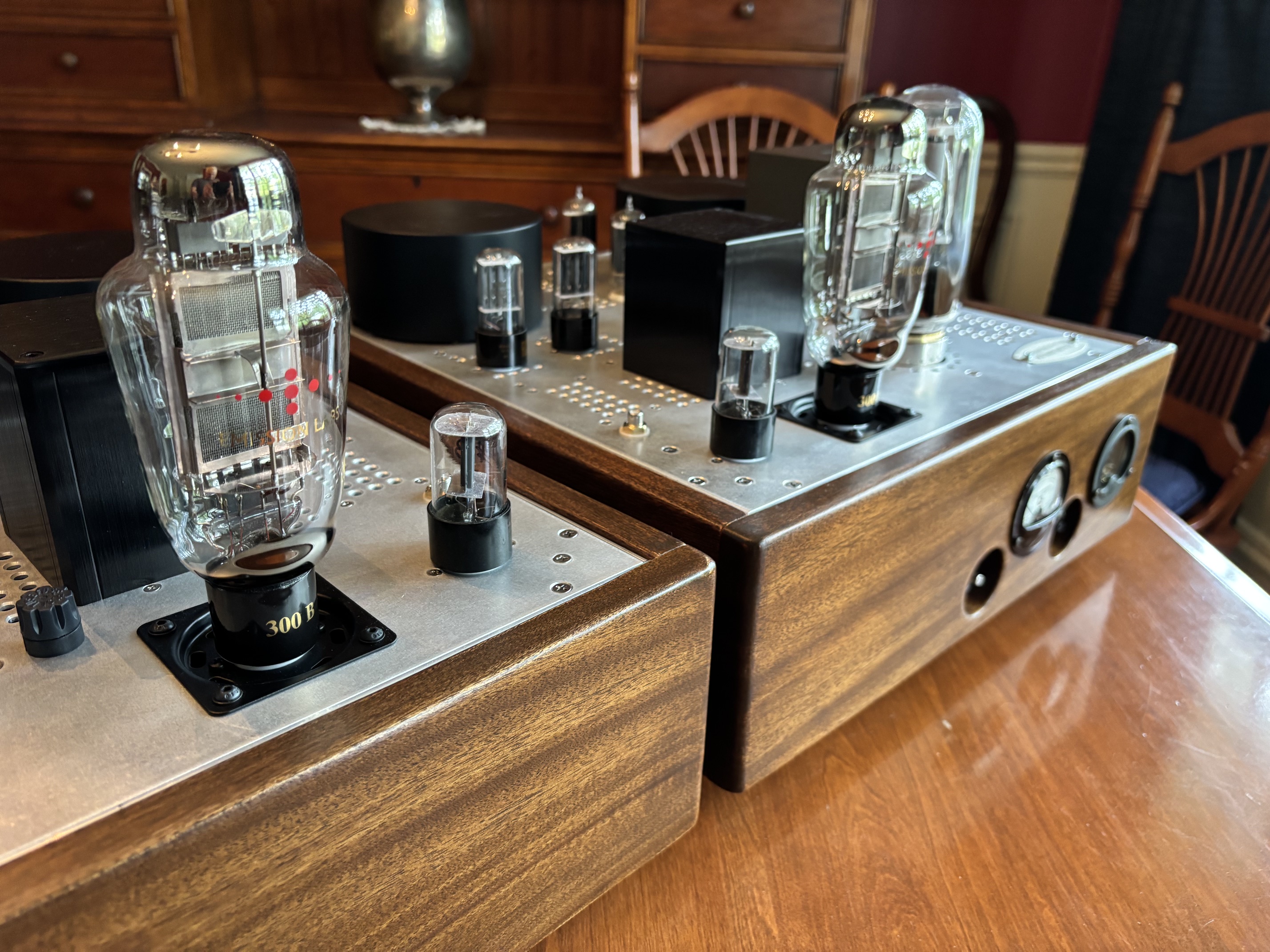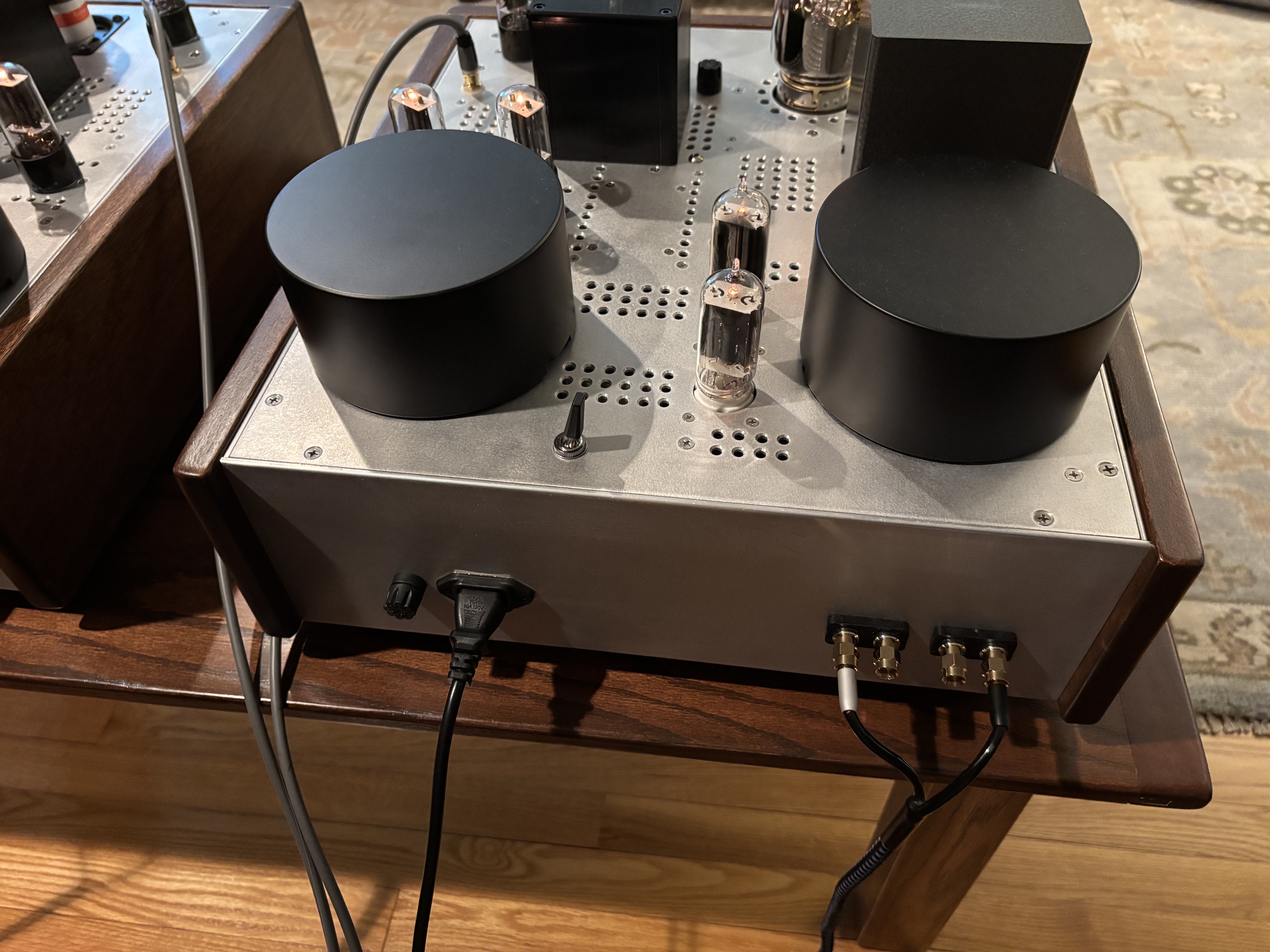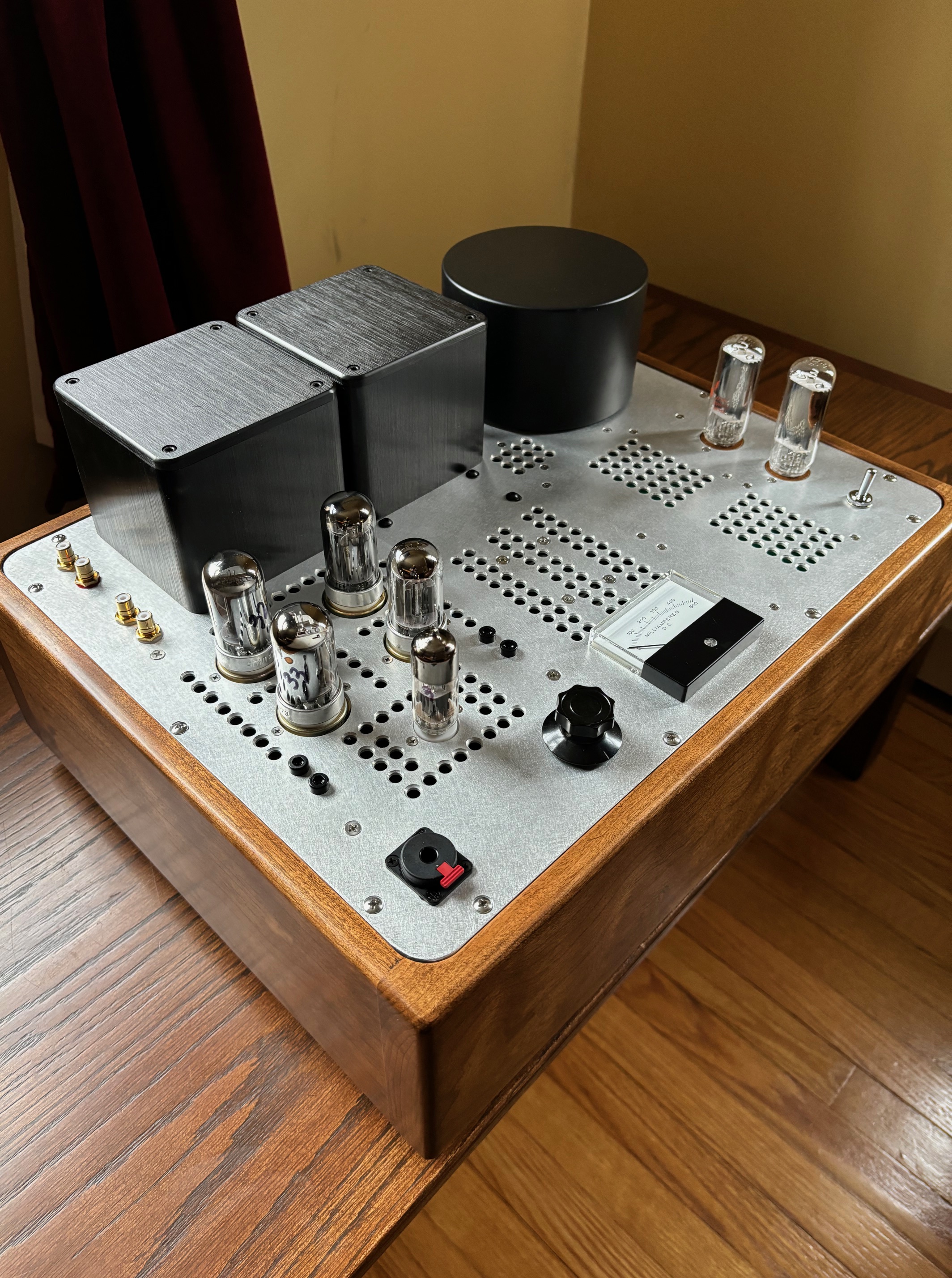
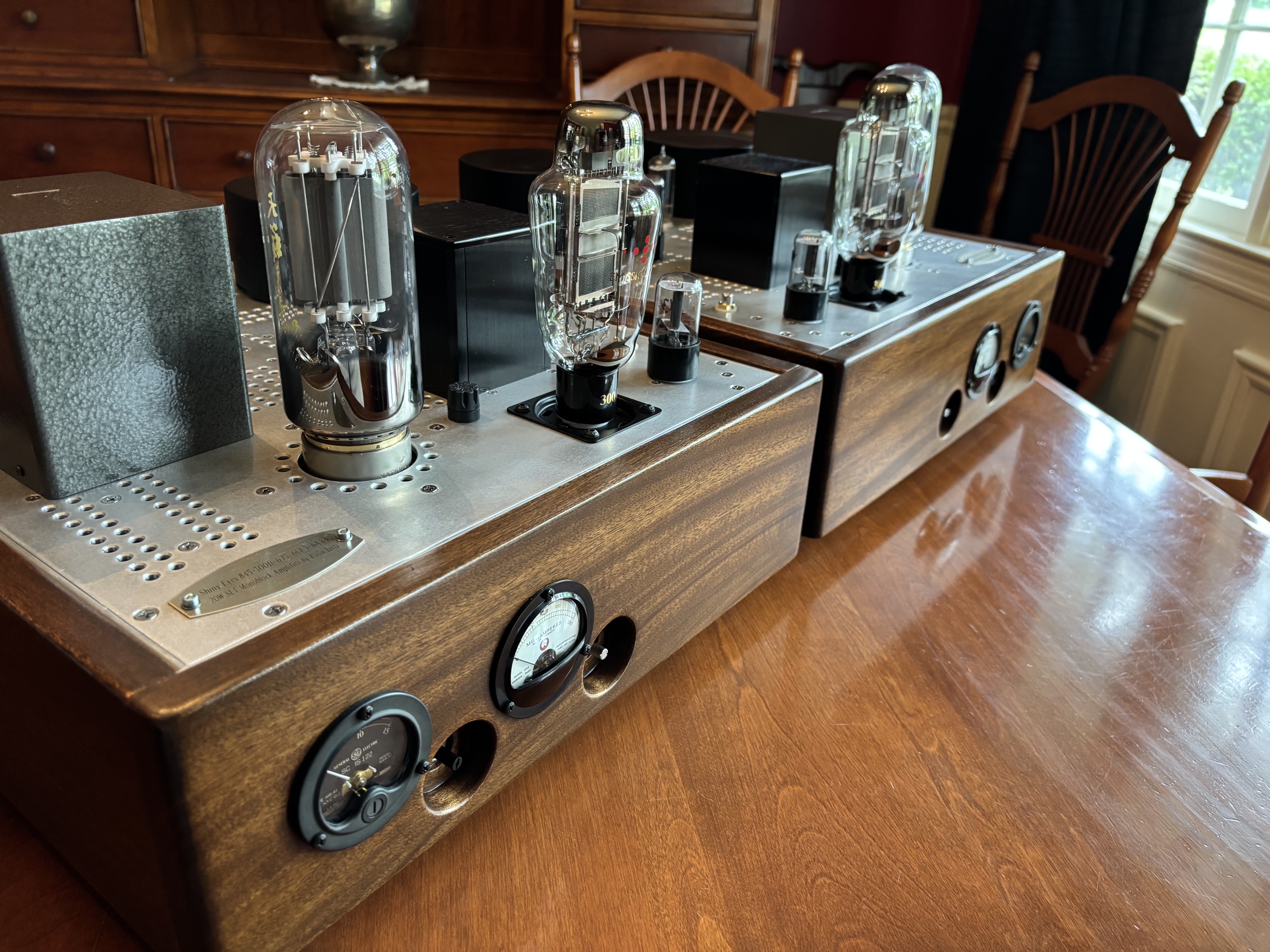
It has been a while since I started thinking about designing a high-performance, reliable 845 DHT amplifier. From the very beginning, I wanted to build an amplifier around the 845 that would combine the power and authority of this transmitting triode with the refinement, low distortion, and musicality expected from a high-end SET design.
As with any serious SET project, the first step was selecting the output transformer. Once the output transformer was chosen, the required B+ voltage, operating point, and power-supply requirements could be established around the characteristics of the 845. I ultimately settled on the ISO Tango FC-30-10S output transformer, which led to a B+ of approximately 1,000 V. The amplifier is capable of approximately 18 W of clean output power before gradually entering clipping.
The second major design decision was the driver. The 845 requires a substantial drive voltage—approximately 100 Vrms to reach full power—while maintaining very low distortion. This significantly limits the number of suitable driver configurations.
I chose a 300B DHT, loaded by a Lundahl LL1677 interstage transformer. The LL1677 was specifically designed with the 300B in mind and provides an excellent combination of bandwidth, linearity, and drive capability. The result is a very clean drive signal to the 845, even when the amplifier is operating close to full output.
For the input stage, the 6J5 was chosen primarily for its gain characteristics and sonic qualities. It provides the gain required while contributing very little coloration to the overall amplifier.
One of my primary goals was to make the amplifier as quiet as possible, with extremely low hum and ripple. Many compact SET amplifiers using 211 or 845 tubes can produce audible hum when paired with high-sensitivity loudspeakers. I wanted to eliminate that limitation as much as possible.
Several measures were taken to achieve this.
1. Separate Filament Power Supplies
Each tube has its own dedicated filament supply.
The 845 filament supply uses a 100 VA Antek toroidal transformer, MBR1635 rectifiers, and a CRC filter with approximately 80,000 µF of total capacitance and a ripple-current capability of approximately 12 A. The filtered DC is then regulated by a Coleman filament regulator.
A GE panel meter and precision potentiometer are mounted on the front panel, allowing the 845 filament voltage to be monitored and adjusted. The filament is set to 10 V at steady-state operation, after the amplifier has reached full operating temperature, typically after 30–60 minutes.
The 300B filament supply uses a separate dual-bobbin Triad power transformer and an LT1529 ultra-low-dropout regulator.
The 6J5 filament supply uses a dedicated LD1085 low-dropout regulator.
Separating the filament supplies in this way minimizes interaction between the stages and helps keep filament-related noise from reaching the audio signal.
2. High-Voltage Power Supply
The 845 high-voltage supply uses a hybrid bridge rectifier, combining SF1600 diodes with 6CL3 damper diodes.
Filtering is accomplished with a CLC network using MKP capacitors rated at 1,200 V, selected for their long life, stability, and reliability in a high-voltage environment.
The main choke is a Lundahl LL2742 17H choke, configured in a common-mode rejection arrangement. The combination of the hybrid rectifier, high-voltage MKP capacitors, and large inductance provides exceptionally effective filtering of the high-voltage supply.
3. 845 Bias and Current Adjustment
The 845 operates in a quasi-fixed-bias configuration. The negative bias voltage is adjustable through a Coleman bias regulator, allowing the operating point to be precisely set.
A 150 mA full-scale panel meter is provided, together with a precision adjustment potentiometer. This allows the 845 plate current to be set in the 55–65 mA range.
The negative bias supply has its own dedicated raw power-supply board, further isolating it from the other amplifier circuits.
4. Dedicated Driver and Input-Stage Power Supplies
The driver and input stages have their own dedicated Antek power transformer.
The high-voltage supply uses full-wave rectification with 6AX4 tubes, followed by a CLC filter.
Additional filtering is used for each stage. The 300B driver incorporates a CCS-capacitor filter, while the 6J5 input stage uses an additional RC filter.
The 6J5 is self-biased and loaded by a CCS to achieve very low distortion.
The 300B driver operates at approximately 300 V and 60 mA with constant-current loading. This operating point provides excellent linearity and also allows the use of virtually any 300B, including specialized tubes such as the EML 300B Mesh.
Slow Start and Protection
The amplifier incorporates a carefully controlled slow-start sequence. This provides several important benefits: reduced stress on tubes and other components, elimination of unpleasant turn-on and turn-off transients, and sufficient time for the 845 filament voltage to be checked and adjusted before the high voltage is applied.
Because of the considerable cost of the output transformers, I also included a 200 mA protection fuse in the output stage. Its purpose is to protect the output transformer in the event of an 845 failure that could result in excessive current through the transformer primary.
Construction and Layout
Every component was selected according to its specific function and its potential influence on the final sound.
The physical layout was given the same level of attention as the circuit design. Particular consideration was given to:
- Minimizing power-supply ripple and noise coupling
- Keeping signal paths short
- Separating sensitive signal circuits from high-current power-supply wiring
- Managing the substantial heat generated by the 845
- Proper grounding and circuit isolation
- Mechanical placement of transformers, chokes, and other magnetic components
The goal was not simply to build a technically impressive amplifier, but to create a complete system in which every part of the design contributes to the final result.
The Result
The result is an amplifier that combines power, control, smoothness, and refinement in a way that is characteristic of a well-executed 845 SET, while maintaining unusually low noise for an amplifier of this type.
It sounds forceful yet smooth, clean yet detailed, powerful yet musical. The presentation has excellent impact and authority without becoming aggressive or overly analytical.
With 18 watts of clean single-ended power, the amplifier should be capable of driving a wide range of loudspeakers, including many moderately sensitive designs.
Specifications
| Specification | Performance |
| Maximum clean output power | 18 W/channel |
| Input sensitivity for maximum output | 0.7 Vrms |
| Output impedance | 3.5 Ω |
| Frequency response | ±0.5 dB, 20 Hz–20 kHz @ 8 W |
| THD | 1.9% @ 8 W |
| Dominant distortion component | 2nd harmonic |
| Harmonic character | Smooth harmonic decay |
| Power consumption | 210 W/channel |
The measured THD and harmonic spectrum will vary somewhat depending on the individual 300B and 845 tubes used. Higher-quality, more linear tubes can produce measurably lower distortion and may also provide a cleaner and more refined presentation.
Shiny Eyes 845 SET Monoblocks — 2026
A design built around the 845 not simply for its power, but for the combination of authority, musicality, simplicity, and refinement that a properly executed DHT single-ended amplifier can deliver.